Meet the axolotl! People around the world celebrate it on Axolotl Day, every February 1 — a day that honors Mexico, where axolotls come from.
- Wild Atlas Spotlight · Friday, July 9
Read this one out loud together — it's most fun with a slow, bubbly, underwater voice.
Meet the axolotl, the smiling water creature with a frilly pink crown!
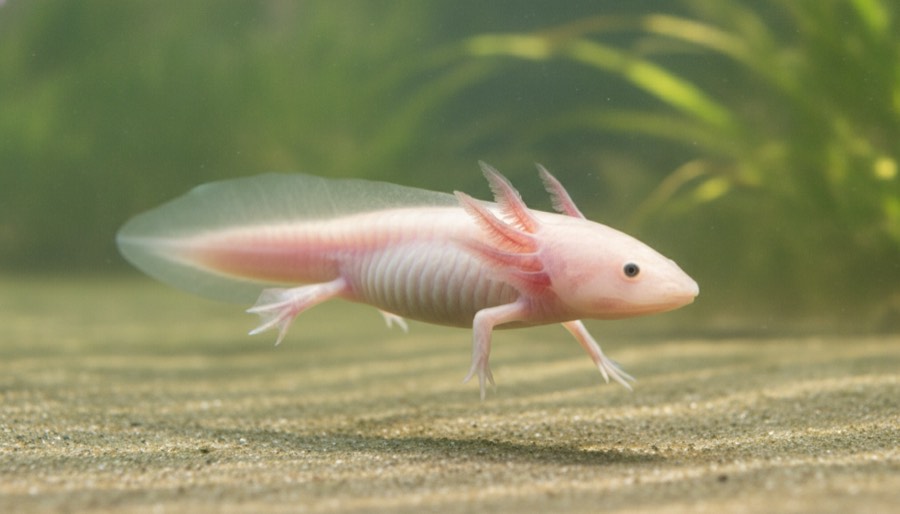
That frilly crown is made of gills. They're how an axolotl breathes underwater. Its mouth curves up at the corners, so it always looks like it's smiling at you.
Here's the biggest surprise. If an axolotl loses a leg or a tail, it can grow a new one! Scientists study axolotls to learn how living things heal and regrow.
An axolotl is a kind of salamander. Most salamanders grow up and crawl onto land. Not the axolotl. It keeps its baby shape and stays in the water its whole life.
Can you wiggle like an axolotl? Make your fingers feathery and sway them around your head, like gills!
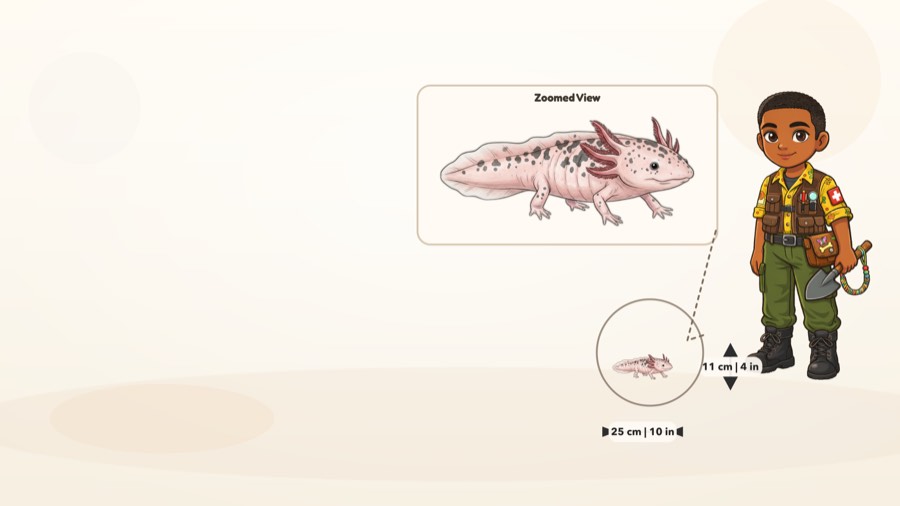
An axolotl is about 25 centimeters (10 inches) long. That's about as long as your forearm, from your elbow to your fingertips.
It's very light, too. An axolotl weighs about 100 grams (about 3.5 ounces), a bit like a small apple. A 5-year-old weighs about as much as 185 axolotls!
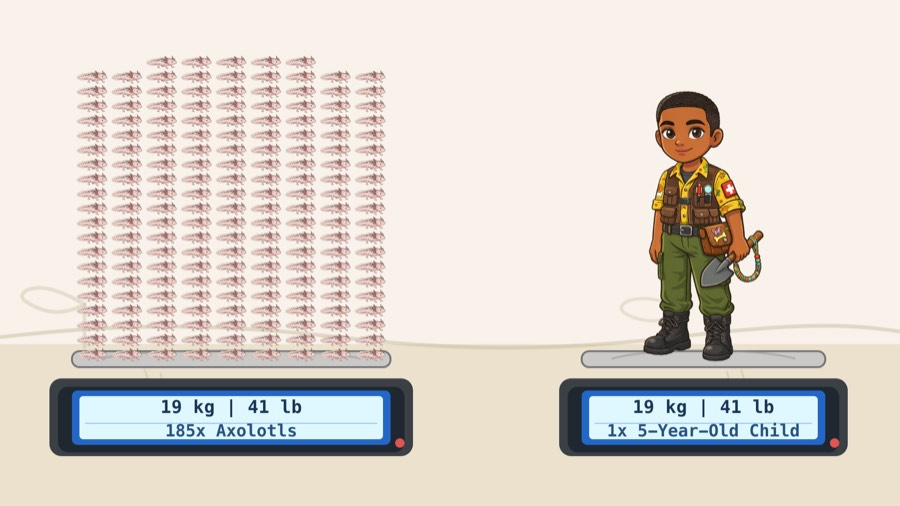
Can you picture 185 axolotls on one big scale?
Axolotls start out very small. Mom lays eggs and sticks them to water plants. When the tiny babies hatch, they are only about as long as your fingernail is wide.
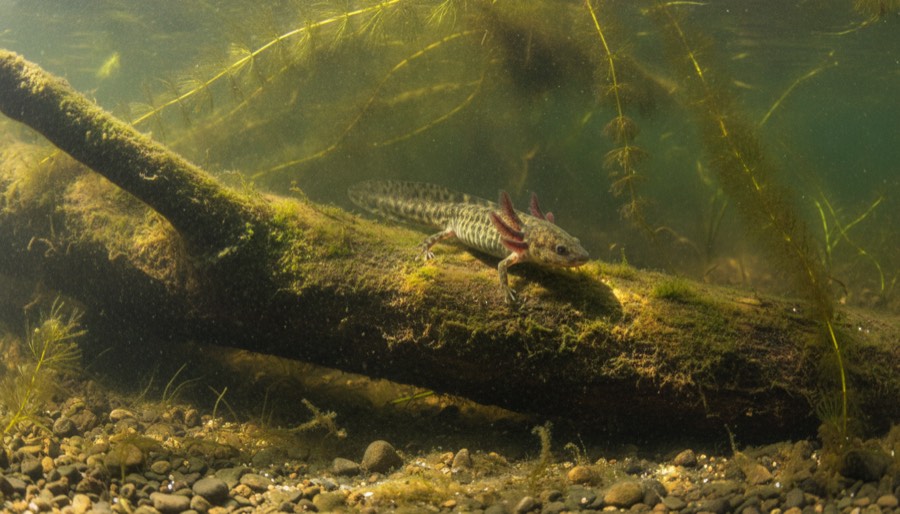
An axolotl doesn't chew its dinner. It opens its mouth and gulps in worms and bugs in one slurp. It finds food by sniffing and feeling tiny wiggles in the water.
Can you make a slurpy gulp sound?
In the wild, axolotls live only near Mexico City, in Mexico. Their name comes from an old Mexican story about a water spirit. Every year on February 1, people celebrate Axolotl Day and help look after their watery home.
Where to see an axolotl
In the wild, axolotls live only in a few waterways near Mexico City, in Mexico, so it's very hard to spot one there. For the rest of us, these zoos and aquariums have axolotls you can visit.
North America
Axolotls at Detroit Zoo
Detroit Zoo — Royal Oak, MichiganMeet these smiling water salamanders up close.
Learn more →Axolotls at San Diego Zoo
San Diego Zoo — San Diego, CaliforniaLook for them in Marsh Meadows at the Wildlife Explorers Basecamp.
Learn more →Axolotls at Lincoln Park Zoo
Lincoln Park Zoo — Chicago, IllinoisSee how an axolotl floats and wiggles through its watery home.
Learn more →Axolotls at New England Aquarium
New England Aquarium — Boston, MassachusettsGet up close to an axolotl and spot its frilly gills.
Learn more →Around the world
Anfibium, the Axolotl Museum
Chapultepec Zoo — Mexico City, MexicoVisit axolotls in their home country, in tanks that look like their natural waterways.
Learn more →Axolotls at Vancouver Aquarium
Vancouver Aquarium — Vancouver, CanadaWatch axolotls drift and glide beside the water plants.
Learn more →Animals sometimes move between zoos — check the zoo's own website before you visit.
For grown-ups
Axolotls are listed as Critically Endangered on the IUCN Red List. In the wild they live only in a few waterways near Mexico City, where polluted water, shrinking habitat, and invasive fish have made life hard. Many more axolotls live in labs and homes than in the wild — which is part of why wild ones need protecting.
There's a hopeful story: researchers released 18 radio-tagged, captive-bred axolotls into restored and artificial wetlands in the Xochimilco area, then tracked them to learn how they get along in the wild. The study is helping conservationists work out how to bring axolotls back to cleaner, restored waterways.
A family hope action: axolotls need clean water. This week, try picking up litter near a pond or stream, and pour only water (not paint or cleaning liquids) down outdoor drains. It's the same idea as Xochimilco's restoration: healthy water means healthy animals.
Starters: "Why do you think the axolotl keeps its frilly gills all its life?" "What would you do if you could grow back a new arm?"
If your kid asks will the axolotls disappear? — this holds up: "There aren't many left in the wild, so people are working hard to keep their water clean and give them safe places to live. Kids and grown-ups can help by taking care of water wherever they are."
Keep exploring
Wild Atlas has a whole page built around this animal — narrated facts, the full scale comparison against a 5-year-old, and a map of where it lives. The axolotl is part of the Legends of the Wild pack.
Meet the axolotl in Wild Atlas →
For more, visit Movement ecology of captive-bred axolotls in restored and artificial wetlands (PLOS One, 2025).
 Subscribe and the Farm Friends pack ($3.99) is free — yours to keep even if you unsubscribe.