Meet the barn owl! People around the world celebrate it on International Owl Awareness Day, every August 4 — a day started around 2011 by conservationists and bird lovers to celebrate owls of every kind.
- International Owl Awareness Day · Wednesday, August 4 — Started around 2011 by conservationists and bird enthusiasts; no single documented founder. Source
Read this one out loud together — it's short, and it's best in a very quiet, whispery voice. Save the screech for the end.
Barn owls can find a mouse in the dark using only their ears!
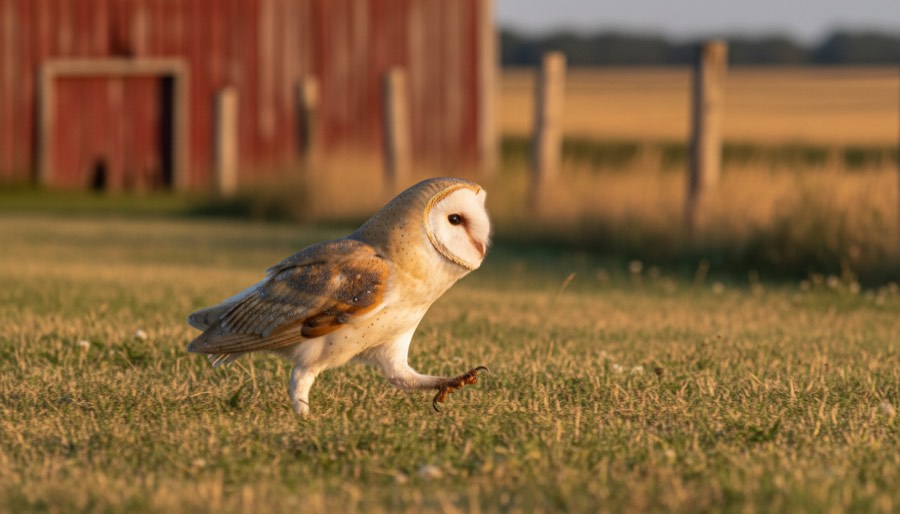
Look at that face. It's shaped like a heart! The heart works like a dish. It scoops up tiny sounds and sends them to the owl's ears.
One ear sits a little higher than the other. That helps the owl tell exactly where a sound is coming from. A barn owl can hear a mouse moving under the snow.
Barn owls don't hoot. They screech and hiss instead!
Here's another surprise: barn owls fly in silence. Their feathers are so soft that you can't hear them go by. Sshhh!
Can you flap your arms as quietly as a barn owl?
Their eyes are so big that they can't wiggle them around. So a barn owl turns its whole head instead, almost all the way around to look behind it.
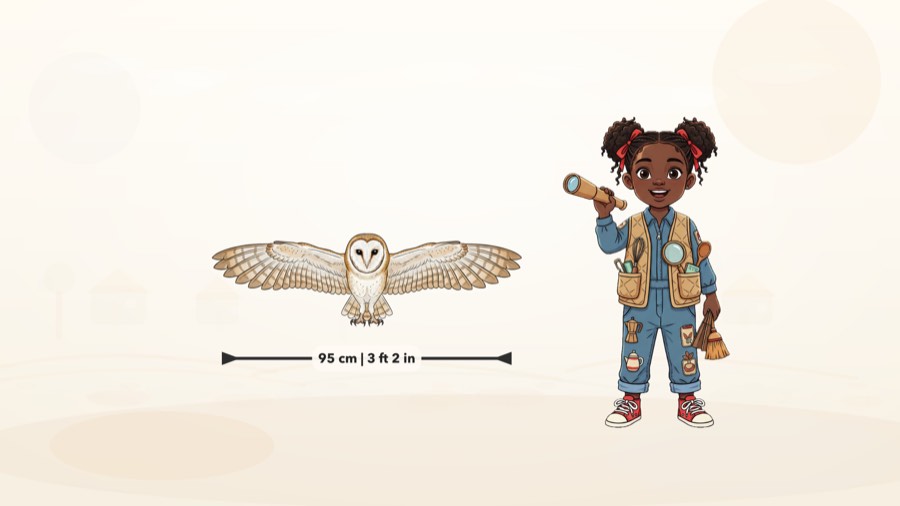
A barn owl is not very big. With its wings open, it measures about 95 centimeters (3 feet 2 inches) from tip to tip. That's nearly as wide as a 5-year-old is tall. Stretch out your arms. Who is wider, you or the owl?
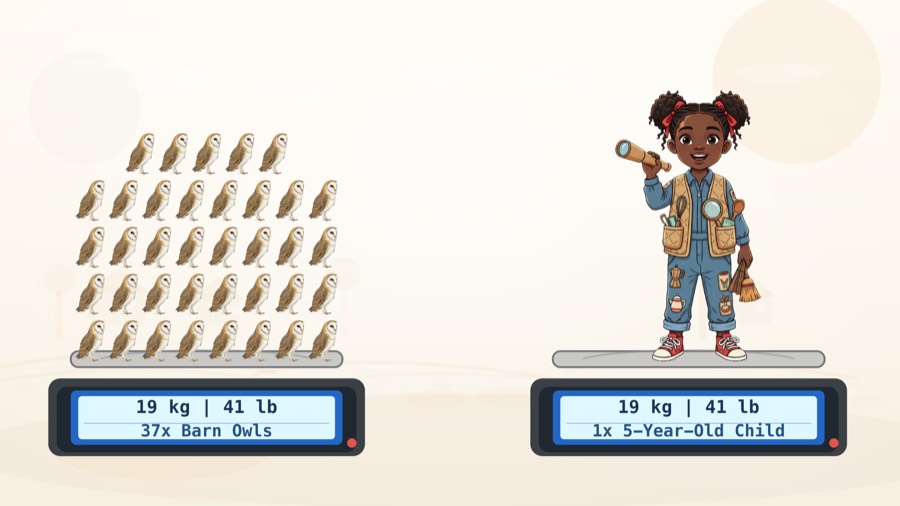
A barn owl weighs about half a kilogram (1 pound), about as much as a loaf of bread. It would take around 37 barn owls to weigh as much as one 5-year-old!
Barn owls have a funny way of finishing a meal. They swallow a mouse whole. Later, they cough up a little fuzzy ball called a pellet. It holds the bones and fur they couldn't use.
Barn owls often live in old barns, church towers, and hollow trees. A baby barn owl is covered in fluffy white down, like a little cotton ball.
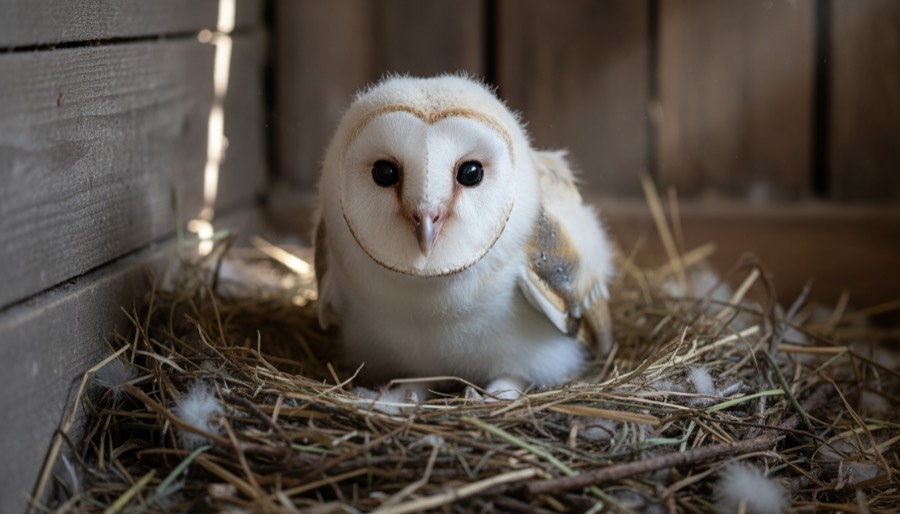
Barn owls live on every continent except Antarctica. In the farmland, they help by eating mice that nibble on the farmer's grain.
Can you listen very, very quietly for one whole minute? What do you hear?
Where to see a barn owl
In the wild, barn owls live in grasslands, farm fields, and old barns on almost every continent. They come out at dusk and after dark, so they're hard to spot. For the rest of us, these zoos and farms have barn owls you can visit.
North America
A barn owl in training
Cheyenne Mountain Zoo — Colorado Springs, ColoradoThis zoo's barn owl takes part in a daily training session, where you can watch him fly and hear him screech.
Learn more →Barn owls on the farm
Roger Williams Park Zoo — Providence, Rhode IslandBarn owls live in the Farmyard here, right beside the farm animals.
Learn more →Two barn owls
ZooAmerica — Hershey, PennsylvaniaTwo male barn owls live here, one who arrived in 2018 and one who arrived in 2020.
Learn more →Summer barn owls
Zoo Ecomuseum — Sainte-Anne-de-Bellevue, QuebecThe barn owls are out for visitors in summer, or in the zoo's learning programs.
Learn more →Around the world
A silent night hunter
Hoo Zoo and Dinosaur World — Telford, EnglandThis zoo's barn owl helps visitors learn how owls hunt at night.
Learn more →Barn owls are active at night, so a zoo may keep them in a dim, quiet spot — and animals sometimes move between zoos. Check the zoo's own website before you visit.
For grown-ups
Barn owls are listed as Least Concern worldwide, with millions living on the planet. In some places, though, they're getting harder to find — especially on busy farmland where rough grassy corners and old nesting spots have disappeared, and where rat and mouse poisons and roads can harm them.
There's a hopeful story: many farmers and wildlife groups put up nest boxes, and barn owls move right in. They're one of the most-loved nest-box birds, and a family of owls can help keep mice in check — a team-up between farmers and wildlife.
This week's hope action: leave one wild, grassy corner in the yard or park for the small creatures that owls eat, and skip mouse poison if you can — poisoned mice can harm the owls that eat them. (If you have a yard, a nest box for owls is another option; check local advice first.)
Starters: "Why do you think owls fly without making a sound?" "If you could only listen — no looking — what could you find out about your room?"
If your kid asks do owls only come out at night? — this holds up: "Barn owls do most of their hunting at night, so they sleep tucked away in barns, hollow trees, and church towers during the day. Their super ears help them find dinner in the dark."
Keep exploring
Wild Atlas has a whole page built around this animal — narrated facts, the full scale comparison against a 5-year-old, and the sound a barn owl actually makes. The barn owl is part of the Farm Friends pack.
Meet the barn owl in Wild Atlas →
For more, visit the International Owl Awareness Day page from the American Eagle Foundation.
 Subscribe and the Farm Friends pack ($3.99) is free — yours to keep even if you unsubscribe.