Meet the camel! People around the world celebrate it on World Camel Day, every June 22 — a day to say thank you to one of the toughest, most helpful animals we know.
- World Camel Day · Tuesday, June 22 — Founded in 2009 by camel scientist Dr Abdul Raziq Kakar. Source
Read this one out loud together. It's more fun with a slow, swaying camel-walk voice.
A camel's hump is not full of water. It's full of fat — like a pantry that you wear on your back!
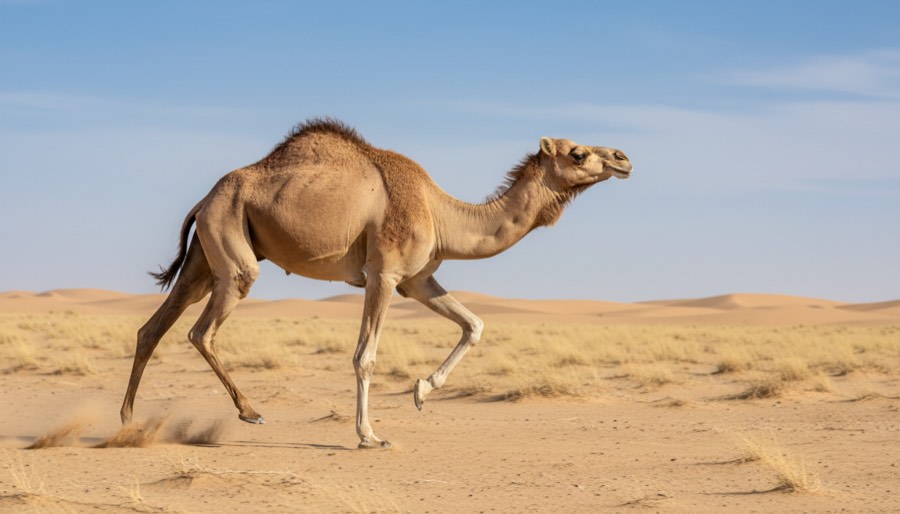
When a camel can't find food, its body turns that fat into energy. That's one reason a camel can go more than a week without a drink. And when it does find water, it can slurp up a huge amount in just a few minutes.
Camels have other desert super-powers too. They can close their nostrils tight to keep out blowing sand. Thick eyelashes sweep sand away from their eyes. And their wide, flat feet spread out like snowshoes, so they don't sink into the soft dunes.
Camels come in two kinds. The dromedary has one hump. The Bactrian has two!
How big is a camel? Very big. A camel stands about 1.9 meters (6 feet 3 inches) tall at the hump. That's much taller than you, and a little taller than most grown-ups. From nose to tail it's about 3 meters (almost 10 feet) long.
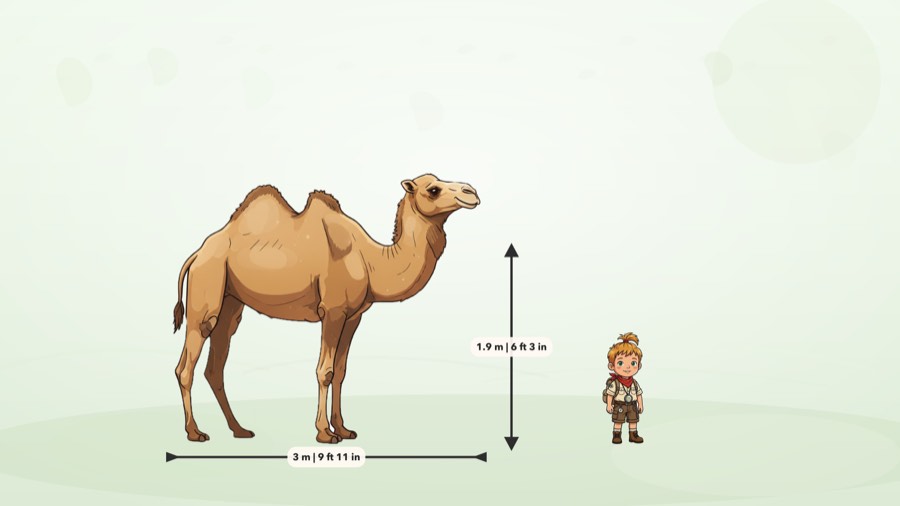
Can you stand on tiptoe and stretch your arm up high? Is a camel still taller?
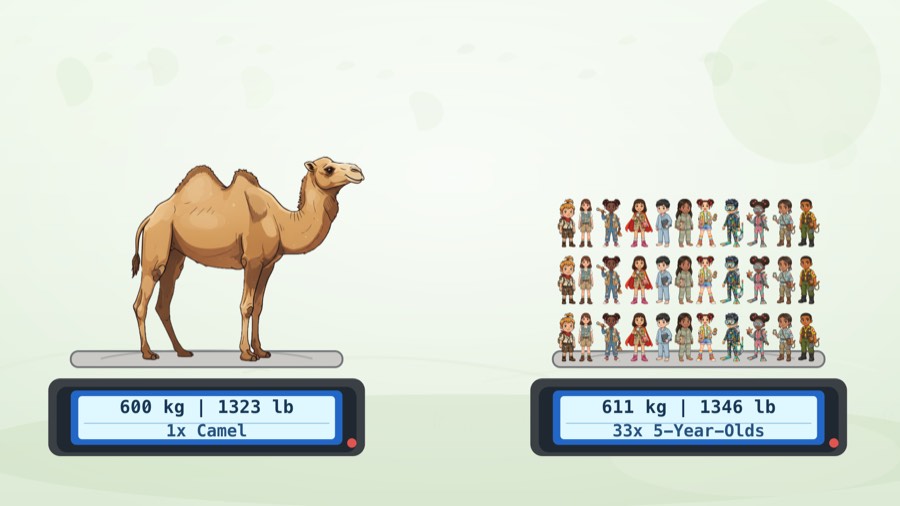
A camel weighs about as much as 33 five-year-olds, all standing on one big scale together. That's about 600 kilograms (1,323 pounds).
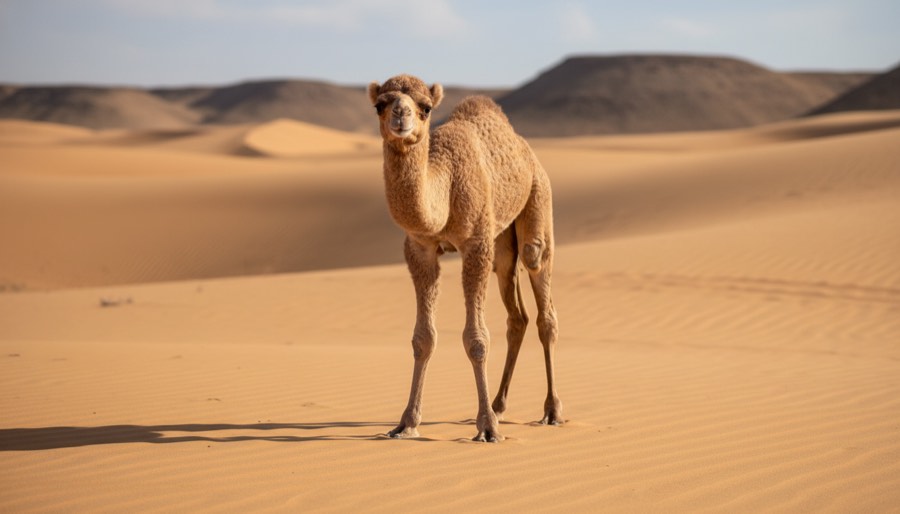
Here's a surprise. Baby camels are born without humps! A baby camel, called a calf, has soft, fluffy fur and long wobbly legs. The humps grow later, as the calf gets bigger.
People and camels have been friends for thousands of years. Camels have carried families, food, and tents across hot, dry lands.
Can you walk across the room with slow, swaying camel steps? Can you squeeze your nose shut like a camel's nostrils when the sand blows? What sound do you think a camel makes? It's a low grunt, and sometimes a big bellow. Try it!
Where to see a camel
In the wild, a few wild camels live in the deserts of China and Mongolia, far from most visitors. Most camels in the world live with people, as helpers on farms and desert trails. For the rest of us, these places around the world have camels you can visit.
North America
Camels in Elephant Odyssey
San Diego Zoo — San Diego, CaliforniaLook for one-humped camels in the Elephant Odyssey area.
Learn more →Bactrian camels
San Diego Zoo Safari Park — Escondido, CaliforniaTwo-humped Bactrian camels share a big space with a herd of Przewalski's horses.
Learn more →Bactrian camels
Saint Louis Zoo — St. Louis, MissouriThis zoo has cared for two-humped camels for many years.
Learn more →Bactrian camels
Brookfield Zoo Chicago — Brookfield, IllinoisLearn how two humps help camels handle hot days and cold nights.
Learn more →Around the world
The camel meadow
Tierpark Berlin — Berlin, GermanyDromedaries and Bactrian camels share a big open meadow in the middle of the park.
Visit Tierpark Berlin →Animals sometimes move between zoos — check the zoo's own website before you visit. Camels can also be met at farms, sanctuaries, and animal parks, so look near you.
For grown-ups
Camels come in two main kinds: the one-humped dromedary and the two-humped Bactrian. Almost all of them live with people, as working and farm animals, so the IUCN Red List doesn't give them a conservation status in the usual way. Their wild cousin, the wild Bactrian camel, is a separate species that lives only in remote parts of China and Mongolia. It is listed as Endangered, with around a thousand adults left. That's an improvement: in October 2025 the IUCN moved it down from Critically Endangered, partly because of new information and partly because protected areas such as Great Gobi National Park in Mongolia are helping. It still needs a lot of care, since water, mining, and mixing with domestic camels remain worries.
A small family hope action: camels survive on very little water, and we can be careful with water too. This week, try turning off the tap while brushing teeth, or collecting a little cool bathwater or rinse water to give a plant a drink. Talk about how desert animals make a little go a long way.
Starters: "How do you think a camel feels when the wind blows sand?" "What would you pack for a long trip with no shops?"
If your kid asks do camels really spit? — you can say: "Sometimes, when a camel feels crowded or upset, it might. It's the camel's way of saying 'please give me some space!' Most of the time camels are calm, and the people who work with them learn to read their signals."
Keep exploring
Wild Atlas has a whole page built around this animal — narrated facts, the full scale comparison against a 5-year-old, and the sound a camel actually makes. The camel is in the Planet Pioneers pack, which is a paid pack.
Meet the camel in Wild Atlas (Planet Pioneers pack) →
For more, visit the wild Bactrian camel, with its IUCN status.
 Subscribe and the Farm Friends pack ($3.99) is free — yours to keep even if you unsubscribe.