Meet the cougar! People around the world celebrate it on Save the Florida Panther Day, on the third Saturday of March, and on National Cougar Day, every June 12. (The Florida panther is a cougar, too!)
Read this one out loud together — it's short, and it's best with a big, soft purr between the facts.
A cougar has more names than almost any other animal — more than 40 in English alone!

Some people say puma. Some say mountain lion. Some even say panther. They all mean the very same big cat.
Here's a surprise: a cougar can't roar like a lion. Instead, it purrs, meows, and chirps — a little like a house cat does!
Can you purr like a cougar? Take a deep breath and try a soft, rumbly purr.
A cougar's back legs are longer than its front legs, like springs ready to go. They help it make giant leaps — sometimes farther than a car is long. Its long, thick tail swings out behind to help it stay balanced.
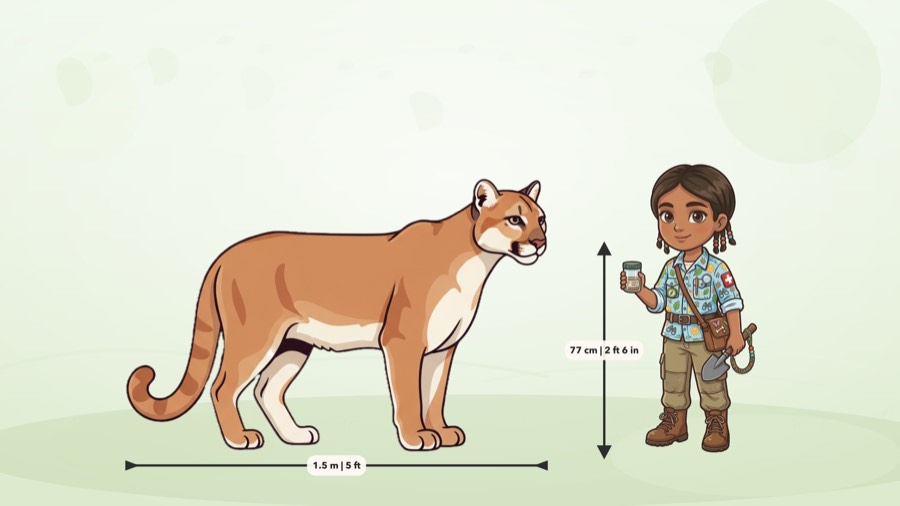
A grown-up cougar is about as high as a 5-year-old's chest at the shoulder. It weighs about 70 kilograms (154 pounds) — about the same as four 5-year-olds, all standing on one big scale together!
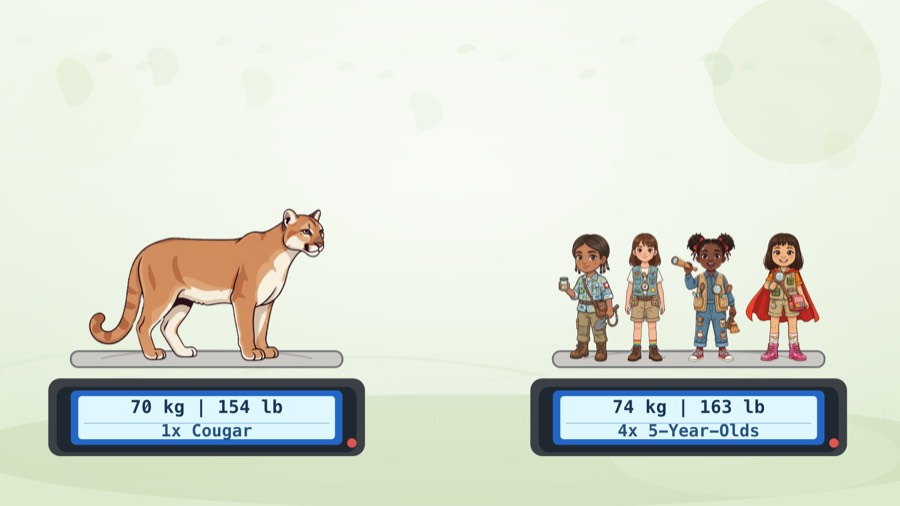
Can you picture four friends on one scale?
Cougars are shy and quiet. They move softly, and they are most active at sunrise and sunset, when the light is low. Can you tiptoe as quietly as a cougar?
A baby cougar is called a kitten. It's born with spots and blue eyes! As it grows up, the spots fade away, and its fur turns the soft tan color of its mom.
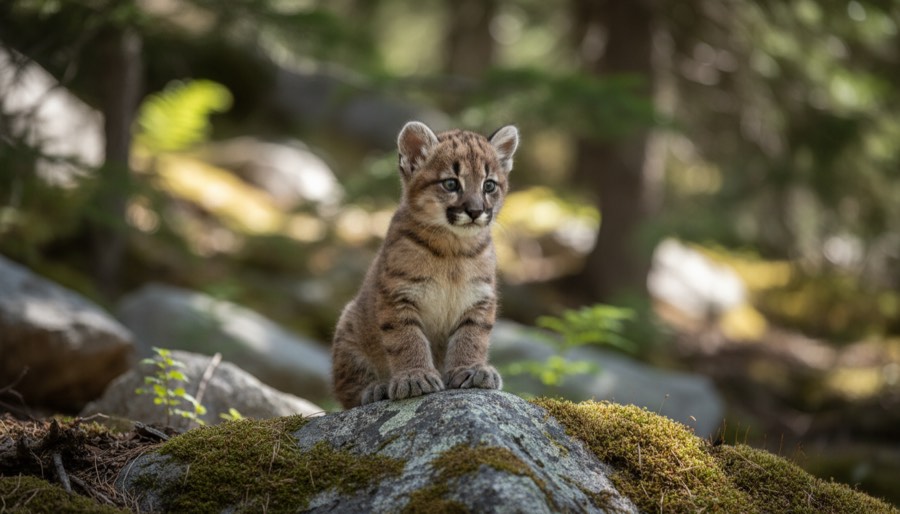
And the Florida panther? It's a cougar, too, living in the swamps and forests of Florida. Today, people are working together to keep these quiet cats safe.
Where to see a cougar
In the wild, cougars live in mountains, forests, and rocky country across North and South America, but they're so quiet and shy that very few people ever spot one. For the rest of us, these zoos have cougars you can visit.
North America
Cheyenne Mountain Zoo
Colorado Springs, ColoradoMountain lions — another name for cougars — live in the zoo's Rocky Mountain Wild area.
Learn more →San Diego Zoo
San Diego, CaliforniaCome see a mountain lion, one of the many names for this cat.
Learn more →Columbus Zoo and Aquarium
Columbus, OhioLook for the cougar and see how long its tail really is.
Learn more →Animals sometimes move between zoos — check the zoo's own website before you visit.
For grown-ups
Cougars are listed as Least Concern overall, because they live across a huge range, from Canada to the southern Andes. But some groups are in more trouble than others, and roads and growing towns can cut their territory into pieces. The Florida panther is a hopeful story: by the 1990s fewer than 30 were left, and they were sick from inbreeding. In 1995, wildlife managers brought eight female cougars from Texas to Florida to add fresh family genes. Thirty years later the Florida population has climbed to about 200, and scientists report that inbreeding has dropped.
Cougars need room to roam, and a small family action can help. This week, try learning one wild neighbor near your home, and tell your kids that driving slowly where wildlife crosses roads keeps animals safe. Or look up your state wildlife agency together and see which wild cats live near you.
Starters: "How is a cougar like a house cat? How is it different?" "Why do you think cougars like to hide and move quietly?"
If your kid asks would a cougar hurt me? — this holds up: "Cougars are very shy and they like to stay away from people. They'd much rather hide. If you ever visit wild places, grown-ups stay close and keep kids near, and everybody gives wild animals lots of space."
Keep exploring
Wild Americas is a paid expansion pack in Wild Atlas. It has a whole page built around the cougar — narrated facts, the full scale comparison against a 5-year-old, and the sounds a cougar actually makes.
Meet the cougar in Wild Atlas →
For more, visit the IUCN Red List.
 Subscribe and the Farm Friends pack ($3.99) is free — yours to keep even if you unsubscribe.