Happy Endangered Species Day! Every third Friday in May, people take a moment for animals that need our help — and today, we're taking that moment for the black rhino.
About this day: Endangered Species Day began in 2006, when the Endangered Species Coalition asked the U.S. Senate to create it. It's for all endangered animals, and we picked the black rhino. Source
Read this one out loud together — it's short, and it's even better in a big, huffy rhino voice.
A black rhino's top lip is pointy and bendy — it works almost like a finger, reaching out to grab its favorite leaves and twigs off a bush.
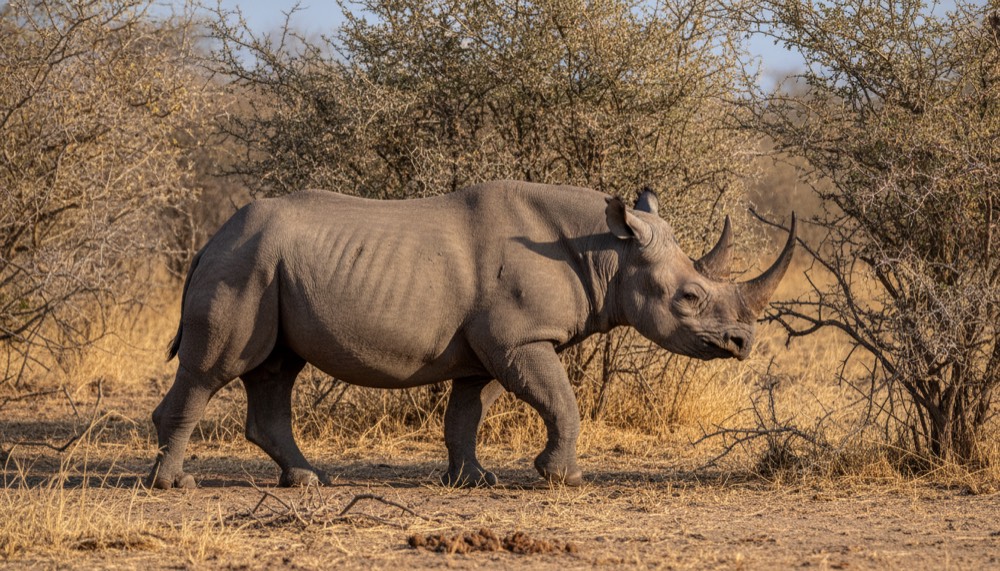
Here's a surprise: black rhinos aren't black at all. They're grey — and often the color of whatever mud they rolled in last!
Can you make your own lips pointy, like you're reaching for a leaf?
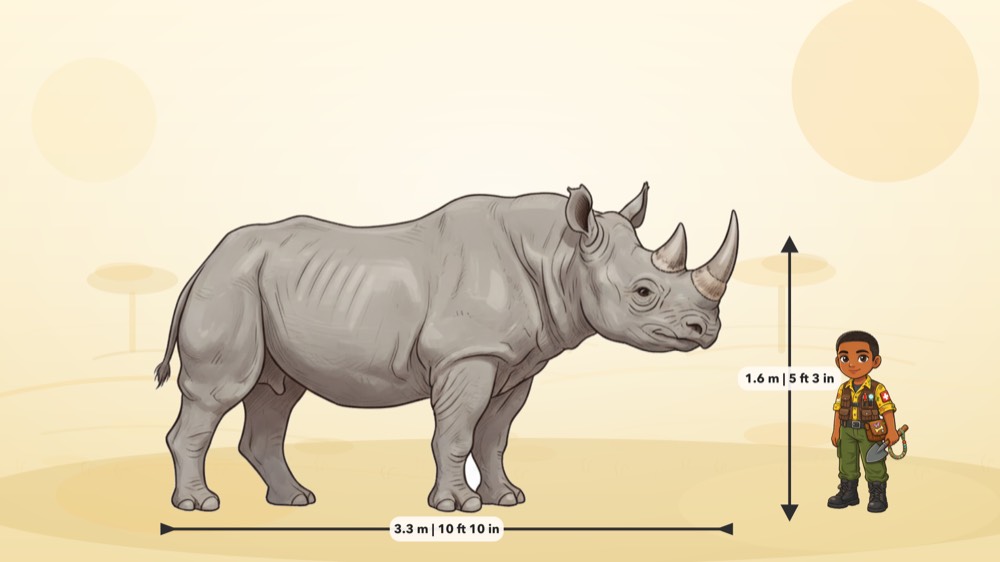
Stand up as tall as you can. A grown-up black rhino's shoulder is still way up above your head — about 1.6 meters, or 5 feet 3 inches high.
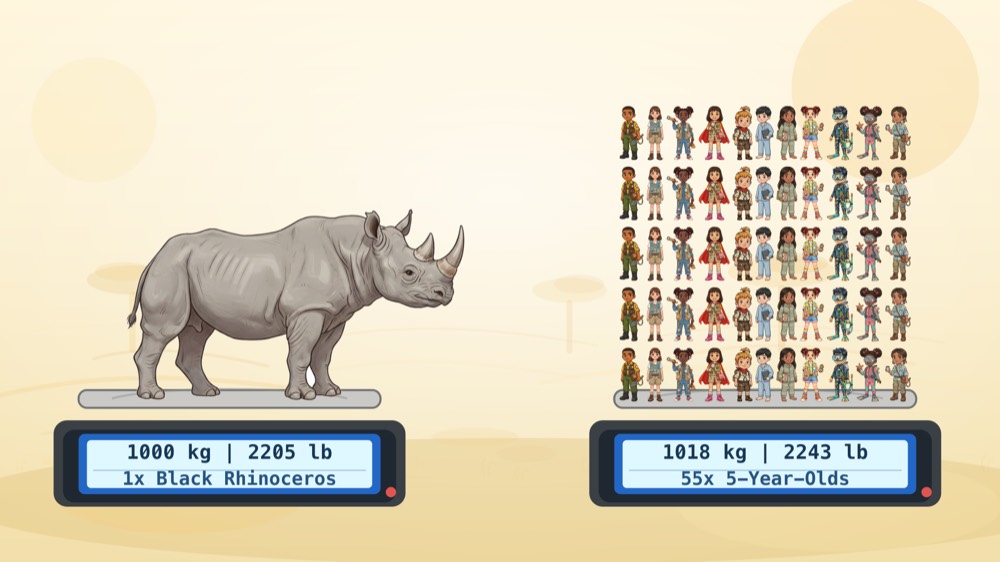
Now picture 55 five-year-olds all climbing onto one giant scale together. That's about how much one black rhino weighs — around 1,000 kilograms, or 2,205 pounds!
A black rhino carries two horns, one longer than the other, and they're made of the very same stuff as your fingernails.
Can you wiggle your ears like a rhino listening for sounds in the bushes?
Black rhinos have a small feathered friend: a bird called an oxpecker rides right on their back. When people come near, the bird calls out — a warning just for the rhino.
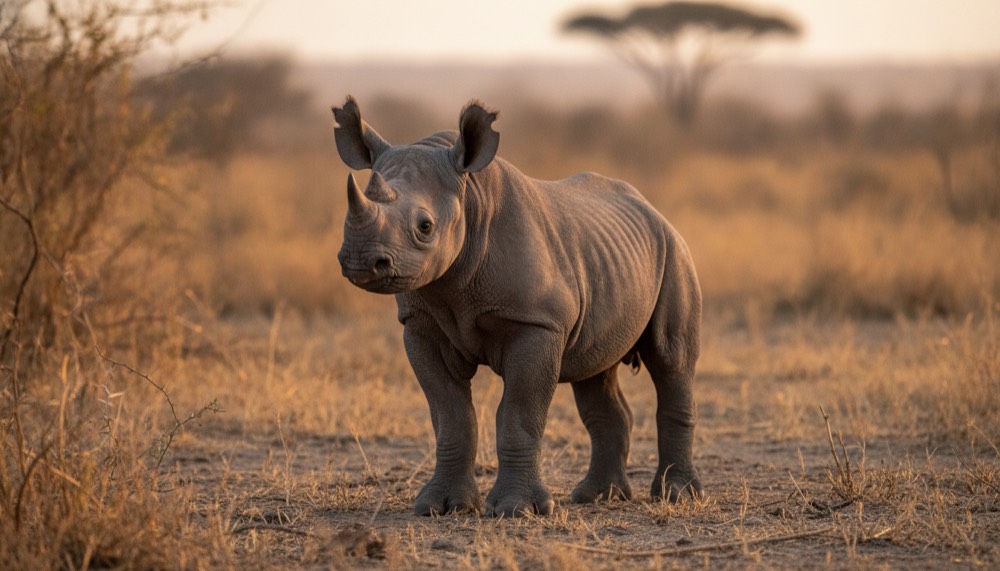
A brand-new baby rhino can stand up and start walking on its very first day! It stays close to its mom for two or three years, learning how to be a rhino.
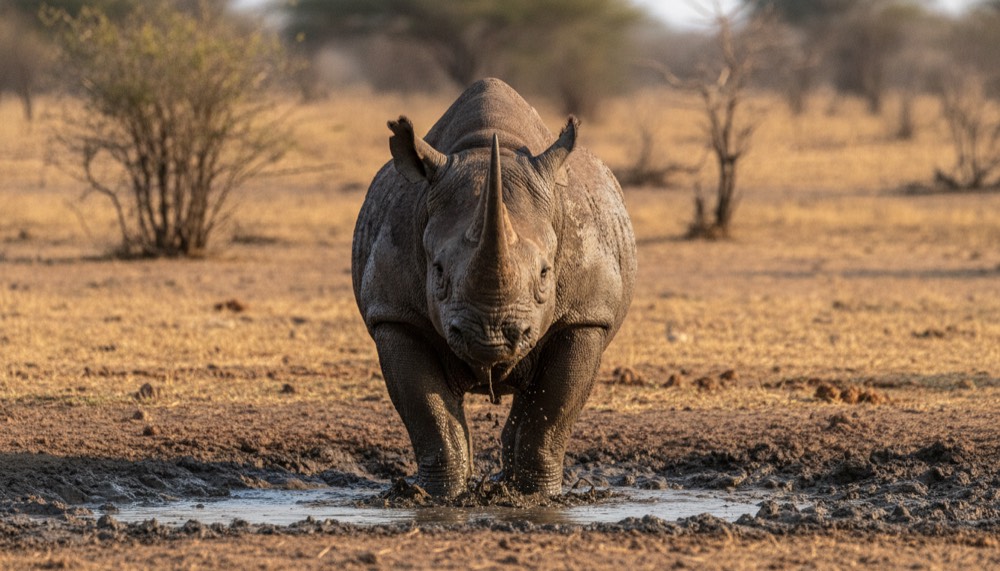
This is a black rhino's home — the wide, bushy grasslands of eastern and southern Africa.
Can you walk s-l-o-w-l-y and heavily, like a rhino ambling through the grass?
Where to see a black rhino
In the wild, black rhinos live in the bushy grasslands and savanna of eastern and southern Africa — but they're shy and hide in thick bush, so even on a guided safari they're much harder to spot than elephants or zebras. For the rest of us, a number of zoos around the world care for black rhinos, and today is a good day to go say hello to one.
North America
Hazina
Lincoln Park Zoo, Regenstein African Journey — Chicago, IllinoisBorn in March 2026, this young black rhino took her first wobbly steps just 90 minutes later. Look for her with her mom, Kapuki, and dad, Utenzi.
Learn more →A calf born at the Daniel Maltz Rhino Reserve
Cleveland Metroparks Zoo — Cleveland, OhioA black rhino calf was born here in September 2025. See if you can spot his pointy, grabby lip at work on a bush.
Learn more →Zuri and Kianga
Milwaukee County Zoo, Ladish Co. Foundation Rhino Care Center — Milwaukee, WisconsinBlack rhinos came back to Milwaukee in a brand-new rhino home that opened in December 2025.
Learn more →Around the world
Eastern black rhinos in Heart of Africa
Chester Zoo — Cheshire, United KingdomChester Zoo's black rhinos live in a giant area of the zoo built just for them — and the zoo helps protect wild rhinos in Africa too.
Learn more →Mesi and her calf
Taronga Western Plains Zoo — Dubbo, AustraliaThis open-range zoo has raised more black rhinos than any other zoo outside Africa. Mesi had a baby boy here in 2024.
Learn more →Animals sometimes move — check the zoo's own website before you visit.
For grown-ups
Black rhinos are listed as Critically Endangered by the IUCN. Poaching for their horn — made of keratin, the same material as your fingernails, and worth nothing more than that — pushed their numbers from about 65,000 in 1970 down to roughly 2,300 by the mid-1990s.
Here's the hope. Black rhinos had disappeared entirely from Rwanda's Akagera National Park; the last one was seen there in 2007. In 2017, conservationists brought 18 rhinos back from South Africa, and in 2019 five more flew in from zoos in Europe — one of them, a rhino named Jasiri, has since had two calves of her own in Rwanda. Across Africa, the black rhino population has climbed from that 1990s low to 6,788 at the end of 2024, and still rising.
This week's hope actions: be a rhino fan — learn the finger-lip fact from the story, then tell someone in your family. Pick one zoo from "Where to see a black rhino" and plan a visit. And if you want to mark the rhino's very own day, World Rhino Day is September 22.
Starters: "Did you know a rhino's top lip works almost like a finger?" · "What do you think it would feel like to have skin as thick as a rhino's?" · "How do you think a little bird and a big rhino help each other?"
If your kid asks why are there so few black rhinos? — this holds up: "A long time ago, some people hunted rhinos and hurt how many there were. But rangers and scientists have worked hard for years to keep rhinos safe, and now there are more than twice as many as there used to be."
Keep exploring
Wild Atlas has a whole page built around the rhinoceros — narrated facts, the full scale comparison against a 5-year-old, and more — in the Safari Stars pack. (Its rhinoceros page is built around a bigger rhino, so its size numbers will be larger than a black rhino's.)
Meet the rhino in Wild Atlas →
For more, visit Save the Rhino.
 Subscribe and the Farm Friends pack ($3.99) is free — yours to keep even if you unsubscribe.