Happy International Beaver Day! Every April 7, people celebrate all beavers everywhere — the date honors Dorothy Richards, a researcher who spent decades studying beavers and became known as the "Beaver Woman." There are two kinds of beaver in the world, and today we're visiting one of them: the Eurasian beaver.
About this day: International Beaver Day was started in 2009 by the group Beavers: Wetlands & Wildlife. It falls on April 7, the birthday of 'Beaver Woman' Dorothy Richards. Source
Read this one out loud together — it's short, and it's even better with a big SMACK sound effect.
Beavers have bright orange teeth that never stop growing — and the front door to their home is underwater!
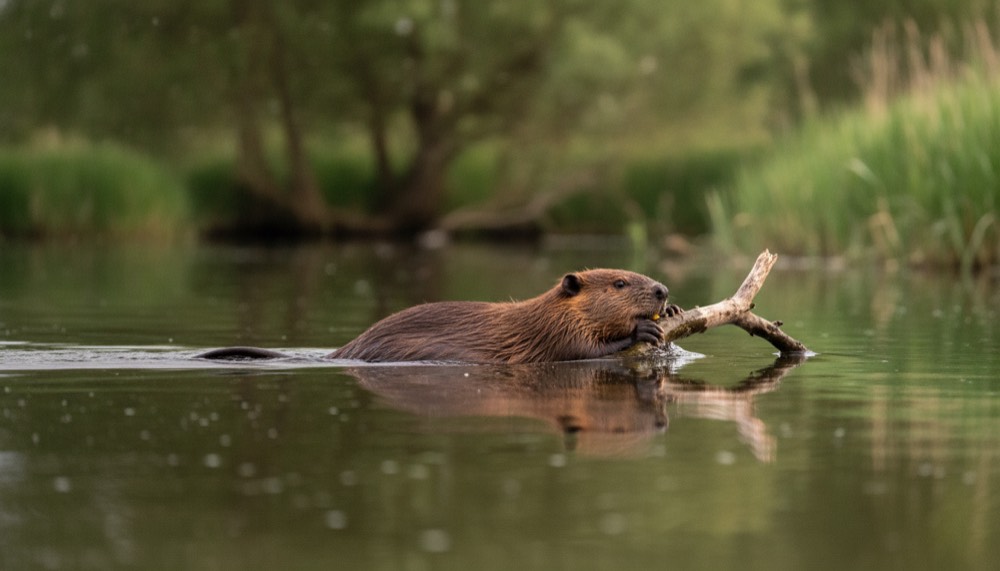
Look closely at the stick in its paws — see the orange? A beaver's front teeth have iron built right into them, which is what turns them that color and keeps them strong for gnawing wood, day after day. The teeth never stop growing, so all that gnawing wears them down to just the right size.
A beaver's home is called a lodge, and the front door is underwater, so it stays hidden and safe. Beavers even have their own built-in swimming goggles: clear eyelids that close over their eyes so they can see underwater.
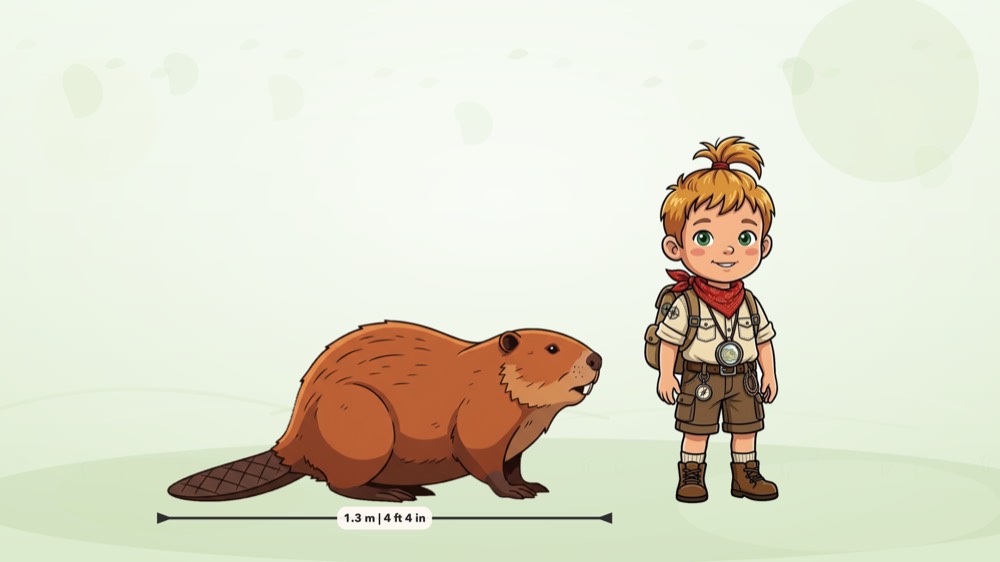
Its body alone is almost as long as you are tall — and add its big, flat tail, and it's even longer!
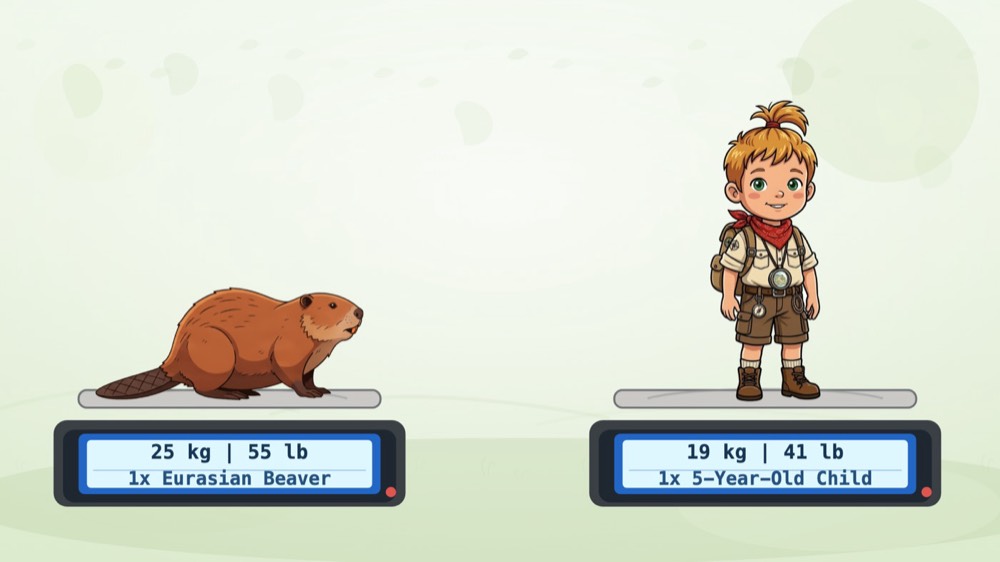
A grown-up beaver weighs about as much as one 5-year-old — a really big one weighs about as much as one and a half 5-year-olds!
SMACK! A beaver slaps its big flat tail on the water to warn its family. Can you slap your hand on the water like that — SPLASH?
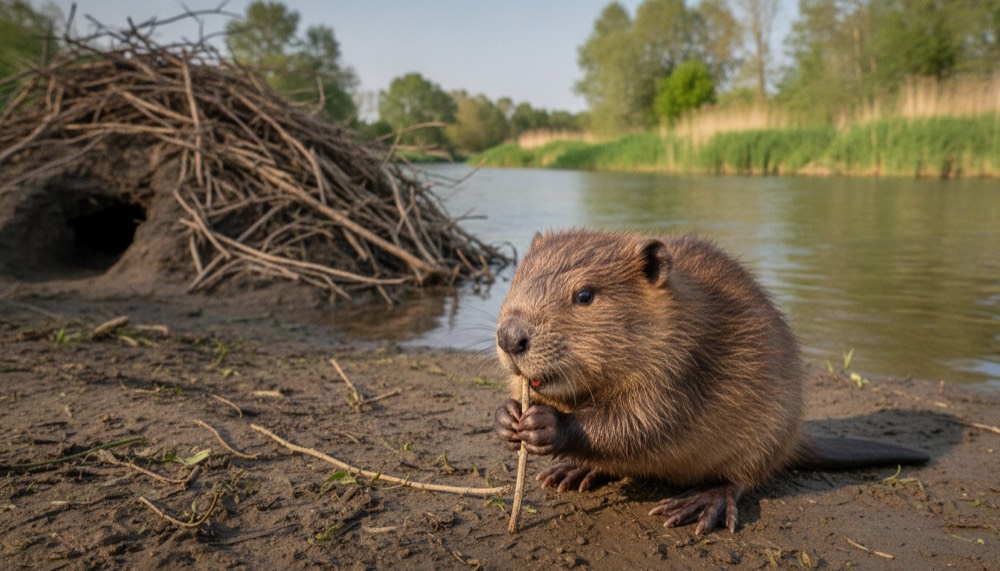
Baby beavers are called kits. They're born with fur already on, and each one weighs about as much as a can of beans or two. Kits live with their mom, dad, and older brothers and sisters for about two years before they swim off on their own.
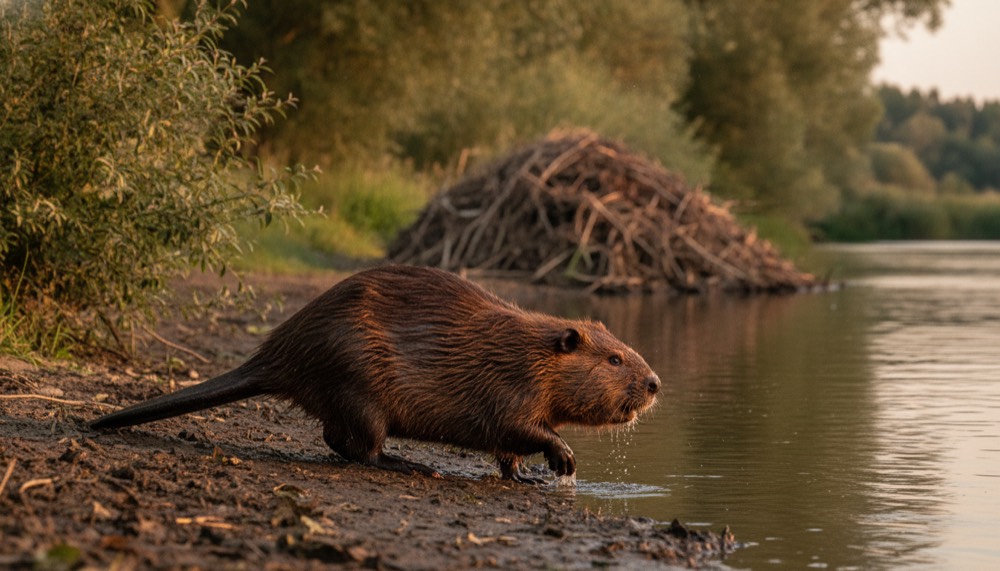
Beavers build dams out of sticks and mud to make their pond just the right depth for that underwater door. Can you show me your best gnawing face, like a beaver chewing a stick? Their busy ponds end up being home for frogs, fish, and birds too.
Eurasian beavers live by rivers and lakes all the way from Britain to Mongolia.
Where to see a Eurasian beaver
In the wild, Eurasian beavers live along rivers and lakes all the way from Britain to Mongolia. They wake up at dusk, so the best way to spot one is to go quietly with a grown-up around sunset and watch from the riverbank for chewed-up tree stumps. For the rest of us, here's where to meet one in person — mostly in Europe, since North American zoos care for its cousin instead.
Zoos and parks in Europe
A beaver den with windows
Wildwood Kent — Herne Bay, EnglandThis den has windows built right in, so you can peek at the beavers without waking them up. They come out to swim at feeding time, usually late in the afternoon.
Visit Wildwood Kent →A lodge with a window
Alpenzoo Innsbruck — Innsbruck, AustriaThese beavers live in a burrow built like a real beaver lodge, with a window in it. In the daytime you can see them snoozing inside.
Visit Alpenzoo Innsbruck →Europe's biggest rodent
Wildpark Bad Mergentheim — Bad Mergentheim, GermanyLook for chewed branches by the water — that's a sure sign a beaver has been busy nearby.
Visit Wildpark Bad Mergentheim →Wild beavers you can (quietly) watch for
Scotland's first wild beavers
Knapdale Forest, Argyll — ScotlandScotland's first official wild beavers were set free here in 2009. Walk the forest trails and look for signs of beavers, like chewed stumps, dams, and lodges.
Learn about Knapdale's beavers →Beavers that came back on their own
River Otter, East Devon — EnglandWild beavers showed up along this river on their own, and they've built dam after dam ever since. It's a river to read about rather than a spot to visit.
Read the River Otter story →Meet a cousin: the American beaver
In North America, you can meet the Eurasian beaver's cousin, the American beaver, at Buttonwood Park Zoo. It's a different species — but it's still a real beaver, with its own family that has had babies in recent years.
Visit Buttonwood Park Zoo →Animals sometimes move — check the zoo's own website before you visit.
For grown-ups
Eurasian beavers are listed as Least Concern by the IUCN, and their numbers are increasing — a real conservation win. But it wasn't always this way: about a hundred years ago, people hunted beavers so much that very few were left, as few as 1,200 across all of Europe and Asia. Beavers disappeared from Britain entirely, for about 400 years.
Then people changed the rules. Wild beavers turned up again on Devon's River Otter around 2008, and in 2020 the government said they'd proven so good for the river that they could stay for good. In 2025, England set out a plan to license wild beaver releases in more rivers, and in Scotland, beavers have even been set free in new places like Glen Affric. Across Europe and Asia, beaver numbers have grown from about 1,200 to around 1.5 million.
Go on a beaver-sign hunt this week: on a walk by a stream or pond (stay on the path, away from the water's edge), look for tree stumps chewed to a pencil point, or piles of sticks. Look, maybe draw what you find, and leave everything just as it is.
Starters: "If you could build a house out of just sticks and mud, what would you build first?" "Why do you think a beaver's pond is a good home for lots of other animals too?"
If your kid asks would a beaver hurt me? — this holds up: "No — a beaver would much rather swim away and hide than come near a person. If you ever saw one, the best thing to do is stay still and quiet and just watch."
Keep exploring
Wild Atlas has a whole page about beavers, part of the Wild Americas pack — narrated facts and the full scale comparison against a 5-year-old.
Meet the beaver in Wild Atlas →
For more, visit the IUCN Red List.
 Subscribe and the Farm Friends pack ($3.99) is free — yours to keep even if you unsubscribe.