Happy International Jaguar Day! Every November 29, people across the Americas celebrate the jaguar — the biggest cat in North and South America, and one of the few big cats that truly loves the water.
About this day: International Jaguar Day was announced in 2018 by Latin American governments and conservation groups, including the UN Development Programme, WWF, WCS and Panthera. Source
Read this one out loud together — it's short, and it's even better with a low, rumbly jaguar growl.
The jaguar is a big cat that loves to swim — and its spots have spots!
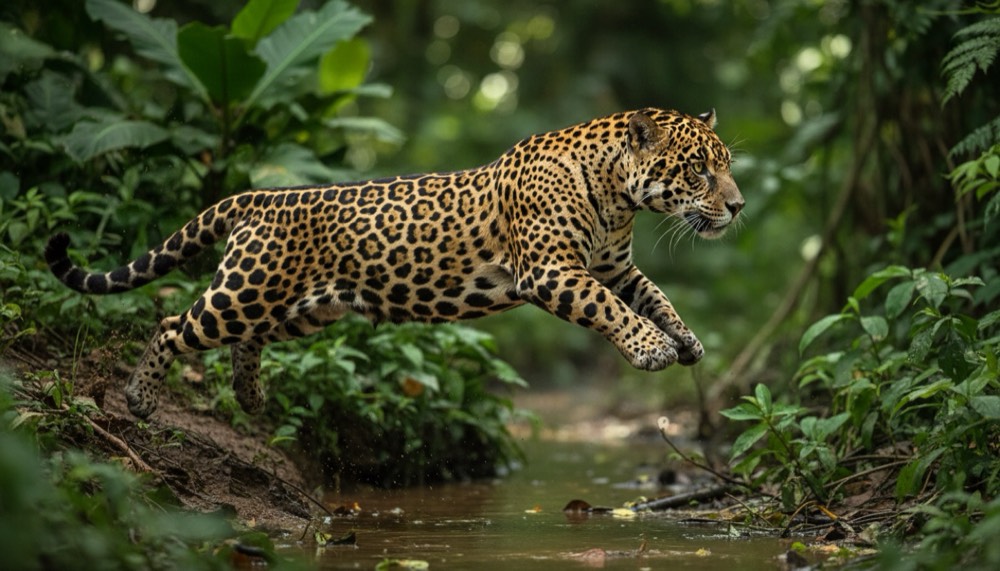
Meet the jaguar — the biggest cat in North and South America, and the third-biggest cat in the whole world. It has a big head, strong shoulders, and a golden coat covered in dark rosettes.
Can you make your best low, rumbly jaguar growl?
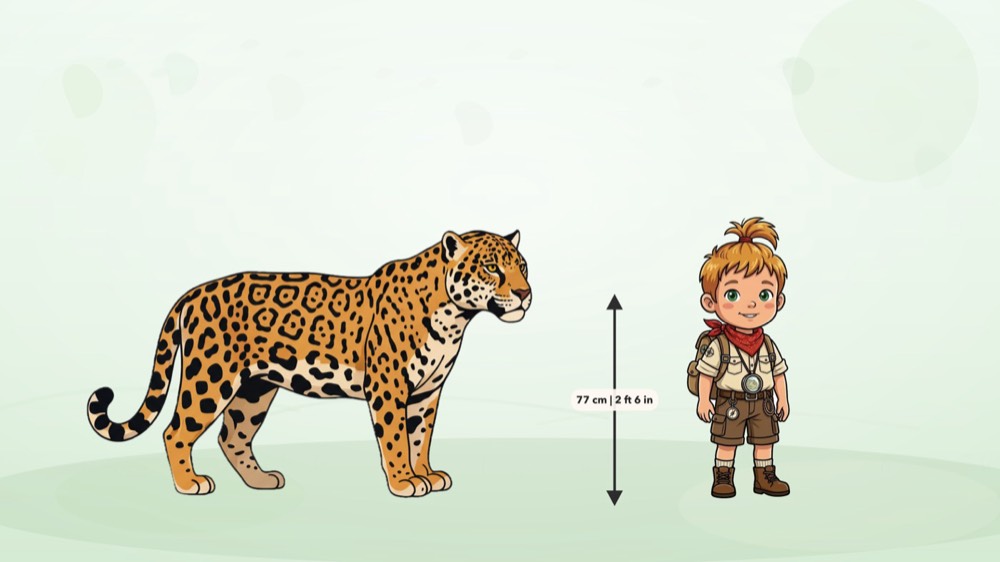
Standing on all four paws, a jaguar's back reaches about a 5-year-old's shoulders. Nose to the end of its body, a big jaguar is almost as long as two 5-year-olds lying head to toe — and then there's the tail!
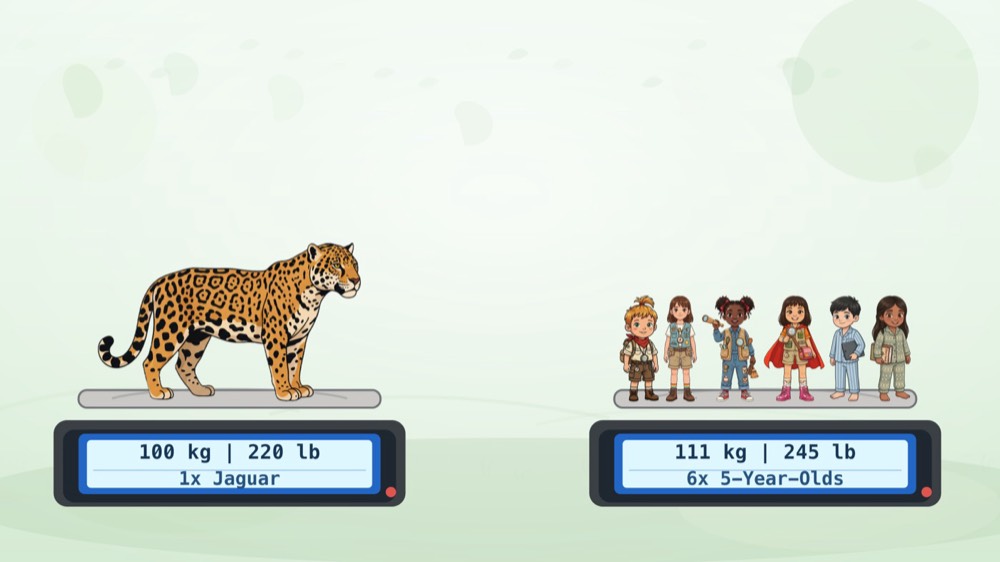
And it's heavy, too — a big jaguar weighs about as much as six 5-year-olds, all standing on one big scale together!
Here's a jaguar's best-kept secret: most cats hate water, but jaguars love it. They swim across wide rivers, and scientists found that one jaguar swam across a lake about as far as twelve soccer fields in a row — all in one go.
Can you show me your best "swimming cat" arms?
Now look closely at those spots. Many of a jaguar's rosettes have a tiny spot hiding inside them — spots within spots! And no two jaguars have exactly the same pattern, just like fingerprints. Some jaguars are even born almost all black, but catch one in the sunlight, and you can still see its spots glowing through the dark fur.
Can you find a spot pattern on your clothes or a stuffed animal, like a jaguar's?
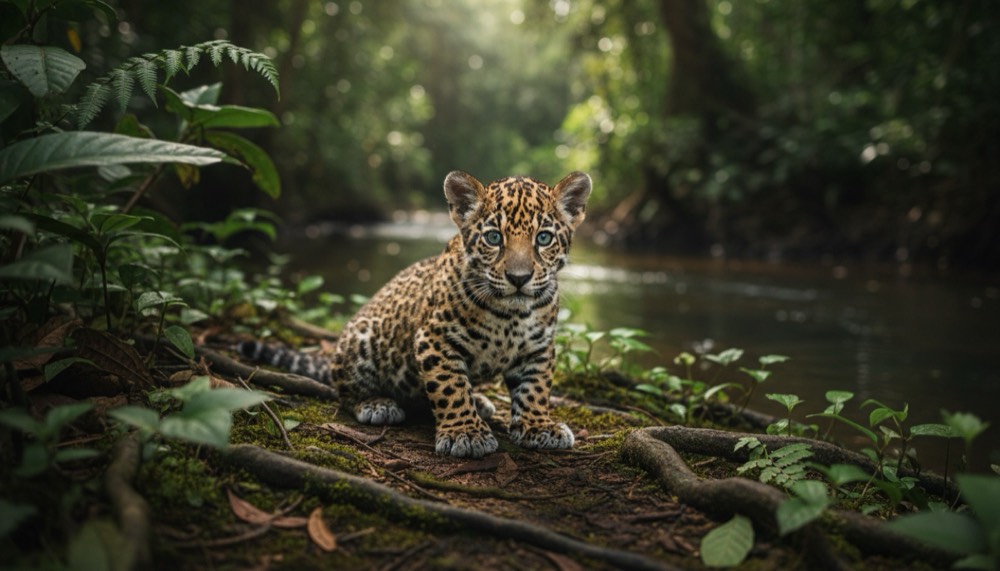
Baby jaguars are born with their eyes shut tight, and jaguar moms usually have twins. Cubs stay close to their mom for about a year and a half, learning to swim, climb, and pad through the forest without making a sound.
Can you make quiet, soft paws and tip-toe like a jaguar?
Where to see a jaguar
In the wild, jaguars live from Mexico all the way to Argentina, in rainforests and wetlands — and they're so secretive that most people who live near them never see one. The best place on Earth to spot a wild jaguar is the Pantanal wetlands of Brazil, where they often rest on quiet riverbanks. For the rest of us, these zoos around the world have jaguars you can visit.
North America
Filly and Frankie
Milwaukee County Zoo — Milwaukee, WisconsinMeet the jaguars in Big Cat Country. Filly came all the way from The Belize Zoo in Central America, where she was rescued as a wild jaguar.
Learn more →A growing jaguar family
Brevard Zoo — Melbourne, FloridaKhan moved here in 2025 from Birmingham Zoo to meet Lua, a young female jaguar — part of a plan to help zoo jaguars have healthy families.
Learn more →Diego
Birmingham Zoo — Birmingham, AlabamaDiego's outdoor home has a waterfall and climbing structures — just right for a cat that loves water and heights.
Learn more →Solana
Alexandria Zoo — Alexandria, LouisianaA surprise cub! Solana ("sunshine" in Spanish) was born last year, after the zoo had hoped for a cub for nine years. Her dad, Bebu, came from the wild in Panama.
Learn more →Around the world
Bonita and Remi
Chester Zoo — Chester, UKA mom and her grown-up son live together here, in a home built especially for older big cats.
Learn more →Animals sometimes move — check the zoo's own website before you visit.
For grown-ups
Jaguars are listed as Near Threatened, and their numbers are decreasing — in trouble, but not gone. The biggest threat is losing the wild spaces they need to roam. In places where jaguars and farm animals share land, that can cause trouble too, so people are building better fences and protecting wild corridors so both can do well.
Here's the hopeful part: jaguars disappeared from Argentina's Iberá wetlands about 70 years ago. Starting in 2021, the Rewilding Argentina Foundation began releasing jaguars back into Iberá National Park. Wild cubs showed up on camera traps the very next year, and by June 2026, Rewilding Argentina announced the 50th wild-born jaguar cub since the project began.
This week's hope action: draw a "jaguar path." Sketch two patches of forest on paper, then draw a green path of trees connecting them, so a jaguar could walk safely from one to the other. That's what real scientists call a wildlife corridor.
Starters: "Did you know jaguars are one of the few big cats that love to swim?" "Why do you think a spotted coat helps a jaguar hide in the forest?" "What do you think it would feel like to move as quietly as a jaguar?"
If your kid asks do jaguars hurt people? — this holds up: "Almost never. Jaguars would much rather stay far away and be left alone. That's why people protect quiet, wild places where jaguars can have their space."
Keep exploring
Wild Atlas has the jaguar, narrated, in the Rainforest Explorers pack — the full scale comparison against a 5-year-old, the weight scale showing six kids, and a close-up of a spotted cub.
Meet the jaguar in Wild Atlas →
For more, visit Panthera.
 Subscribe and the Farm Friends pack ($3.99) is free — yours to keep even if you unsubscribe.