Happy International Pallas's Cat Day! Every year on April 23, people everywhere celebrate one of the fluffiest-looking wild cats around — the Pallas's cat, also called the manul. The date lands right in wild kitten season, when Pallas's cat kittens are born.
About this day: Its origins aren't well documented, but zoos and groups like the Pallas's Cat International Conservation Alliance celebrate these fluffy wild cats every April 23. Source
Read this one out loud together — it's short, and it's more fun with your best frowny-cat face.
Meet the Pallas's cat: a wild cat about the size of a pet cat, with fur so thick it looks much bigger, and a flat, round face that makes it look grumpy, even when it isn't!
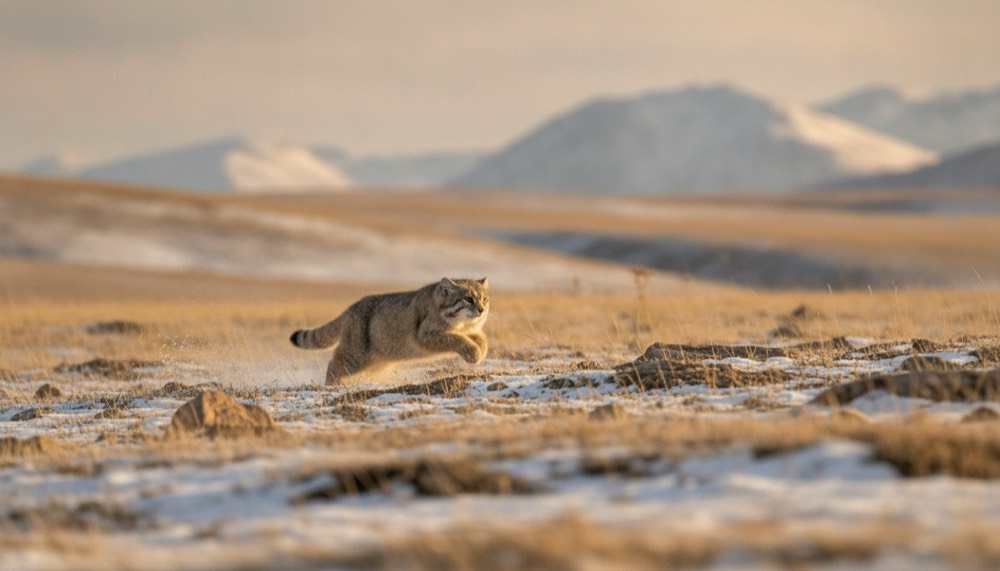
People in Mongolia call it the manul. It lives in the cold, rocky grasslands of Central Asia, and its fur is so thick that about 9,000 hairs fit on a spot the size of your fingernail! That's why a cat no bigger than a house cat looks like a big fluffy cushion.
Look closely and you'll spot two more surprises. Its eyes have round pupils, not slit-shaped ones like a pet cat's. And its little ears sit low on the sides of its head, so it can peek over a rock without being spotted.
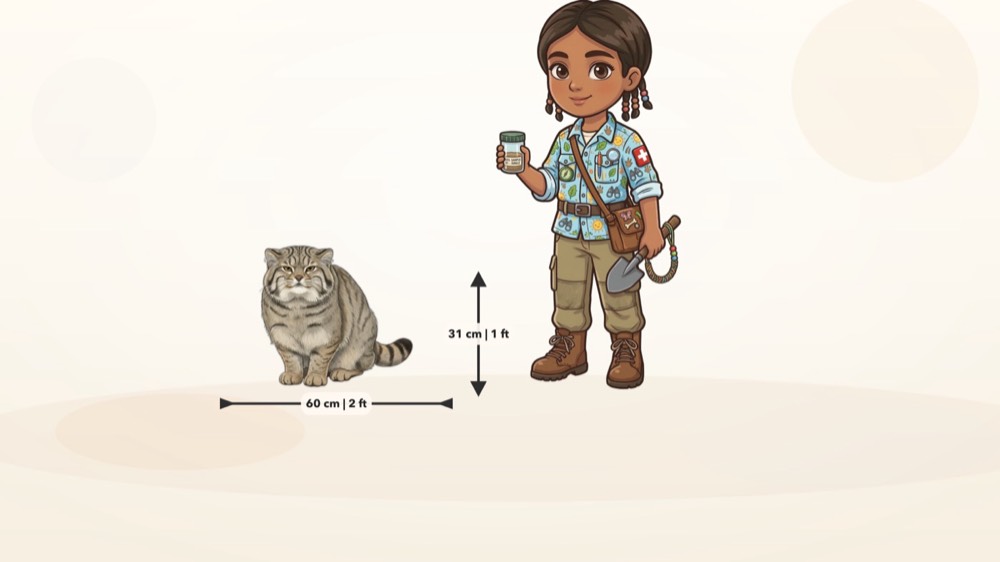
Standing next to a 5-year-old, a Pallas's cat's body is only about 60 centimeters (2 feet) long, and it stands about 31 centimeters (1 foot) tall at the shoulder — it would only come up to about a 5-year-old's knee!
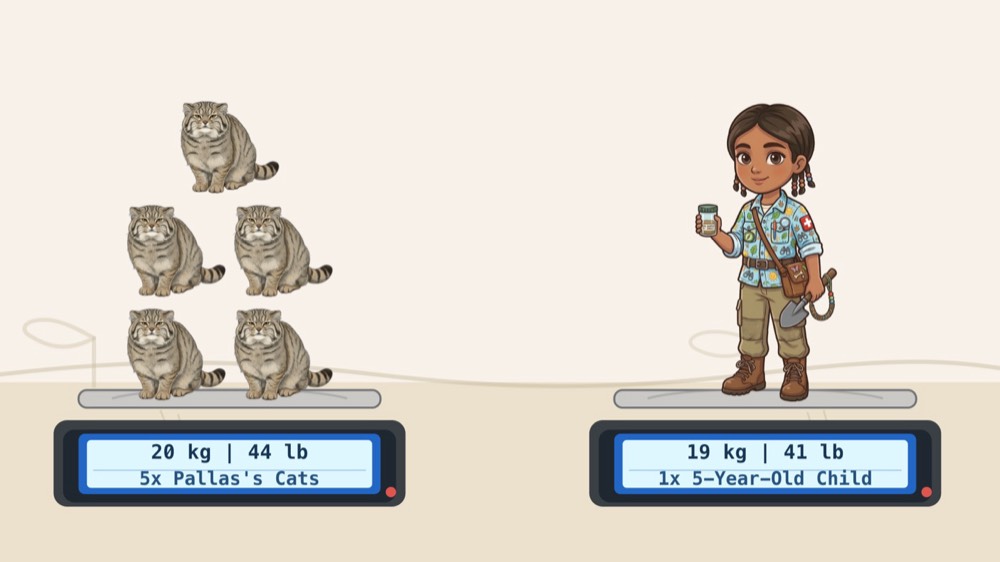
Can you picture five Pallas's cats on one big scale? Together, they'd weigh about 20 kilograms (44 pounds) — about as much as one 5-year-old, at around 19 kilograms (41 pounds).
The Pallas's cat isn't a fast runner, so instead it waits very still, then pounces. It sneaks up on little furry creatures at dawn and dusk, especially pikas — small, round-eared cousins of the rabbit.
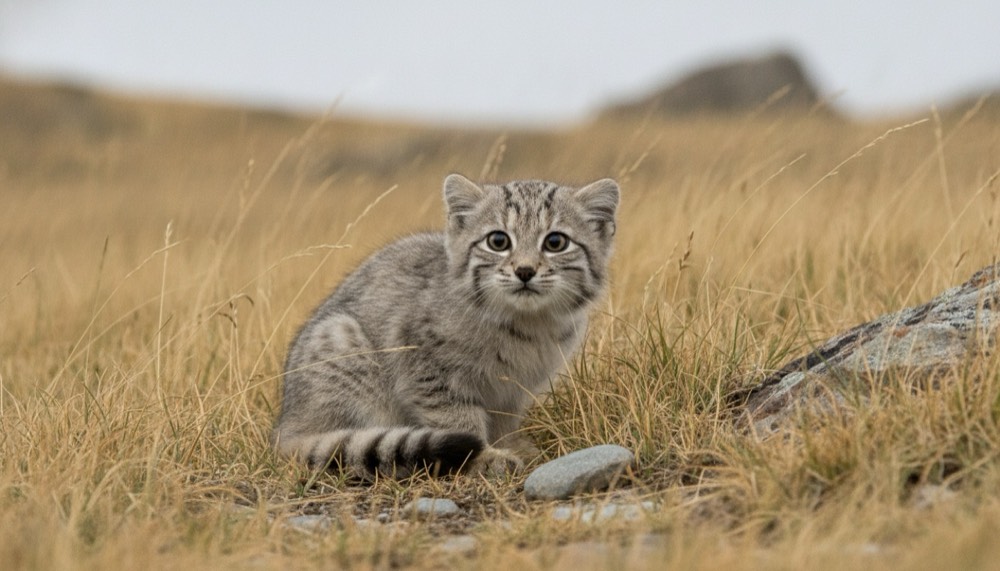
Pallas's cat kittens are born in spring — right around this time of year — in a cozy den tucked into the rocks. By the end of summer, they're already practicing their best pounce, with their mom showing the way.
Can you make your best frowny manul face? Can you go flat and still like a Pallas's cat hiding in the rocks, with your "ears" tucked down low?
Where to see a Pallas's cat
In the wild, Pallas's cats live in the cold, windy, rocky grasslands of Central Asia, in places like Mongolia and China. They're so shy and so well camouflaged that even scientists rarely spot one. For the rest of us, these zoos care for Pallas's cats — look carefully, because they're champion hiders!
North America
Olaf and Pema
Wilder Institute / Calgary Zoo — Calgary, AlbertaHead to the Imagine Asia zone and look closely among the rocks. Calgary's Pallas's cats are experts at blending in!
Learn more →Salkhi, Kaz, and Tashi
Great Plains Zoo — Sioux Falls, South DakotaThis zoo has a real Pallas's cat family — mom Salkhi, dad Kaz, and their son Tashi, who was born here in 2024.
Learn more →Three Pallas's cats
Red River Zoo — Fargo, North DakotaFargo's zoo cares for three Pallas's cats, and its cold North Dakota winters suit these cats just fine.
Learn more →Around the world
Akiko
Edinburgh Zoo (RZSS) — Edinburgh, ScotlandThis zoo's charity runs the Pallas's cat breeding programme for all of Europe and helped start PICA, a group that protects these cats in the wild.
Learn more →Altani and Mars
Tallinn Zoo — Tallinn, EstoniaTallinn Zoo celebrates International Pallas's Cat Day, and its cats are so good at hiding that visitors have to search hard!
Learn more →Animals sometimes move between zoos — check the zoo's own website before you visit.
For grown-ups
The IUCN lists the Pallas's cat as Least Concern, but its overall population trend is marked as decreasing, so it's watched closely, though not in immediate danger. No one knows exactly how many are left in the wild — they're so good at hiding that even scientists rarely see one. The biggest challenges are shrinking grassland habitat and poisoning campaigns aimed at pikas and small rodents, which remove the little animals Pallas's cats depend on.
There's a hopeful story: for more than 90 years, nobody had confirmed a Pallas's cat in Armenia. Then in January 2020, one was spotted in the north of the country, and researchers published the record so the whole world would know this fluffy cat still lives there.
This week, try playing "freeze like a manul": when a grown-up calls out "Manul!", crouch down low and hold as still as a stone, just like a Pallas's cat hiding in the rocks. Then tell your grown-up one thing a Pallas's cat needs to stay wild: grasslands with plenty of small animals to eat.
Starters: "What do you think a Pallas's cat is frowning about?" "Why do you think all that fur makes it look so much bigger than it really is?" "How do you think its low ears help it hide?"
If your kid asks why does it look so grumpy? — this holds up: "That's just the shape of its face — round and flat, with its ears tucked low. It's not grumpy at all. That shape helps it peek over rocks without being seen, and its super-thick fur keeps it warm in the cold wind."
Keep exploring
Wild Atlas has a whole page built around this animal — narrated facts, the full scale comparison against a 5-year-old, and more — in the Legends of the Wild pack.
Meet the Pallas's cat in Wild Atlas →
For more, visit the IUCN Red List assessment for the Pallas's cat.
 Subscribe and the Farm Friends pack ($3.99) is free — yours to keep even if you unsubscribe.