Meet the king cobra! People around the world celebrate it on World Snake Day, July 16 — a day for learning about snakes and why they matter.
- World Snake Day · Friday, July 16 — Origins not well documented; widely observed since about 2009-2014. Source
Read this one out loud together — save your lowest, growliest hiss for the part about the sound.
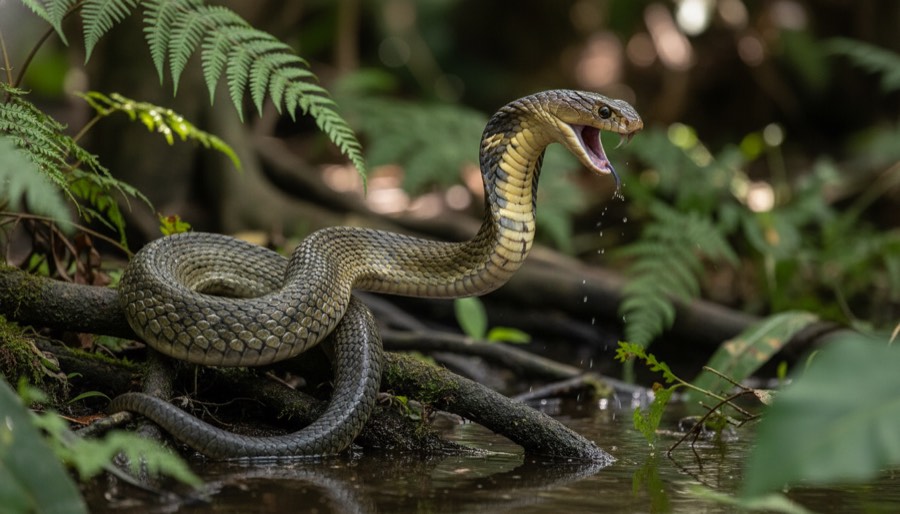
The king cobra is the longest venomous snake in the world!
Just how long? A big king cobra can stretch about 4.5 meters (14 feet 10 inches). That's about as long as a small car — or four 5-year-olds lying head to toe!
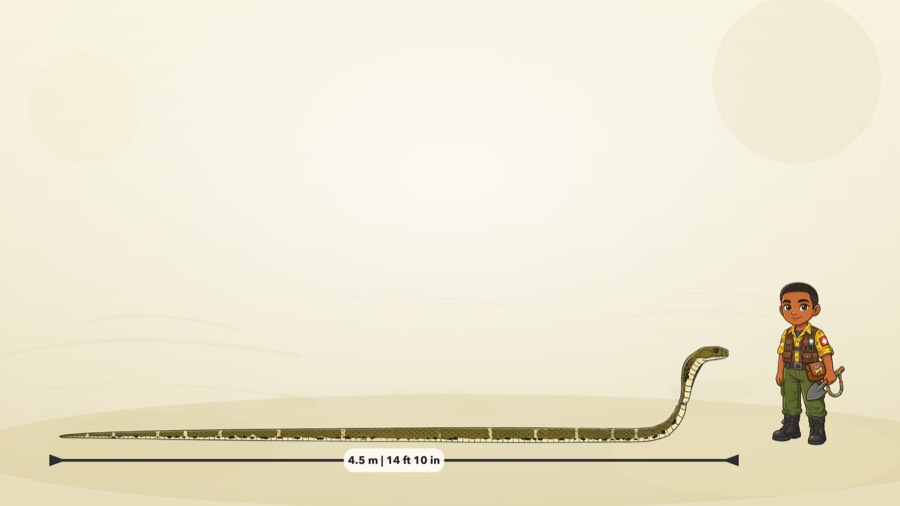
Can you stretch your arms out wide and picture it? Now picture even more!
Here's a name surprise. The king cobra's scientific name means "snake-eater," because it dines mostly on other snakes. That's how it got the "king" in its name!
When a king cobra feels worried, it lifts the front of its body way up and spreads out a wide hood. It can raise its head so high that it could look a grown-up right in the eye. Then it makes a low, rumbly hiss that sounds a little like a growl.
Can you make a low, growly hiss? Try it nice and slow: hhhhhhhhh.
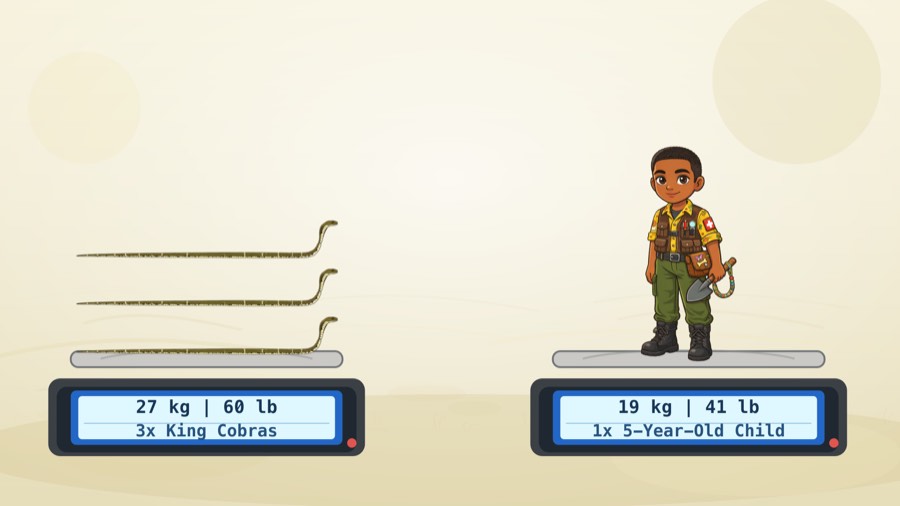
Even with that long body, a king cobra isn't very heavy. One weighs about 9 kilograms (20 pounds) — around half as much as a 5-year-old.
Here's the best part. Most snakes don't build anything — but the king cobra is one of the only snakes that makes a nest! The mother piles up leaves into a cozy mound and lays her eggs inside. Then she stays close by and guards them for about two to three months.
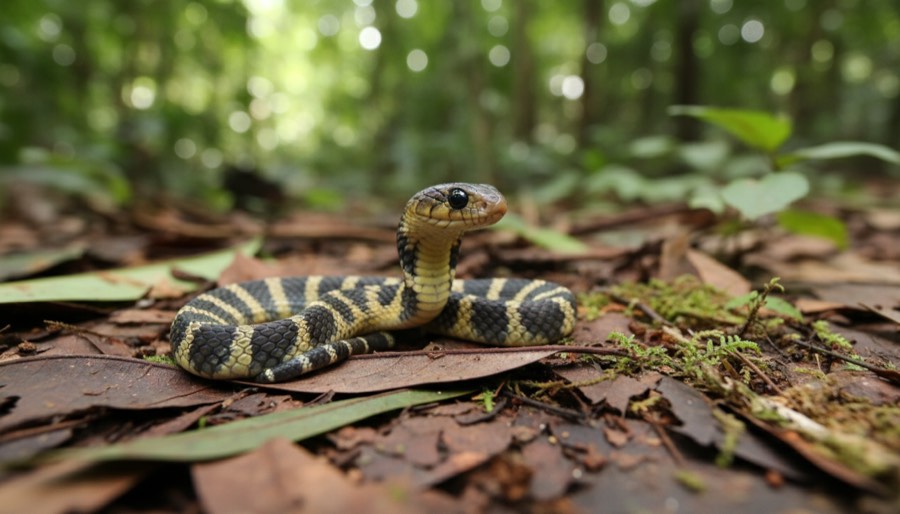
When the babies hatch, they're already little snake-eaters in the making, with bold yellow stripes across their dark bodies, curled up on the leafy forest floor.
King cobras live in the forests and swamps of Asia. They're great swimmers, and they can even climb trees. And like all wild animals, they like their space — so we say hello with our eyes and our imaginations, from far away.
Can you spot the baby with the yellow stripes? Which part of the snake story was your favorite?
Where to see a king cobra
In the wild, king cobras live in the forests and swamps of South and Southeast Asia, where they keep out of sight. For the rest of us, these zoos have king cobras you can visit safely, from behind glass.
North America
King cobra in the Reptile House
Cincinnati Zoo — Cincinnati, OhioLook for the king cobra among the snakes of the zoo's Reptile House.
Learn more →King cobra at Shores & Aquarium
Columbus Zoo and Aquarium — Columbus, OhioThe zoo's page places its king cobras in the Shores & Aquarium region.
Learn more →King cobra in the World of Reptiles
Bronx Zoo — New York CityVisit the World of Reptiles to see how a king cobra holds its head up high.
Visit the Bronx Zoo →Around the world
King cobra at London Zoo
London Zoo — London, EnglandLondon Zoo's own page says king cobras can grow longer than 5 meters (16 feet).
Learn more →King cobra at Tierpark Berlin
Tierpark Berlin — Berlin, GermanyOne of the zoos in Europe that cares for king cobras.
Visit Tierpark Berlin →King cobra at Singapore Zoo
Singapore Zoo — SingaporeSingapore sits close to the forests where wild king cobras live.
Visit Singapore Zoo →Animals sometimes move between zoos — check the zoo's own website before you visit.
For grown-ups
King cobras are listed as Vulnerable on the IUCN Red List. They're not common anywhere, and their forest homes keep shrinking as land is cleared. There's a hopeful thread: researchers in India's Western Ghats have followed king cobras with small radio tags to learn where they roam and nest, and that knowledge helps people protect the forests they need.
Snakes do best where forests and wetlands are left standing. This week, try a family walk in a local green space and look for a few creatures that live there — and if you meet a snake, simply give it room and enjoy the view from afar.
Starters: "What do you think a king cobra does all day in the forest?" "Why might a mother snake want to guard her eggs?"
If your kid asks would a king cobra bite me? — this holds up: "King cobras are shy and would much rather slip away than meet anyone. Their bite is strong, so people who study them keep a safe distance and never touch them — and that's a good rule for every wild snake. If you ever see one outdoors, just back away slowly and tell a grown-up."
Keep exploring
Wild Atlas has a whole page built around this animal — narrated facts, the full scale comparison against a 5-year-old, and the sound a king cobra actually makes. It's part of the Reptile World pack, a paid add-on.
Meet the king cobra in Wild Atlas →
For more, visit the IUCN Red List.
 Subscribe and the Farm Friends pack ($3.99) is free — yours to keep even if you unsubscribe.