Happy Manatee Appreciation Day! Every year, on the last Wednesday of March, people celebrate the manatee — a slow, gentle giant that spends its whole life in warm water. Save the Manatee Club, which has been helping manatees since 1981, invites everyone to join in.
About this day: Manatee Appreciation Day falls on the last Wednesday of March. Save the Manatee Club, started in 1981 by Jimmy Buffett and Florida Governor Bob Graham, champions it. Source
Read this one out loud together — it's short, and it's more fun with a slow, sleepy manatee voice.
A brand-new baby manatee is already longer than a five-year-old is tall — and it weighs more, too!
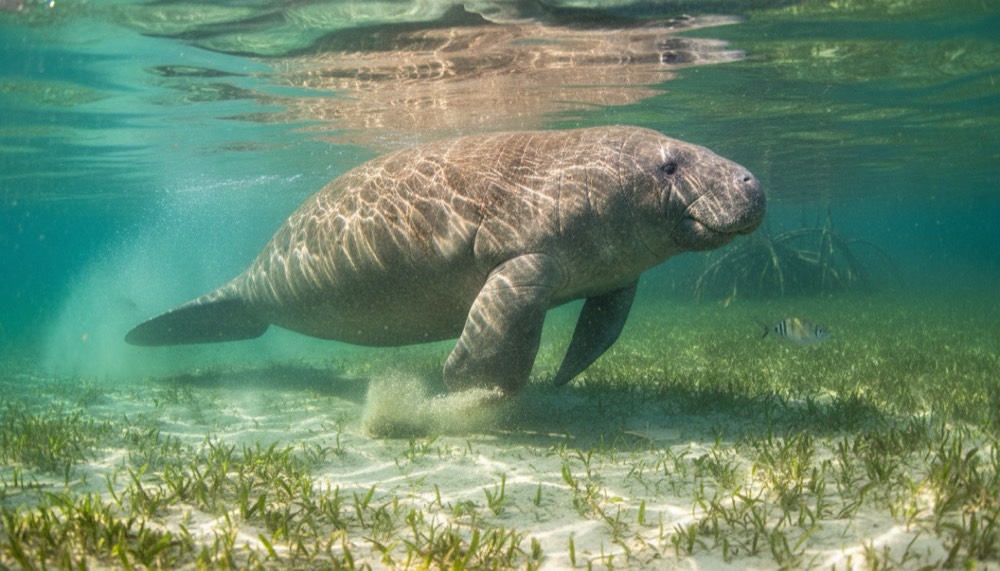
A newborn calf is about 120 centimeters (4 feet) long and weighs around 30 kilograms (66 pounds). That's bigger than a five-year-old, on the very first day of its life.
Manatees look like gentle giants of the sea, round and wrinkly and slow. But their closest cousin isn't a seal or a dolphin — it's the elephant, which lives on land!
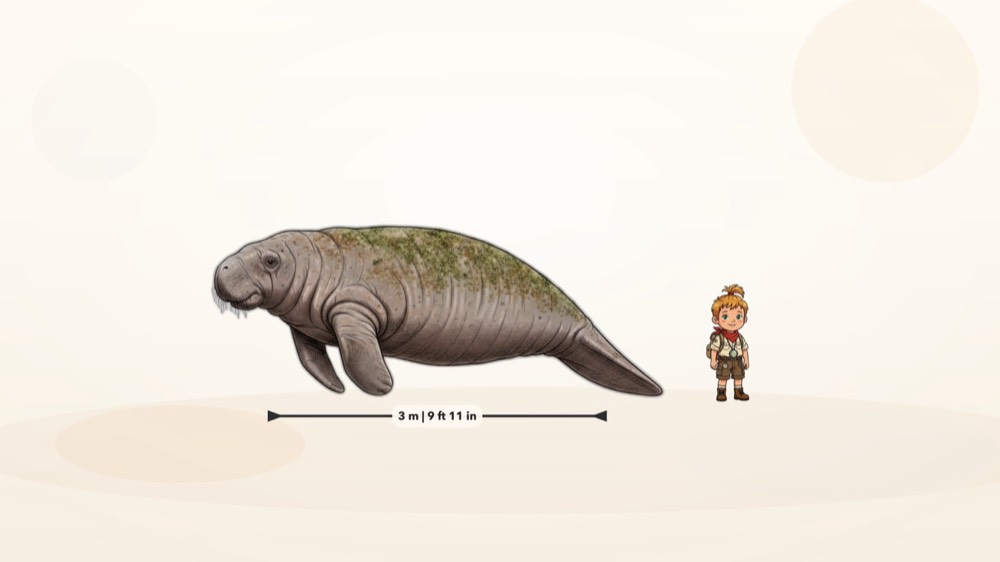
A grown-up manatee is almost as long as three five-year-olds lying head to toe in a row.
And it weighs about as much as 30 five-year-olds — all standing together on one big scale.
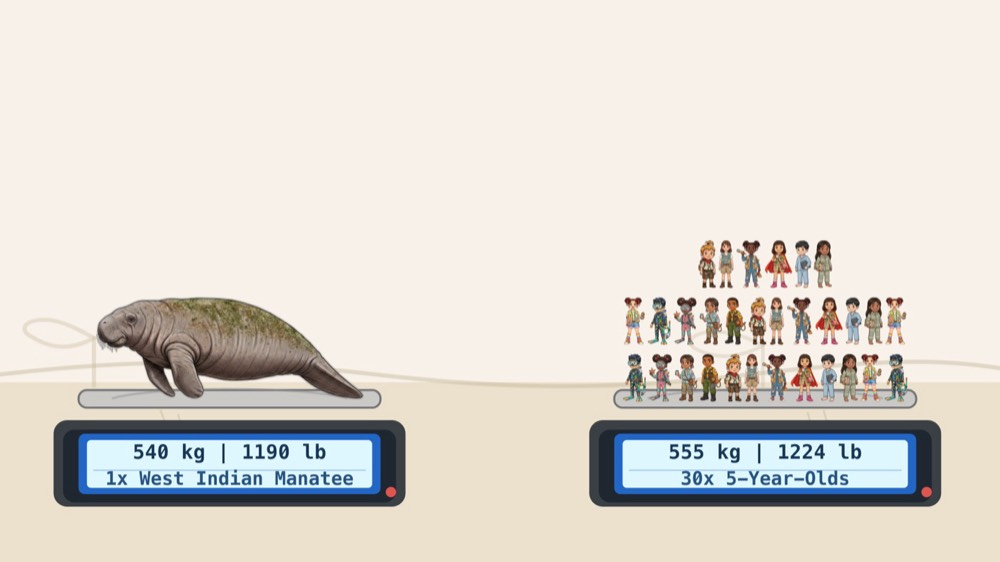
Can you picture 30 friends on one big scale?
Manatees munch sea grass for hours every single day — a giant salad pile! They don't have any front teeth at all. Instead, their back teeth slowly march forward, and new ones grow in behind them, their whole life long.
Every few minutes, a manatee pokes its nose up for a breath of air, then sinks slowly back down to keep munching.
A baby manatee stays close to its mom for a year or two, learning where the warm water is and where the best sea grass grows. Moms and babies chirp and squeak to keep in touch underwater.
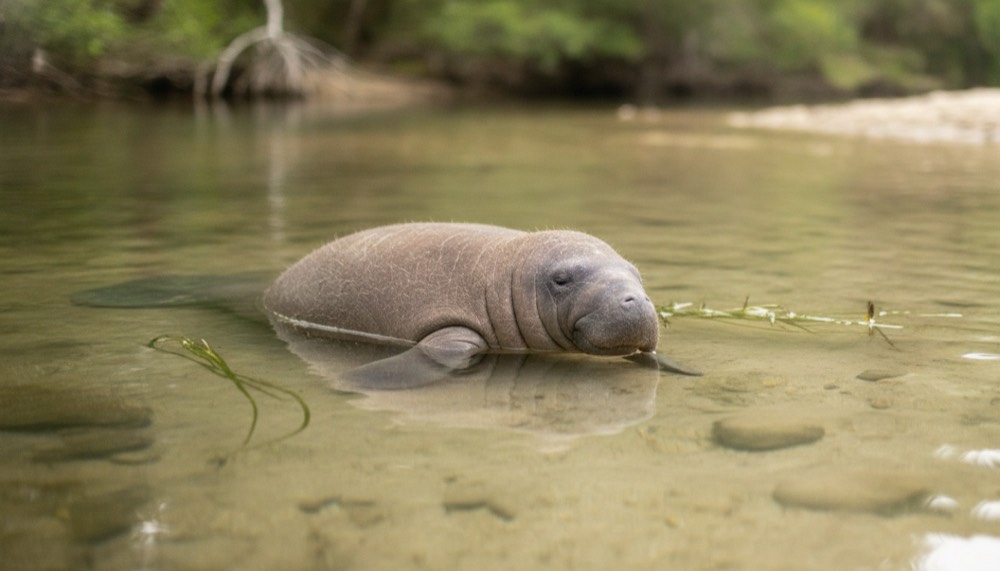
Can you take a big breath and float your arms still, like a resting manatee? Can you wiggle your fingers like a manatee's little flippers?
When the sea turns chilly in winter, manatees swim to warm springs to cosy up together — kind of like curling up under a warm blanket.
Where to see a manatee
In the wild, manatees live in warm, shallow water — rivers, springs, and coasts from Florida through the Caribbean to Brazil. In winter, Florida's manatees gather in warm springs, where families can watch them from a boardwalk. For the rest of us, these zoos and parks around the world have manatees you can visit too.
North America
Stubby
Columbus Zoo and Aquarium — Powell, OhioStubby was hurt and probably can't go back to the wild, so the zoo is her home. Young rescued manatees grow up alongside her before heading back to Florida.
Learn more →Manatee Springs
Cincinnati Zoo & Botanical Garden — Cincinnati, OhioRescued manatees rest and grow here before going back to Florida. You can even follow released manatees on a map online!
Learn more →Manatee Critical Care Center
ZooTampa — Tampa, FloridaThis zoo runs a real manatee hospital! It has helped more than 630 manatees, and most went back to the wild. Watch patients on the live underwater camera.
Learn more →Blue Spring State Park
Orange City, FloridaIn winter, hundreds of wild manatees swim into this warm spring to stay cosy, and you can watch them from a long boardwalk. Manatee season runs from about mid-November to late March, so plan a winter visit.
Visit Blue Spring State Park →Around the world
Equatorial Dome
ZooParc de Beauval — Saint-Aignan, FranceBeauval has the biggest group of manatees in Europe, swimming under a giant warm dome full of tropical plants.
Learn more →The Oceanium
Odense ZOO — Odense, DenmarkIn the Oceanium, you can watch manatees roll, turn somersaults, and even swim on their backs!
Learn more →Amazon-Guyana Biozone
Parc Zoologique de Paris — Paris, FranceAt the foot of a waterfall in a big tropical greenhouse, manatees glide by.
Learn more →Animals sometimes move — check the zoo's own website before you visit.
For grown-ups
Manatees are listed as Vulnerable — there aren't as many as there used to be. The Antillean manatees found through the Caribbean, Central America and South America have it hardest.
There's a hopeful story, though. In 1991, surveys counted only 1,267 manatees in Florida. Today there are at least 8,350 — some of that rise is from better counting, but a lot of it is real. Slow-speed boating zones, warm-water refuges, and rescue programs have all helped — enough that in 2017 the US moved manatees from Endangered to Threatened. The work isn't finished: seagrass loss has made some recent winters hard for Florida's manatees, which is one more reason people keep helping. At ZooTampa, a real manatee hospital has rescued more than 630 manatees over 30+ years and returned most of them to the wild.
Manatees move slowly, and boats move fast, so people who love manatees ask boaters to slow down and watch for them in "Manatee Zone" areas — boats are one of the biggest dangers manatees face, so slow zones really matter. This week, if you're near a river, lake, or the sea with a grown-up, help pick up litter — and a grown-up can handle any old fishing line or hooks, since manatees can get tangled in it. And if you ever spot a "Manatee Zone — Slow Speed" sign, you can tell everyone what it means!
Starters: "Did you know a manatee's closest cousin isn't a seal — it's an elephant?" "How do you think boats and manatees can share the same water safely?"
If your kid asks do manatees get hurt? — this holds up: "Some do, mostly from boats going too fast, so people who study manatees ask boaters to slow down and watch for them — and there are special hospitals just for manatees that help them heal."
Keep exploring
Wild Atlas has a whole page built around this animal — in the Legends of the Wild pack — narrated facts, the full scale comparison against a 5-year-old, and the weight scale showing 30 kids.
Meet the manatee in Wild Atlas →
For more, visit the U.S. Fish & Wildlife Service.
 Subscribe and the Farm Friends pack ($3.99) is free — yours to keep even if you unsubscribe.