This week's Wild Atlas Spotlight: to finish the year, we're heading to the top of the world — all the way to the icy Arctic Ocean — to meet one of the strangest, most wonderful animals alive.
About this day: There's no official day for the narwhal this week, so this one is a Wild Atlas Spotlight.
Read this one out loud together — it's short, and it's more fun with a swooshy, underwater voice.
A narwhal's long, twisty "horn" isn't a horn at all. It's a tooth — and it grows right out through its lip!
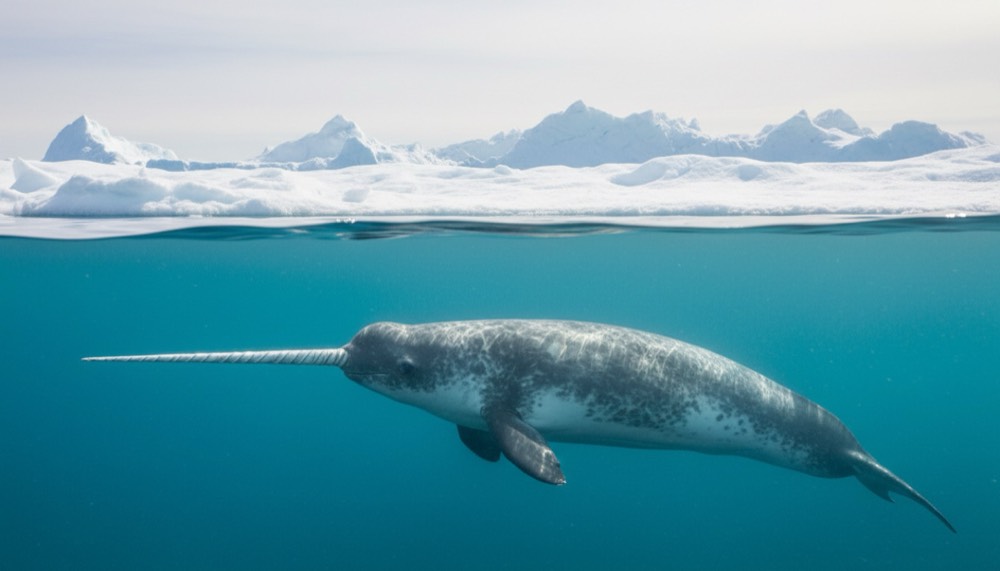
Meet the narwhal, a whale that lives its whole life in the icy Arctic Ocean. People sometimes call it the "unicorn of the sea," because of that long, spiraling tusk. But a narwhal isn't magic — it's just wonderfully strange. That tusk is really a giant tooth, usually its left one, that twists like a corkscrew as it grows.
Can you spiral your arm slowly, like a narwhal's twisty tusk?
Scientists are still finding out what that twisty tusk is for. It may help a narwhal feel what the water around it is like, and boy narwhals may show off their tusks to each other, a bit like antlers. Most boy narwhals grow a tusk, and some girls have one too. Once in a while, a narwhal even grows two!
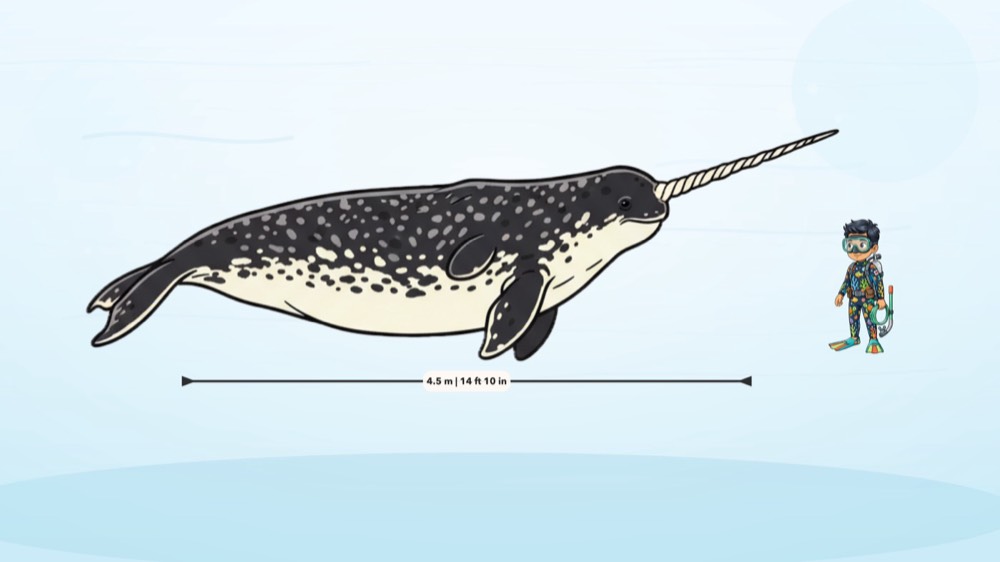
A grown-up narwhal is about 4 times as long as a 5-year-old is tall — and that's before you even add the tusk!
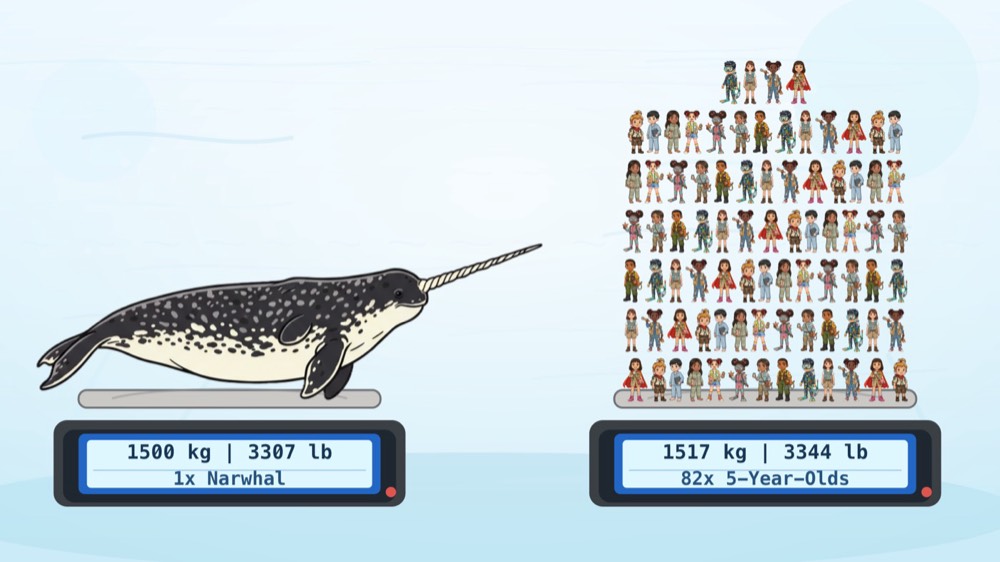
A big narwhal weighs about as much as 82 five-year-olds, all balanced on one enormous scale. Can you picture that many friends in one place?
Narwhals are excellent divers. They can swim down deeper than the world's tallest building is tall, and hold their breath for up to 25 minutes. They have no fin on their back — just a low ridge — which may help them glide under the ice. In winter, they breathe through cracks in the frozen sea.
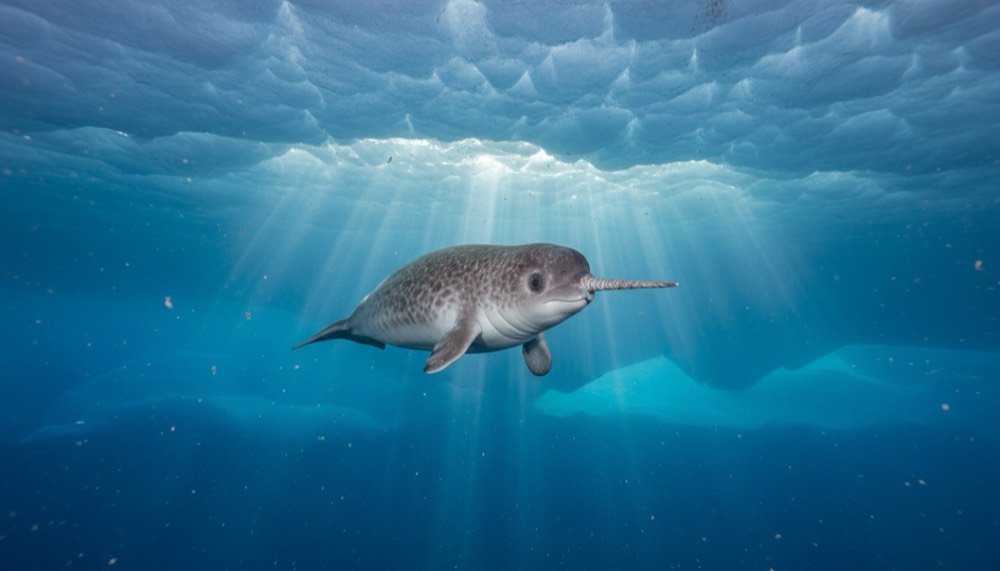
A brand-new baby narwhal is already longer than a 5-year-old is tall! Babies are smooth and grey. As narwhals grow older, they get spotty, and the oldest ones turn almost white.
Narwhals travel together in groups called pods, clicking and whistling to talk to each other. Their clicks bounce back like echoes, helping them find fish in the dark water below.
Can you click, whistle and squeal, like a narwhal talking to its pod?
Where to see a narwhal
Narwhals live only in the icy Arctic Ocean. They need deep, cold, ice-covered water, so no zoo or aquarium anywhere has one. The only way to see a real narwhal is on a trip to the far north — or by watching videos of scientists and Inuit guides who study them every year.
North America
The floe edge
Pond Inlet, Arctic Bay & Lancaster Sound, Nunavut, CanadaIn spring, some visitors travel by sled to the edge of the sea ice, where narwhals come up to breathe. In summer, they're sometimes spotted right from shore.
Learn more →Around the world
Inglefield Bredning
Qaanaaq, North GreenlandEvery summer, narwhals swim by the thousands into the fjord near Qaanaaq — one of the best places on Earth to spot one.
Learn more →These are real wild animals, so nothing is guaranteed — narwhals are shy, and a sighting always depends on ice, weather and luck. Maybe one day you'll see one!
For grown-ups
Narwhals are listed as Least Concern by the IUCN, which is good news. Orcas are a natural predator of narwhals, which is how food chains work, not cruelty. Inuit communities have hunted narwhal for generations, and today that hunt is legal and co-managed with wildlife authorities, as part of a living culture.
There's a hopeful story here too. In 2019, Inuit communities and the Government of Canada teamed up to protect Tallurutiup Imanga, a huge stretch of Arctic ocean in Nunavut where a large share of the world's narwhals spend their summers. Inuit guardians, called the Nauttiqsuqtiit, now watch over the water as its eyes and ears.
A changing Arctic still brings real challenges for narwhals: shifting sea ice, more ship traffic and ocean noise. Narwhals use sound to find food and find each other, so a quieter ocean matters to them. This week's hope action: draw a narwhal on a "quiet ocean" poster, with one thing that helps keep the water calm and icy, like boats going slow. A drawing won't quiet the Arctic by itself, but noticing why quiet water matters is how helpers start.
Starters: "If your tusk could sense the water around you, what would you want to feel first?" "Why do you think people used to think narwhal tusks came from unicorns?"
If your kid asks could a narwhal stab me with its tusk? — this holds up: "No — narwhals are shy and keep far away from people. Scientists think the tusk may help them sense the water, or show off to other narwhals. People who study them always keep their distance and let narwhals be narwhals."
Keep exploring
Wild Atlas has the narwhal in the Ocean Creatures pack — narrated facts, the full scale comparison against a 5-year-old, and a close-up look at that spiraling tusk.
Meet the narwhal in Wild Atlas →
For more, visit NOAA Fisheries.
 Subscribe and the Farm Friends pack ($3.99) is free — yours to keep even if you unsubscribe.