Happy National Bison Day! Every first Saturday in November, people across the US celebrate the American bison — the giant, shaggy grazer of the prairie, and the official national mammal of the United States.
About this day: National Bison Day was started in 2012 by the Vote Bison Coalition, a group of tribes, ranchers and conservationists. The U.S. Senate has recognised it every year since 2013. Source
Read this one out loud together — it's short, and it's even better with a low, grunty bison voice.
Baby bison are born a bright orange-red — people call them "red dogs" — and just a couple of hours later, they can keep up with the whole herd.
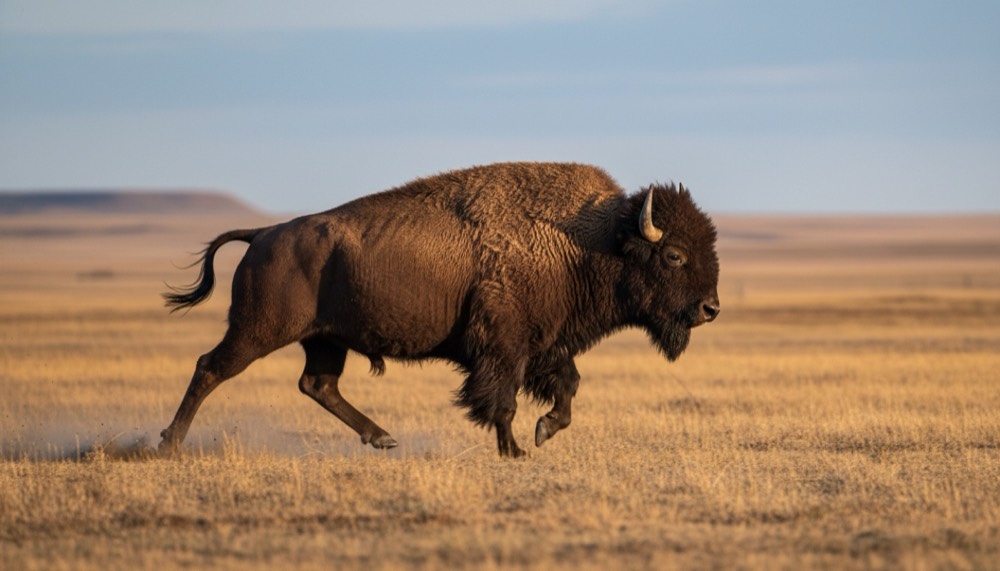
Meet the American bison — the biggest land animal in North America. It has a huge, furry hump on its shoulders (that's mostly muscle!), a shaggy beard, and two curved horns.
Can you make your voice low and rumbly, like a bison's grunt?
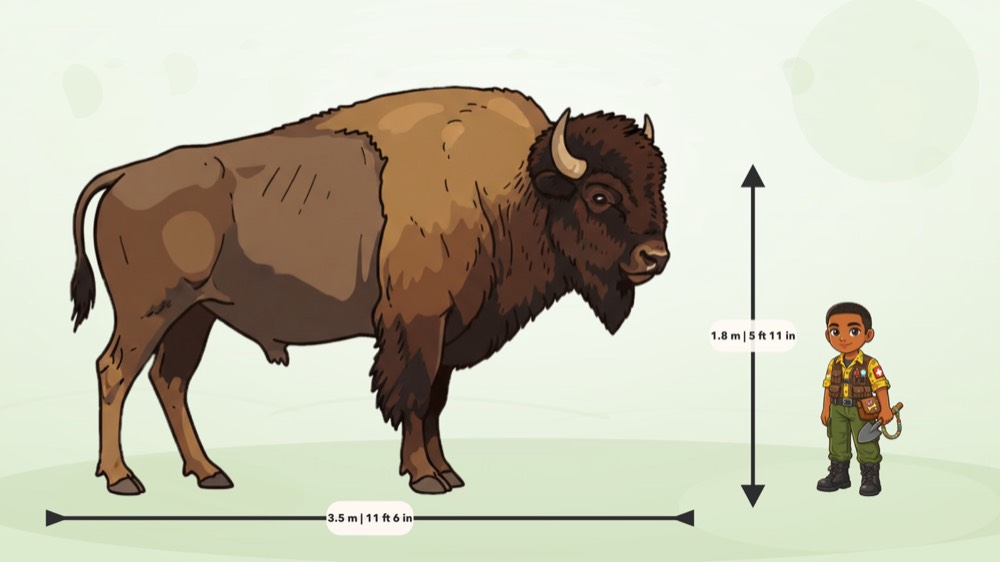
A big bull bison's shoulders reach higher than most grown-ups' heads — stand next to one, and a 5-year-old's head would only reach partway up its side! Nose to tail, it's about as long as three 5-year-olds lying head to toe.
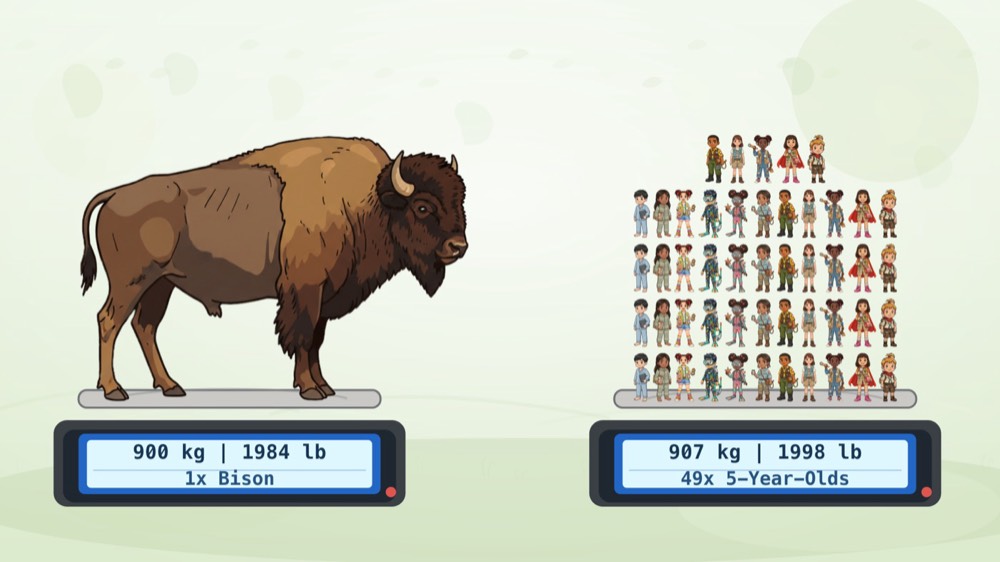
And it's heavy, too — a big bull can weigh as much as 49 five-year-olds, all standing on one big scale together! But don't let the size fool you: a bison can run about as fast as a car driving through town, and jump right over a fence taller than you. It can even swim.
Can you curl up small, then jump up tall like a bison leaping a fence?
In winter, a bison uses its giant head like a snowplow, sweeping snow aside to find the grass underneath. And when bugs bother it, it rolls around in the dirt like a big dusty pillow, right there on the open prairie.
Can you swing your head slowly side to side, like a bison sweeping snow off the grass?
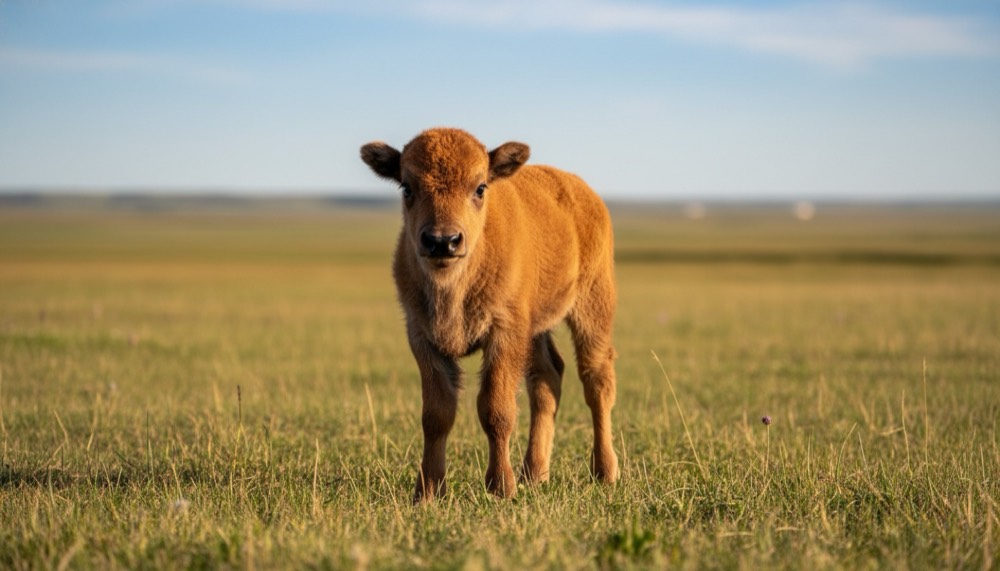
Here's the best wow fact of all: baby bison are born a bright orange-red — people call them "red dogs"! A red-dog calf can stand up within about half an hour — and a couple of hours later, it can keep pace with the whole herd. By the time it's a few months old, its coat turns brown, just like the grown-ups around it.
Can you spot something orange today that reminds you of a red-dog calf?
Where to see an American bison
In the wild, bison roam the grasslands of North America — places like Yellowstone National Park, where there were nearly 5,300 bison in 2025. You'd watch from the car or with binoculars, staying far, far back. For the rest of us, these zoos around the world have bison you can visit.
North America
The Minnesota Bison Conservation Herd
Minnesota Zoo — Apple Valley, MinnesotaWalk the Northern Trail to meet the zoo's herd. Calves born here grow up and move out to a Minnesota state park, helping Minnesota's conservation herd grow toward a goal of 500 bison.
Learn more →Sunny and her calf
Northwest Trek Wildlife Park — Eatonville, WashingtonRide a tram through a 435-acre wild area where bison roam free alongside elk and deer. Sunny had a calf here in spring 2025.
Learn more →A summer calf
Sedgwick County Zoo — Wichita, KansasLook for the herd from the overlook in the zoo's North America area. A bull calf was born here in July 2026.
Learn more →Wood bison, the forest kind
Toronto Zoo — Toronto, OntarioIn the Canadian Domain, look for wood bison — a bigger, northern, forest-living kind of American bison. A girl calf was born here in 2025, with help from the zoo's scientists. The zoo's female herd is off view for now, so check the zoo's page before you visit.
Learn more →Around the world
A June calf
Tierpark Hagenbeck — Hamburg, GermanyA plains bison calf was born here in June 2026. It started out light brown, and will grow a thick coat that keeps it warm down to −30°C.
Learn more →On the hilltop
Thüringer Zoopark Erfurt — Erfurt, GermanyBison live up on a hilltop plateau here. A giant bull lives with the family group, and calves are born here every year.
Learn more →Animals sometimes move — check the zoo's own website before you visit.
For grown-ups
American bison are listed as Near Threatened, with a stable population — doing better, but they still need our help. There were once millions of bison. Then there were almost none — by 1902, only about two dozen were left in Yellowstone National Park. People noticed, and started protecting them, and now thousands roam again: Yellowstone estimated nearly 5,300 bison in 2025, in two breeding herds — the only place in the US where bison have lived continuously since prehistoric times.
The comeback keeps going. Since 2012, the Minnesota Zoo and the Minnesota DNR have grown a conservation herd that now numbers about 150 bison across four sites, with a goal of 500. And in February 2026, Yellowstone's Bison Conservation Transfer Program moved 213 bison — the largest transfer yet — to the Assiniboine and Sioux Tribes at Fort Peck, Montana. From there, bison go on to help Tribal Nations across the US and Canada build their own herds.
This week's hope action: be a great wildlife watcher. If you ever visit a park with bison, stay far, far back — about two school buses' worth of space — in the car or on the trail, and use binoculars to spot a "red dog" calf. Giving bison their space helps keep them wild.
Starters: "Did you know a baby bison is born orange-red, like a little red dog?" "How do you think a bison keeps warm and finds grass under the snow?" "If you were as big and fast as a bison, what would you do all day?"
If your kid asks why did the bison almost disappear? — this holds up: "A long time ago, so many bison were hunted that only a couple dozen were left in one famous park. People noticed, and started protecting them and giving them room to roam again. Now there are thousands, and more keep being born every spring."
Keep exploring
Wild Atlas has the American bison, narrated, in the Wild Americas pack — the full scale comparison against a 5-year-old, the weight scale showing 49 kids, and a photo of a red-dog calf.
Meet the bison in Wild Atlas →
For more, visit NPS Yellowstone.
 Subscribe and the Farm Friends pack ($3.99) is free — yours to keep even if you unsubscribe.