Happy National Panda Day! Every March 16, people celebrate one of the most recognizable animals on Earth — the giant panda.
About this day: No one knows for sure who started National Panda Day, but zoos and conservation groups mark it every March 16 to celebrate giant pandas. Source
Read this one out loud together — it's short, and it's more fun with a bamboo-crunching voice.
When a giant panda is born, it's pink, almost bare, and about the size of a stick of butter — but it grows up to weigh as much as seven five-year-olds!
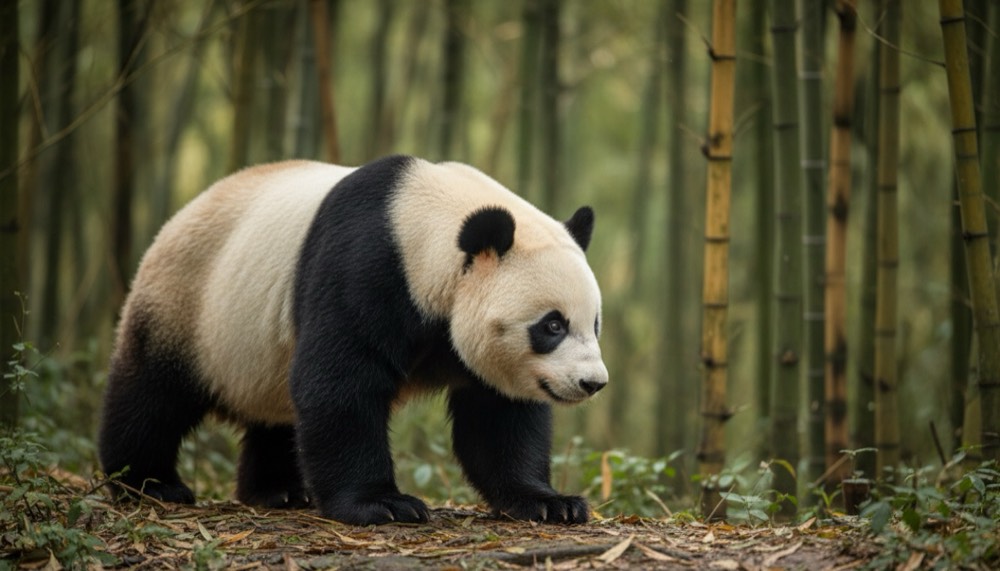
A giant panda is a real bear — but unlike most bears, it almost only eats bamboo. More than 99 out of 100 bites a panda takes are bamboo! Bamboo isn't very filling, so a panda eats for up to 16 hours a day — that's most of the whole day!
How does a panda hold onto slippery bamboo stalks? It has a special wrist bone that works like an extra thumb, so it can grip a stalk the way you hold a carrot stick.
Can you pretend to munch bamboo for one whole minute, like a panda does for most of its day?
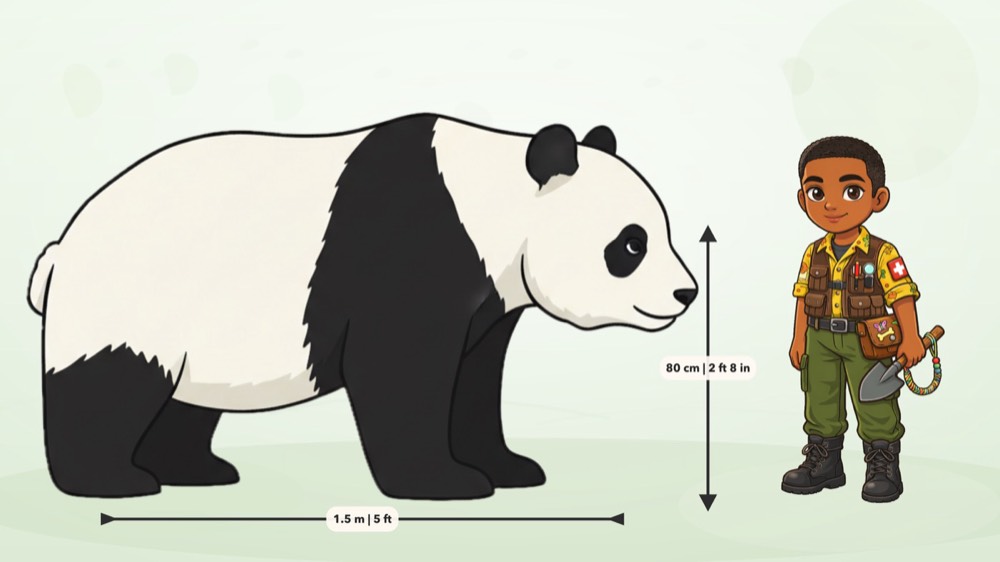
Standing on all fours, a grown-up panda's back comes up to about your chest — and nose to tail, it's longer than you are tall.
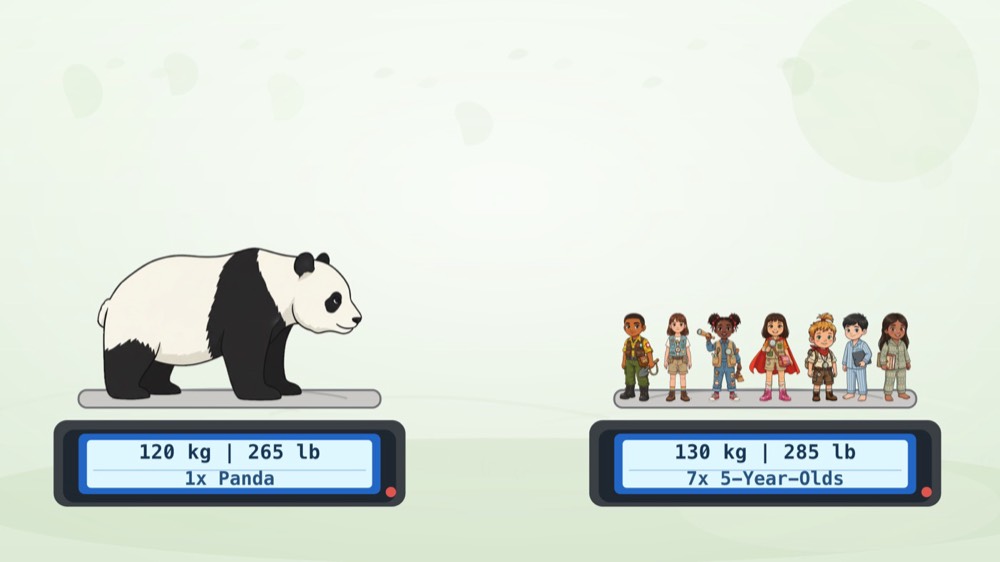
Can you picture seven five-year-olds all standing on one big scale together? That's about how much one grown-up panda weighs.
Because bamboo is hard to digest, a panda can poop up to 40 times a day! And even though pandas are real bears, they don't hibernate — they keep munching bamboo, even in the snow. Sometimes a panda mom has twins!
Pandas bleat a bit like a sheep, and sometimes honk. Can you try out your best panda honk?
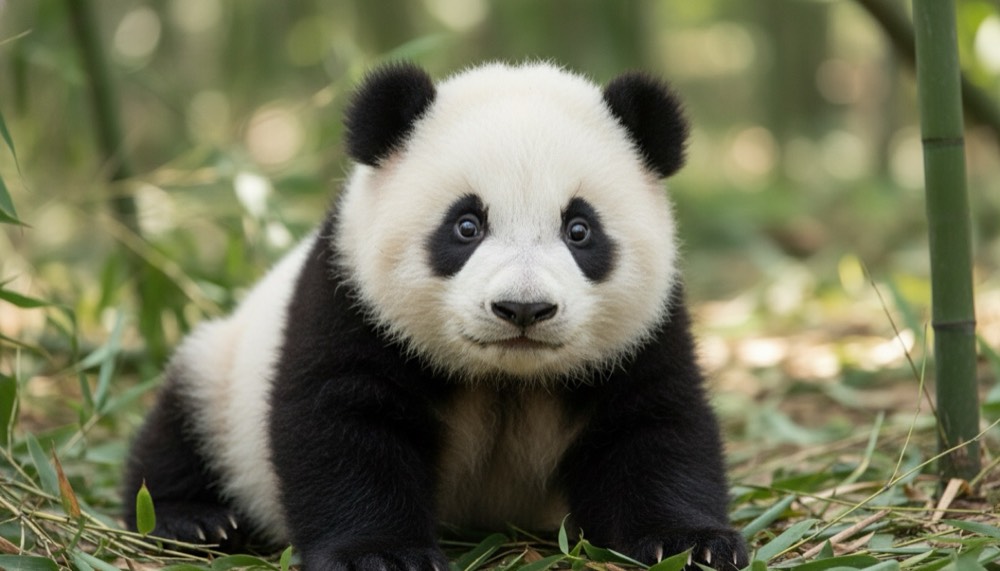
By the time a cub looks like this — fluffy, round, and full of fur — it's already grown a lot from the stick-of-butter size it was on the day it was born. It'll stay close to its mom for about a year and a half, learning to climb and find bamboo of its own.
Where to see a giant panda
In the wild, giant pandas live only in China, high in misty mountain forests full of bamboo — even people who live nearby almost never see one. For the rest of us, these zoos around the world have pandas you can visit.
North America
Bao Li and Qing Bao
Smithsonian's National Zoo — Washington, D.C.Bao Li comes from a long line of the Zoo's pandas — his mother, Bao Bao, was born there too.
Learn more →Yun Chuan and Xin Bao
San Diego Zoo — Denny Sanford Panda RidgeThe paths at Panda Ridge are planted to look like the misty mountain forests where wild pandas live.
Learn more →Ping Ping and Fu Shuang
Zoo Atlanta — Atlanta, GeorgiaPing Ping and Fu Shuang came from China in fall 2026 — the newest giant pandas in the United States. Check the zoo's site to make sure they're out on view before you go.
Visit Zoo Atlanta →Around the world
Xing Qiu and Yi Lan
Adelaide Zoo — Adelaide, AustraliaThe only giant pandas in the whole Southern Hemisphere live here, in a home called the Bamboo Forest.
Learn more →Leni and Lotti
Zoo Berlin — Berlin, GermanyLeni and Lotti are twins, born at the zoo in 2024 — together with their mom and dad, they're the only giant pandas in Germany.
Learn more →Lan Yun and He Feng
Tiergarten Schönbrunn — Vienna, AustriaOne of the world's oldest zoos is home to this pair, who have climbing frames and a splashy pool.
Visit Tiergarten Schönbrunn →Animals sometimes move — check the zoo's own website before you visit.
For grown-ups
Giant pandas are listed as Vulnerable (IUCN) — but here's the hopeful part: in 2016, the IUCN moved pandas from Endangered to Vulnerable, and China's own government followed in 2021. China's last national survey (2011–2014) counted 1,864 wild pandas, a 17% rise over the decade before, thanks to protected bamboo forests. In 2021, China opened the Giant Panda National Park, joining dozens of reserves into one connected space more than twice the size of Yellowstone, so separated panda groups can find each other again.
This week, try a Bamboo Count: sit down together and slowly crunch some celery or cucumber sticks for one minute, like a panda — a grown-up should watch, and little ones can use soft pieces. Then draw a map of a panda forest with a green path connecting two patches — that's what the new national park does for real pandas.
Starters: "If you had to eat the same food almost all day, what would you pick?" "What do you think it would feel like to have a wrist that works like a thumb?"
If your kid asks are pandas still in danger? — this holds up: "They're doing better than they used to — people protected the forests pandas need, and it worked. Pandas still need our help, but it's a good story so far."
Keep exploring
Wild Atlas has a whole page built around this animal — narrated facts, the full scale comparison against a 5-year-old, and more — in the Planet Pioneers pack.
Meet the panda in Wild Atlas →
For more, visit Smithsonian's National Zoo.
 Subscribe and the Farm Friends pack ($3.99) is free — yours to keep even if you unsubscribe.