Meet the parrot! People around the world celebrate it on World Parrot Day, May 31 — a day for appreciating one of the chattiest, most colorful birds we know.
- World Parrot Day · Monday, May 31 — Started by the World Parrot Trust with a London march and petition against the wild-caught parrot trade (early 2000s). Source
Read this one out loud together — it's even better with your best parrot squawk.
Some parrots can learn to copy human words!
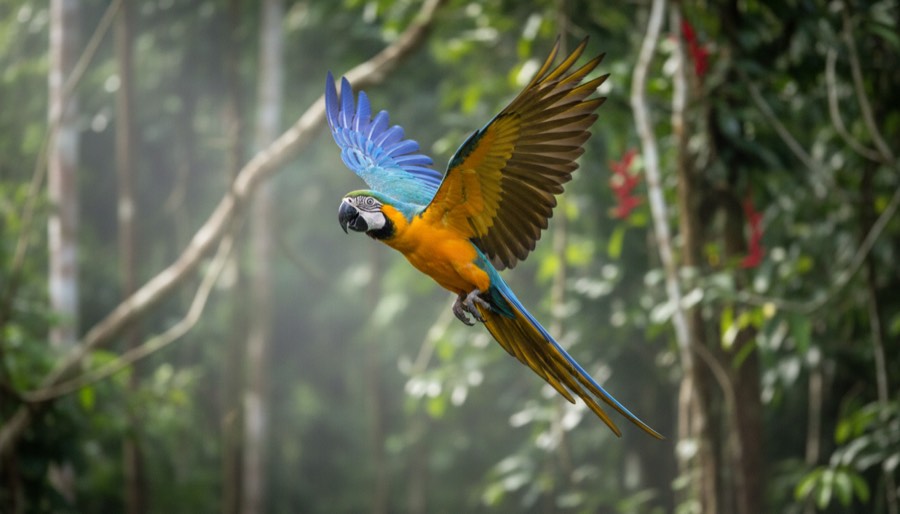
A parrot makes sounds with a special voice box called a syrinx, and it uses its clever tongue to shape them. That's how a parrot can say "hello" back to you. Some parrots can learn over 100 different words!
Parrots live in warm forests all around the world, from South America to Australia.
Look at that curved beak. It is strong enough to crack open hard nuts. And look at the feet! Many parrots hold their food in one foot, just like you might hold a cracker in your hand.
Can you hold a snack in just one hand and take a bite? That's a parrot trick!
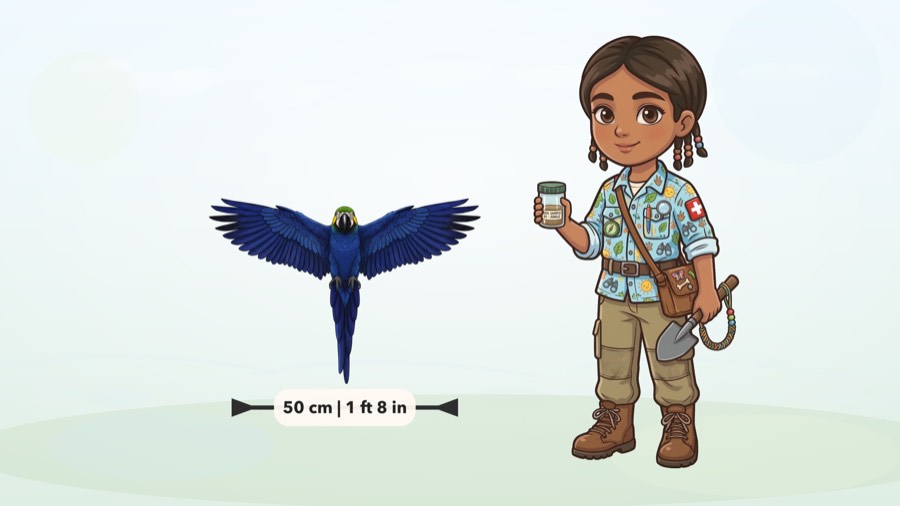
Parrots come in lots of sizes. A parrot like the one in the app is about 40 centimeters (16 inches) long (the big blue parrot in the picture is a larger kind, about 50 centimeters long), a little longer than a ruler. A 5-year-old is 109 centimeters (3 feet 7 inches) tall, so you are much taller. Many parrots are smaller, and some are bigger!
A parrot weighs about 1.5 kilograms (3 pounds). It would take about 13 parrots to weigh as much as one 5-year-old.
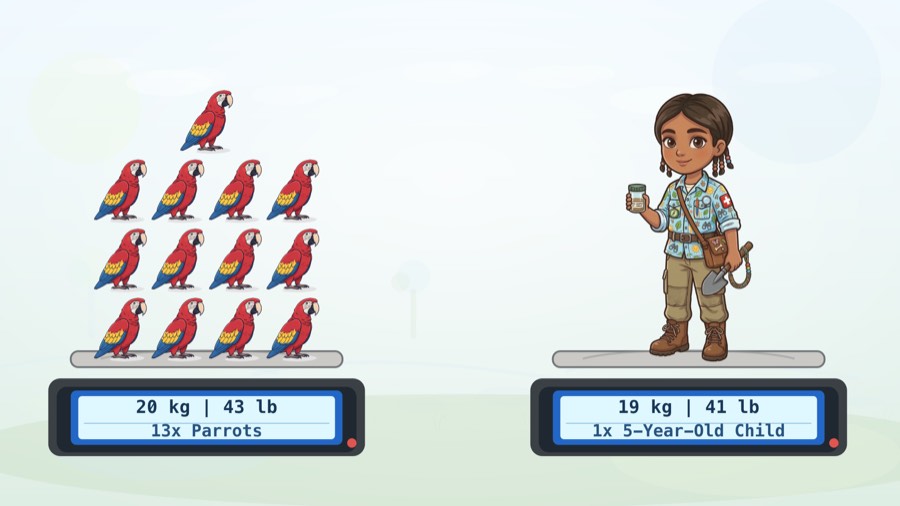
Can you picture 13 parrots on a scale? What a noisy scale that would be!
Some parrots live a very long time, too — some can live for many decades, even longer than a grandparent has been alive.
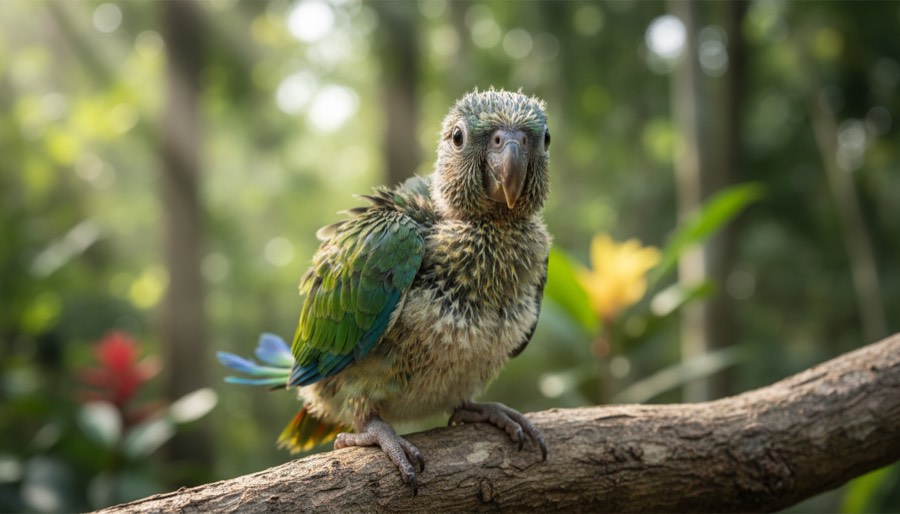
A baby parrot is called a chick. It hatches with hardly any feathers at all.
Wild parrots often sleep together in big groups called flocks. Many snooze side by side, and that helps keep them safe at night.
Some parrots even bob their heads when they hear music. Can you bob your head like a parrot? Can you make your best parrot squawk?
Where to see a parrot
In the wild, parrots live in warm forests in places like South America, Africa, Asia, and Australia, where they flap and squawk through the treetops. For the rest of us, these zoos and bird parks have parrots you can visit.
North America
Lorikeet Adventure
Denver Zoo — Denver, ColoradoLorikeets are small, bright parrots from Australia and the South Pacific, and they fly overhead in an open aviary.
Visit Denver Zoo →Lorikeet Landing
San Diego Zoo Safari Park — Escondido, CaliforniaVisitors can feed lories and lorikeets, colorful parrots that love sweet nectar.
Visit San Diego Zoo Safari Park →Lorikeet aviary
Birmingham Zoo — Birmingham, AlabamaFour kinds of lorikeets share an interactive aviary.
Visit Birmingham Zoo →Around the world
The world's biggest parrot collection
Loro Parque — Tenerife, SpainAround 350 kinds of parrots live in this park, whose name means "Parrot Park."
Visit Loro Parque →Lory Loft
Bird Paradise — SingaporeA rainbow of lories and lorikeets lives in this bird park's Lory Loft.
Visit Bird Paradise →Land of Parrots
Healesville Sanctuary — Victoria, AustraliaWalk through a big aviary with budgerigars, cockatoos, lorikeets, and more.
Visit Healesville Sanctuary →Birds sometimes move between zoos and exhibits change — check the zoo's own website before you visit.
For grown-ups
"Parrot" covers about 400 kinds of birds, and many are doing well, but roughly 1 in 4 to 1 in 3 species are threatened. The main reasons are losing forest homes and being taken from the wild for the pet trade. There's a hopeful story: the Spix's macaw, a blue parrot that had disappeared from the wild by the year 2000, was released back into the wild in Brazil from care programs in 2022. In October 2023, two chicks hatched in the wild to a pair that formed after release, the first wild-born Spix's chicks in decades. The work is ongoing, and the birds still need help, but it shows what patient teamwork can do.
Parrots need healthy forests and a free life in the treetops. This week, try a family bird-listening walk: stand still for two minutes and count how many different bird voices you can hear. Noticing birds is where caring about them starts.
Starters: "If you could learn to say one word in parrot, what would it be?" "What do you think a flock of parrots talks about?"
If your kid asks why are some parrots in trouble? — this holds up: "Some parrots are losing the forests where they live, and some have been taken from the wild. Lots of people are working to protect their homes and let wild parrots stay wild, so they can fly free with their families."
Keep exploring
Wild Atlas has a page built around this animal — narrated facts, the scale comparison against a 5-year-old, and the sounds a parrot makes. The parrot is in the Feathered Friends pack, which is a paid pack.
Meet the parrot in Wild Atlas →
For more, visit the World Parrot Trust.
 Subscribe and the Farm Friends pack ($3.99) is free — yours to keep even if you unsubscribe.