Happy Wild Koala Day! Every May 3, people everywhere celebrate one of Australia's best-known tree dwellers — the koala. A network of koala conservation groups started it back in 2016, and it's been celebrated every year since.
About this day: Wild Koala Day was started in 2016 by a network of Australian koala conservation groups, led by the Koala Clancy Foundation, to celebrate and protect wild koalas. Source
Read this one out loud together — it's short, and it's more fun with a big, sleepy yawn.
A brand-new koala baby is about the size of a jellybean — and it climbs into its mom's pouch all by itself!
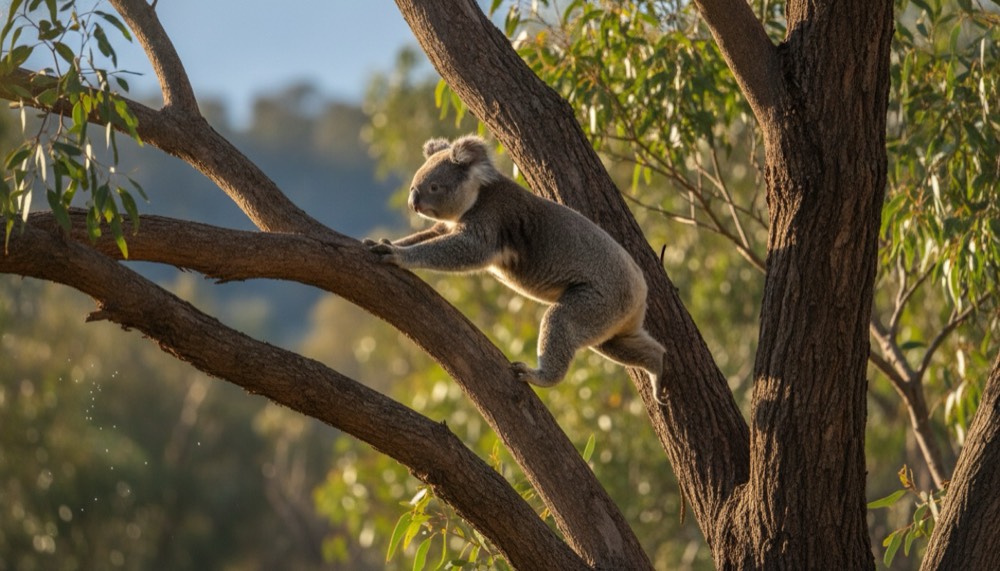
A koala isn't a bear at all. It's a marsupial — a pouch animal, just like a kangaroo — and its closest living relatives are actually wombats. Koalas live high in the eucalyptus, or gum, trees of eastern Australia, and nowhere else in the wild.
Koalas are picky eaters. They munch almost nothing but eucalyptus leaves, and each koala has a few favorite kinds out of hundreds. Those leaves don't give much energy, so a koala's tummy works slowly to break them down — which is why koalas rest or sleep for up to 18 to 20 hours a day!
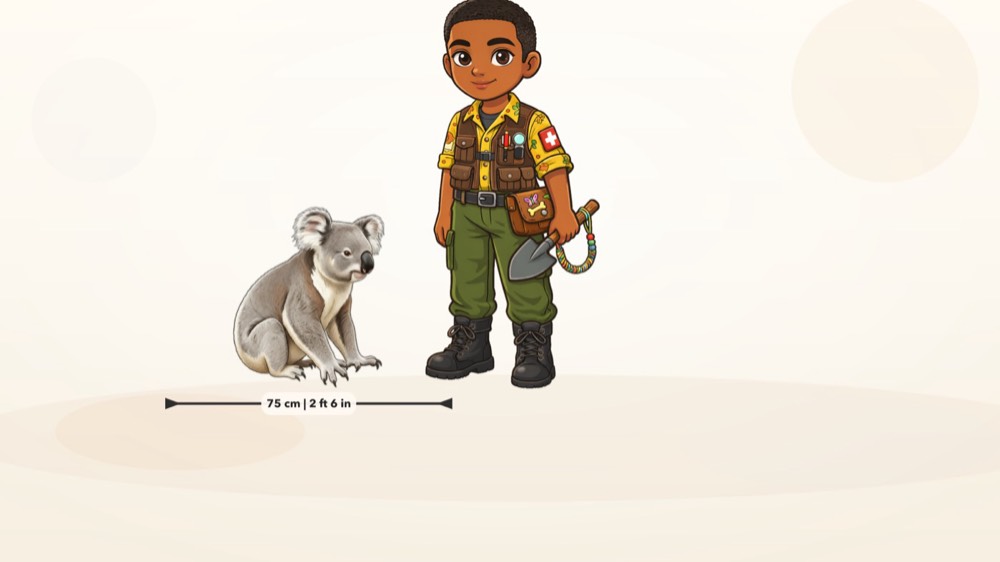
A grown-up koala is about 75 centimeters (2 feet 6 inches) long from nose to bottom — about two-thirds as long as a 5-year-old is tall.
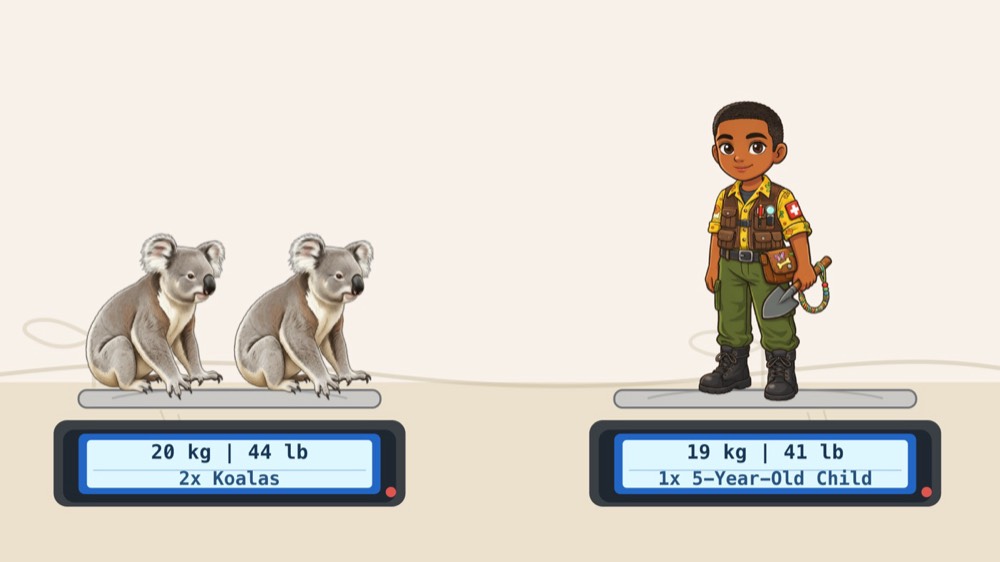
Picture two grown-up koalas together on one big scale. Together, the two koalas would weigh about 20 kilograms (44 pounds) — about as much as one 5-year-old.
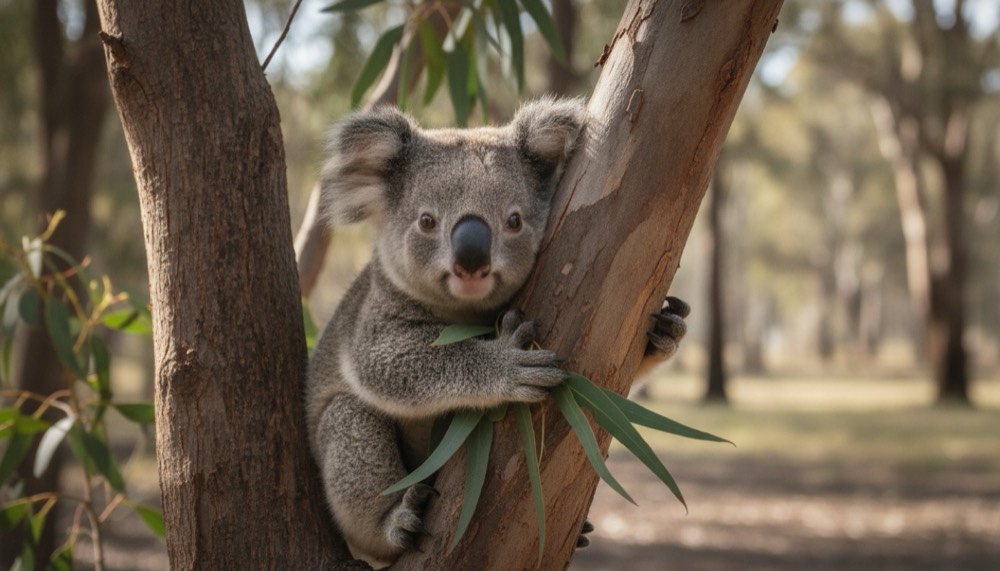
When a koala joey is born, it's about 2 centimeters long — smaller than your thumb — and weighs less than a gram. It can't see or hear yet, but it knows exactly where to go: straight into its mom's pouch, where it grows for months before it's ready to ride on her back.
Koalas hardly ever need a drink of water — their leaves are so full of water that they barely have to. And when a male koala wants to be heard, he can let out a huge, rumbly bellow, using a special extra part in its throat that lets a small animal sound enormous. Here's one more strange thing: koalas have fingerprints that look a lot like yours!
Can you curl up as small as you can and pretend to snooze in a tree for a whole minute, just like a koala? Can you make the deepest, rumbliest sound you can — as deep as a koala's bellow? Can you tiptoe like you're trying not to wake a sleeping koala?
Where to see a koala
In the wild, koalas live only in the eucalyptus forests of eastern Australia, high up in the branches — so even a lucky visitor usually just spots a grey shape napping in a tree fork. For the rest of us, a few zoos around the world care for koalas, and a special hospital in Australia helps koalas that are hurt or sick get back home to the trees. If you ever see a wild one, watch from the ground and let it snooze — never try to touch or feed it.
North America
The Outback treetop paths
San Diego Zoo — San Diego, CaliforniaSan Diego Zoo has cared for koalas since 1925 and runs the most successful koala breeding program outside Australia. Walk the treetop paths and peek into the area where koala moms and their joeys hang out.
Learn more →A Wild Koala Day party
ZooTampa at Lowry Park — Tampa, FloridaZooTampa's koalas live in its Australia area — and the zoo has held its own Wild Koala Day event, with activities about how koalas are built for life in the trees.
Learn more →Around the world
The koala breeding program
Taronga Zoo — Sydney, AustraliaTaronga leads the koala breeding program for zoos across Australia. Look for koalas snoozing in the Nura Diya Australia area.
Learn more →A real koala hospital
Koala Hospital — Port Macquarie, AustraliaThis is a real hospital for wild koalas! Vets and volunteers care for koalas that are sick or hurt, and send them home to the trees once they're better. Right now the hospital is being rebuilt, so it's working from Guulabaa – Place of Koala nearby — check their website before you visit.
Learn more →Animals sometimes move — check the zoo's own website before you visit.
For grown-ups
Koalas are listed as Vulnerable — and Endangered in Queensland, New South Wales and the ACT — because there aren't as many of them as there used to be in many places. The biggest reason is habitat loss, as the eucalyptus forests they depend on are cleared for towns, farms and roads — along with bushfires, cars, and a disease called chlamydia.
But here's the hopeful part: in September 2025, after more than ten years of research, scientists in Australia won approval for the world's first chlamydia vaccine for koalas. In one wild population that's now being vaccinated, infections have dropped by about 75%, and dozens of joeys have been born since.
This week, try planting a native tree with a grown-up, or help your class "adopt" a gum tree through a koala conservation group. Koalas need trees both for food and for homes.
Starters: "If you slept as much as a koala, what would you do with the few hours you're awake?" "Koalas are picky eaters who only like a few kinds of leaves — what's your 'only a few favorites' food?"
If your kid asks are koalas going to disappear? — this holds up: "There aren't as many as there used to be in many places, but people are working hard to help them, like a new medicine that's keeping wild koalas healthier."
Keep exploring
Wild Atlas has a whole page built around this animal — narrated facts, the full scale comparison against a 5-year-old, and more — in the Legends of the Wild pack.
Meet the koala in Wild Atlas →
For more, visit the Australian Museum.
 Subscribe and the Farm Friends pack ($3.99) is free — yours to keep even if you unsubscribe.