Happy World Octopus Day! It's on October 8 — the eighth day of the month, for an animal with eight arms. So today we're diving into the North Pacific to meet the biggest octopus we know of: the giant Pacific octopus.
About this day: World Octopus Day was started in 2007 by TONMO (The Octopus News Magazine Online), a community of octopus fans, who picked the 8th for an animal with eight arms. Source
Read this one out loud together — it's short, and it ends with real aquariums you can go visit.
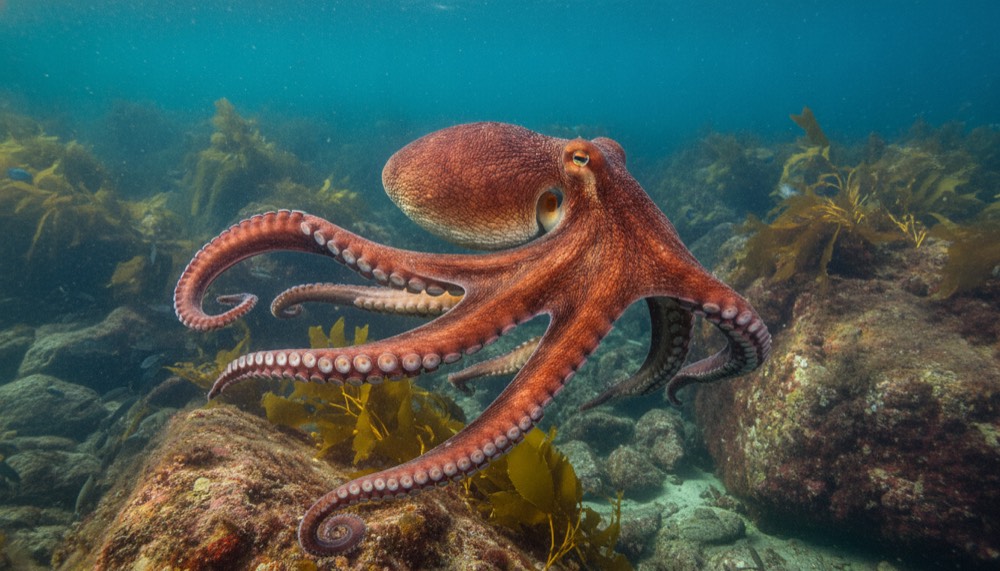
Meet the giant Pacific octopus. It lives in the cold, rocky part of the ocean — the North Pacific, all the way from Japan to Alaska to California.
It has three hearts. Two little ones, and one big one. Can you count to three hearts on your fingers?
Its blood is blue, not red like ours. That's because it carries oxygen with copper instead of iron, and that copper turns blue when it's carrying oxygen.
Here's the wildest part: it has one big brain, plus a mini-brain in every single arm. That's nine "brains" altogether — one big one in charge, and eight helpers, one per arm, that let each arm feel and move on its own. Can you wiggle eight fingers and pretend each one can feel things all by itself?
Every arm is covered in suckers, and every sucker can taste. It tastes rocks, shells and crabs just by touching them. Can you imagine tasting with your hands?
Watch this: in about one second, it can change from smooth and reddish-brown to bumpy and gray — like turning into a rock. Count "one!" as fast as you can. That's how fast it changes.
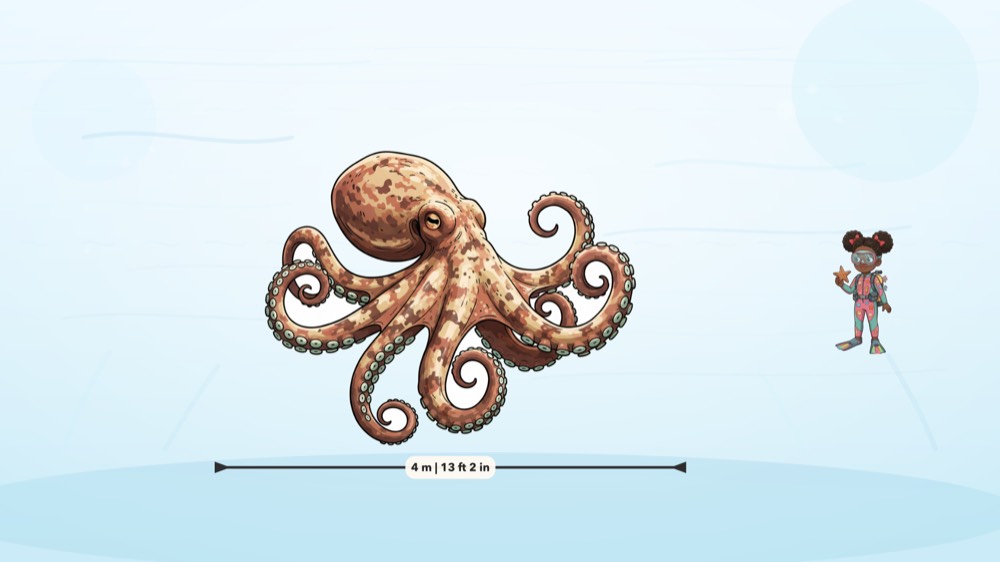
That's a lot of octopus. But it starts out tiny.
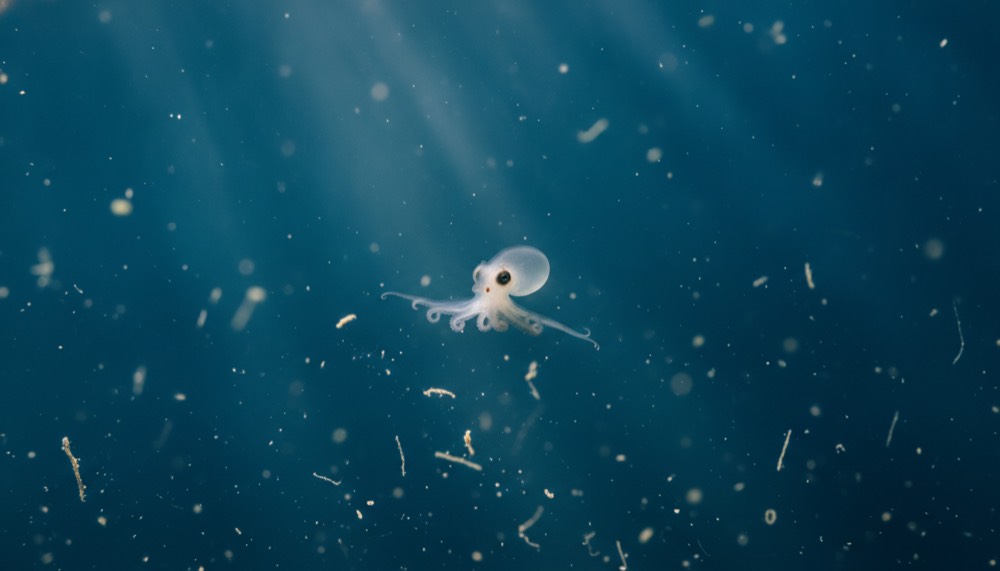
Can you find a grain of rice in your kitchen? That's how small it starts.
First it drifts in the open ocean like a tiny speck. Then it settles down on the seafloor and grows up in a den, tucked into a crack between rocks.
Look outside its den — those are leftover shells from crabs and clams it's eaten, stacked up like a front porch.
Three hearts. Blue blood. Nine "brains." One amazing octopus.
Where to see a giant Pacific octopus
In the wild, giant Pacific octopuses live only in the cold North Pacific Ocean, hiding in rocky dens — lucky divers sometimes spot one. For the rest of us, an aquarium is the best way to meet one.
North America
Monterey Bay Aquarium
Monterey, CaliforniaIt hatches from a rice-sized egg, and by day one, each arm already has about 14 suckers.
Learn more →Seattle Aquarium
Seattle, WashingtonA fully grown giant Pacific octopus can squeeze through a hole the size of a lemon.
Learn more →Vancouver Aquarium
Vancouver, British ColumbiaGiant Pacific octopuses are famous puzzle-solvers — scientists have watched them open jars and unscrew lids.
Learn more →Oregon Coast Aquarium
Newport, OregonIt has three hearts that pump blue blood — see it in the Rocky Coast exhibit.
Learn more →Point Defiance Zoo & Aquarium
Tacoma, WashingtonMeet Eve, the giant Pacific octopus in the Pacific Seas Aquarium's Octopus Garden — a rocky home built with crevices and caves for her to explore.
Learn more →Birch Aquarium at Scripps
La Jolla, CaliforniaEight arms, nine "brains," and up to about 2,240 suction cups — all on one octopus.
Learn more →Around the world
Den Blå Planet (National Aquarium Denmark)
Kastrup, DenmarkIt's one of the aquarium's "Big Five" — and yes, it can unscrew a jar lid.
Learn more →Aquamarine Fukushima
Iwaki, JapanBy day it hides in rocky crevices; by night it hunts shrimp and shellfish.
Learn more →Octopuses are shy and don't live long — some aquariums release theirs to the ocean after a while, so check the aquarium's website before you go, especially for the two farther afield.
For grown-ups
The giant Pacific octopus is Least Concern — not considered at risk. But nobody actually knows how many there are in the wild, so scientists keep watching. Divers who loved these octopuses spoke up after one was legally taken from a favorite Puget Sound dive site — 5,000+ signatures in five days — and the state voted to protect giant Pacific octopuses at seven dive sites there.
Try tonight: "Did you know an octopus has three hearts?" "What do you think it would be like to taste with your arms?" "If you had eight arms, what would you do with them?" "Why do you think an octopus changes color?" "What do you think the ocean needs to stay a good home for octopuses?"
"What happens to the mommy octopus?" A mother octopus lays tens of thousands of eggs and then guards them for about six months without ever leaving — she doesn't even go eat — until they hatch. Once her babies swim off into the ocean, her job is done, and she dies soon after. It's sad, but it's also how new octopuses get such a good start: their mom spent everything she had keeping them safe.
One hope action: at the beach or a tide pool, look and don't take. If you turn over a rock, put it back the way you found it. That's someone's home.
Keep exploring
Wild Atlas has an octopus, narrated, in the Ocean Creatures pack. It's an everyday-sized octopus, much smaller than the giant in this story, with its own three-hearts, nine-"brains" facts already built in.
Meet the octopus in Ocean Creatures →
For more, visit Monterey Bay Aquarium — Giant Pacific Octopus.
 Subscribe and the Farm Friends pack ($3.99) is free — yours to keep even if you unsubscribe.