Happy World Okapi Day! Every October 18, people celebrate one of the rainforest's best-kept secrets — the okapi.
About this day: World Okapi Day was created by the Okapi Conservation Project and first celebrated on October 18, 2016, to help protect okapis and their rainforest home. Source
Read this one out loud together — it's short, and it's part animal facts, part hide-and-seek game.
It looks like a zebra, but it's really the giraffe's secret cousin.
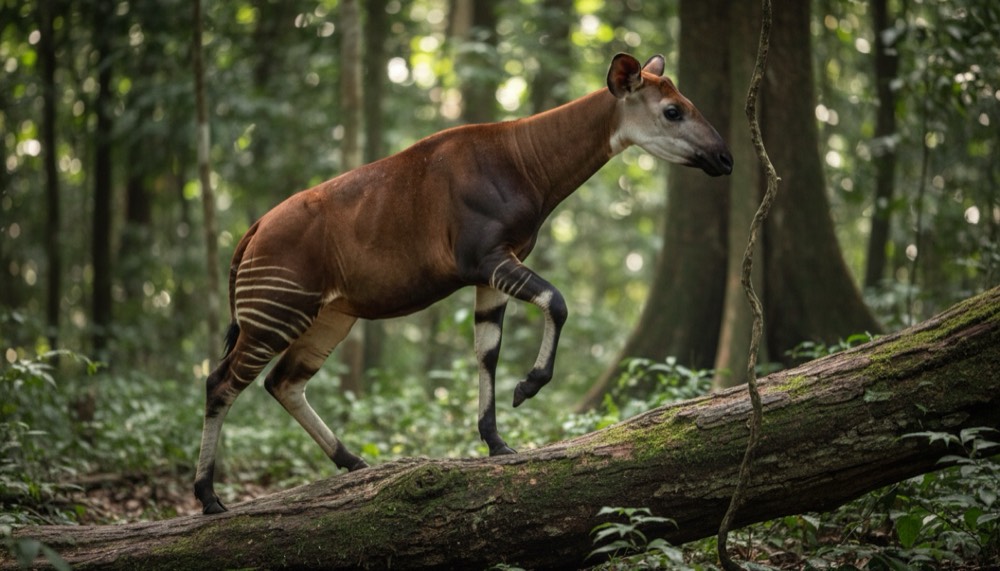
Meet the okapi. It has stripy legs like a zebra and a long neck like a giraffe — and the giraffe really is its only cousin in the whole world.
Okapis live in just one place on Earth: deep rainforest in the Democratic Republic of the Congo, in Africa. They're so good at hiding that scientists far away only learned about okapis a long time after — but people who lived in that forest had known them all along. It's less "undiscovered" and more the best game of hide-and-seek ever played.
Can you tiptoe across the room without a sound, like an okapi slipping through the leaves?
Here's a wow fact: an okapi's tongue is so long and so blue, it can lick its own eyes and ears clean!
Can you touch your tongue to your own nose?
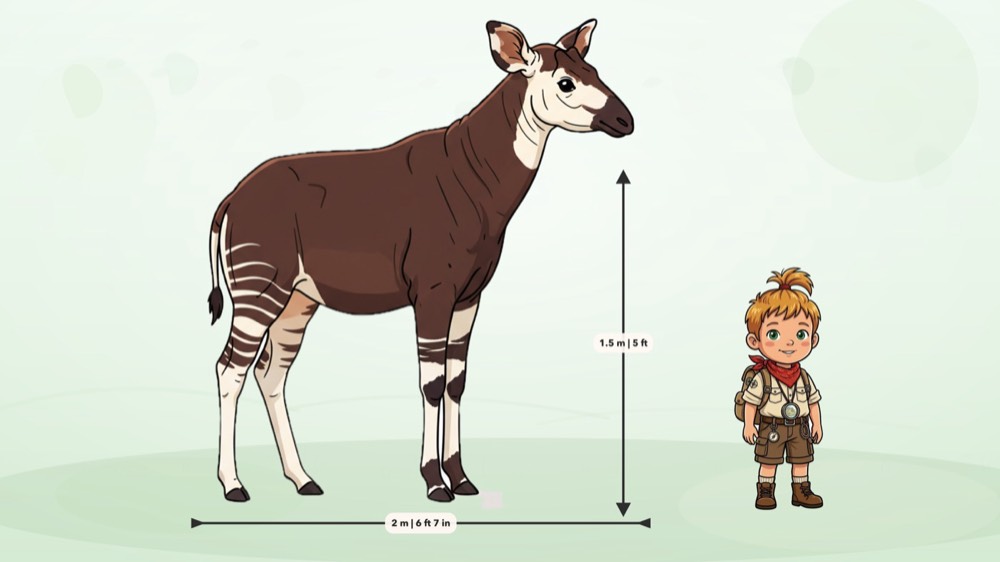
An okapi's back is taller than a 5-year-old — and its head, held high on that long neck, reaches even higher. Nose to tail, an okapi is about as long as two kids lying head to toe.
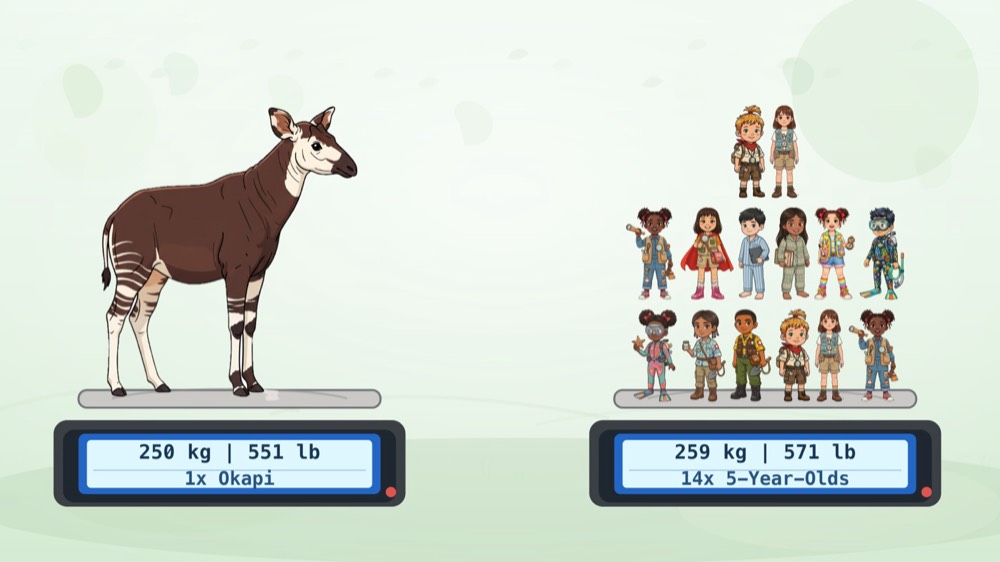
A grown-up okapi weighs about as much as 14 five-year-olds — all standing on one big scale together!
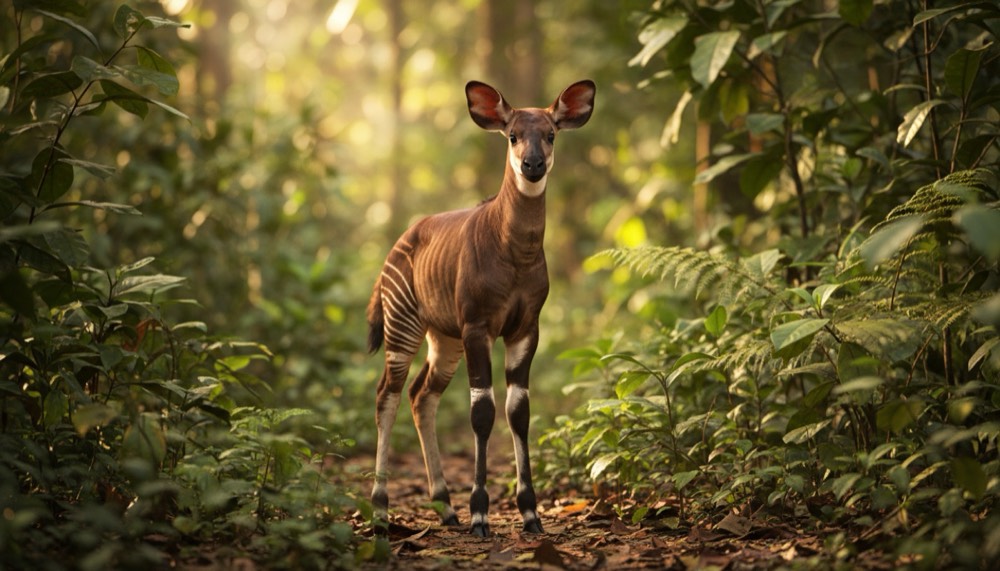
A newborn okapi calf weighs about as much as one five-year-old. It hides quietly in its own little nest in the forest, and its fur barely has a smell at first — a clever trick for staying hidden. And no two okapis have the same stripes. Each one is one of a kind, just like a fingerprint.
Can you find something striped or spotted at home that helps it blend in?
Where to see an okapi
In the wild, okapis live only in rainforest in the Democratic Republic of the Congo, and they're so shy that even the scientists who study them mostly see them on hidden cameras. For the rest of us, these zoos around the world have okapis you can visit.
North America
Subira and Kapu's calf
San Diego Zoo — San Diego, CaliforniaThis calf, born in September 2025, was the first okapi ever born out in the zoo's Lost Forest habitat instead of indoors — so visitors got to see her with her mom extra early.
Learn more →Sukari's calf
Houston Zoo — Houston, TexasSukari's calf, born in September 2025, made his public debut that November. The zoo's own page shares our favorite fact — an okapi's tongue is so long it can lick its own eyeballs!
Learn more →Kayin and Bosomi's calf
Oklahoma City Zoo — Oklahoma City, OklahomaBorn in August 2025, this calf was the zoo's eighth okapi baby since 1973, in Expedition Africa.
Learn more →Around the world
Zaïre and Ubundu's calf
ZOO Antwerpen — Antwerp, BelgiumAntwerp was the very first zoo anywhere to show okapis to the public, and it still keeps the official family tree for every zoo okapi on Earth. A calf born there in March 2026 had a surprisingly pink tongue — okapi tongues are usually grey at birth.
Learn more →Daphne's calf
Marwell Zoo — Hampshire, EnglandMarwell has had three okapi calves in three years. The newest, born to Daphne in September 2025, was announced on World Okapi Day.
Learn more →Quinta and Mambasa's calf
ZooParc de Beauval — Saint-Aignan, FranceBorn at Beauval in August 2026, this calf was standing within half an hour and drinking milk within an hour of being born.
Learn more →Lumara's calf
Dublin Zoo — Dublin, IrelandLumara's calf, a girl born in April 2025, was only the third okapi ever born in Ireland.
Learn more →Animals sometimes move between zoos — check the zoo's own website before you visit.
For grown-ups
Okapis are listed as Endangered. No one knows exactly how many are left in the wild, but their numbers have dropped by about half over the past few decades, mostly from illegal hunting, artisanal gold mining, and logging in their forest home.
There's a hopeful story too. For 13 years, there were no okapis to see at the Okapi Conservation and Education Center in Epulu, inside the Okapi Wildlife Reserve. In 2025, conservationists brought back a female named Tundana. In spring 2026, two males joined her — Pori, meaning "Forest," and Ekpangi, meaning "Thank You" — so Congolese families and schoolchildren can see their country's national animal again, right in its own forest. The Okapi Conservation Project says that in 2025 alone, its school programs reached more than 50,000 students, and it gave local farmers over 100,000 tree seedlings and plants so they can grow food without clearing more forest.
This week's hope action: draw an okapi with your own one-of-a-kind stripes, and share it with your family on World Okapi Day — tell them about the giraffe's secret cousin.
Starters: "If you had stripes to hide in a forest, what pattern would you pick?" "What do you think it would feel like to have a tongue long enough to lick your own ear?"
If your kid asks why didn't anyone find it for so long, if it's so big? — this holds up: "People who live in its forest always knew about the okapi. Scientists from far away took a long time to find it because its forest is thick and shadowy, its stripes work like camouflage, and it's quiet and shy."
Keep exploring
Wild Atlas has the okapi, narrated, in the Rainforest Explorers pack — the full scale comparison against a 5-year-old, its own fact cards, and that famous blue tongue.
Meet the okapi in Wild Atlas →
For more, visit the Okapi Conservation Project.
 Subscribe and the Farm Friends pack ($3.99) is free — yours to keep even if you unsubscribe.