Happy World Pangolin Day! Every year, on the third Saturday in February, people everywhere celebrate one of the shyest, scaliest animals on Earth — the pangolin.
About this day: World Pangolin Day was first held in 2012, started by the wildlife group Annamiticus, and falls on the third Saturday of February. Source
Read this one out loud together — it's short, and it's more fun with a tiptoeing voice.
A pangolin is covered in scales from head to tail, and they're made of the same stuff as your fingernails!
Every scale, stacked on top of the one before it like a pinecone, is made of keratin — the same material as your fingernails and hair. The pangolin is the only mammal in the world covered all over in scales.
The pangolin in Wild Atlas is a Chinese pangolin, one of eight kinds of pangolin. It lives in forests across Asia, from Nepal to China and Taiwan, tiptoeing out at night to sniff out ants and termites.
Here's a strange thing: a pangolin has no teeth at all. It scoops up ants with a long, sticky tongue — so long it's tucked away all the way down inside its chest! Then it swallows a few tiny stones, which help mash up its dinner in its tummy.
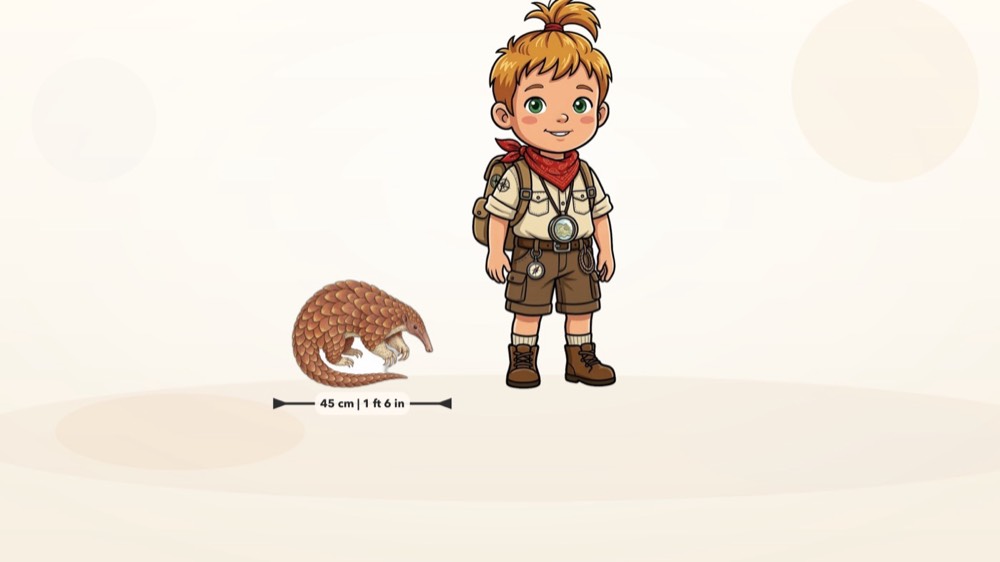
A grown-up Chinese pangolin's body is about 45 centimeters (1 foot 6 inches) long, nose to tail-start. That's much shorter than a 5-year-old is tall! Its long tail adds even more.
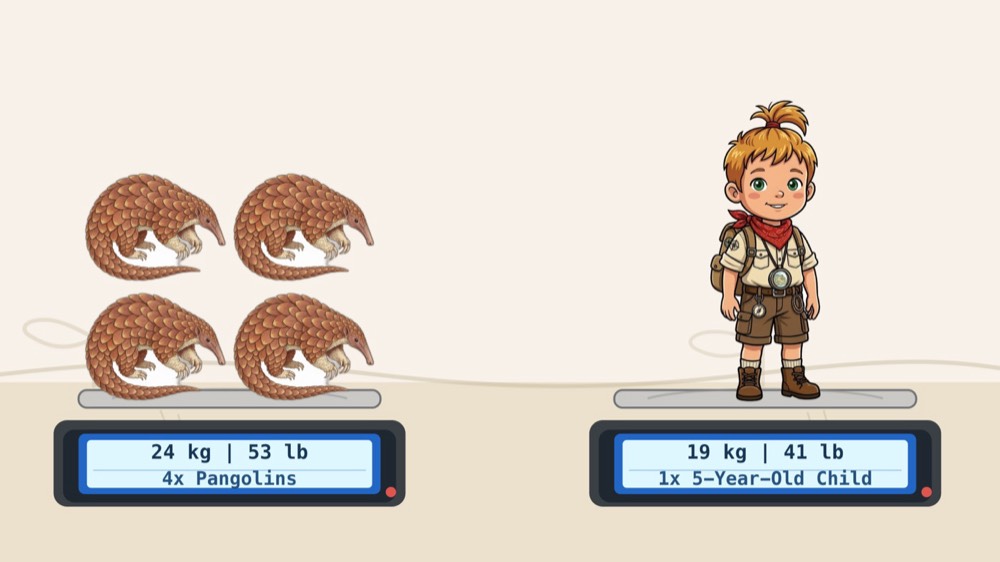
Can you picture four big pangolins on one scale? Together, they'd weigh about 24 kilograms (53 pounds) — a little more than one 5-year-old, at about 19 kilograms (41 pounds).
When a pangolin feels really scared, it often doesn't run away. It curls into a tight, tight ball, so only its tough scales show. Almost nothing can bite through a ball like that.
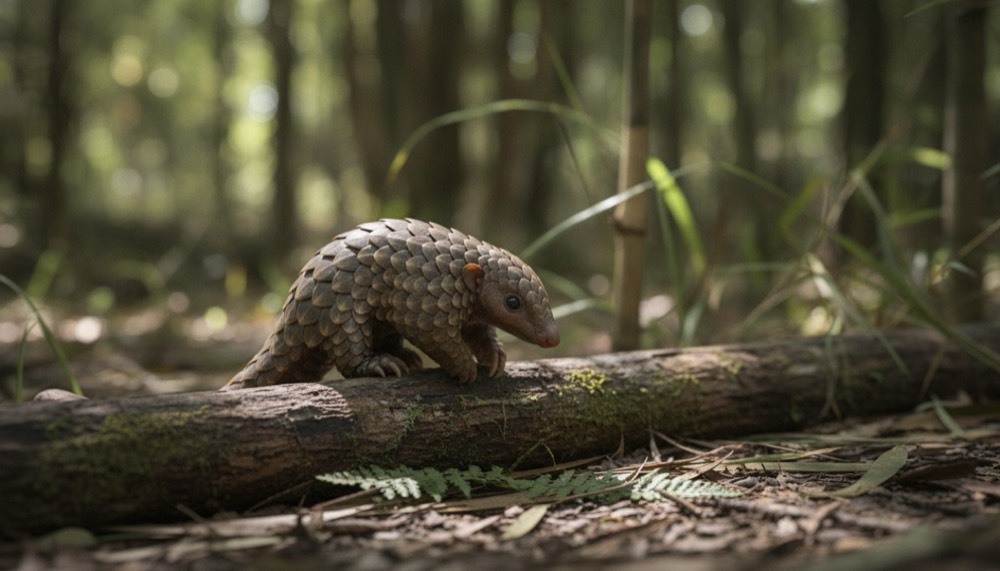
A mother pangolin usually has just one baby. Its scales start out soft and harden within a few days. The baby rides on its mom's back or tail, and when she curls up, she wraps it up safe inside.
Can you curl into the smallest, tightest ball you can, just like a pangolin? Can you tiptoe around the room like a shy, nighttime pangolin, sniffing for ants?
Where to see a pangolin
In the wild, Chinese pangolins live in forests across Asia and only come out at night, so even people who live nearby hardly ever see one. For the rest of us, only a handful of zoos anywhere care for pangolins, and they're often asleep in their burrows when you visit.
North America
Kara
Brookfield Zoo Chicago — Brookfield, IllinoisBrookfield cares for a family of African pangolins — a different species from the one in Wild Atlas. Kara is the one you might spot in Habitat Africa! The Forest. Behind the scenes, a pangolin named Rosy had a pangopup in February 2026.
Learn more →Around the world
The Formosan Animal Area
Taipei Zoo — Taipei, TaiwanTaipei Zoo is famous for caring for the same kind of pangolin as the one in Wild Atlas — the Chinese pangolin. You'll find them in the Formosan Animal Area.
Learn more →The first in Europe
Prague Zoo — Prague, CzechiaPrague Zoo's Chinese pangolins live in its Indonesian Jungle pavilion. In 2023, one was born there — the first pangolin baby ever born in a European zoo.
Learn more →Animals sometimes move — check the zoo's own website before you visit.
For grown-ups
Chinese pangolins are listed as Critically Endangered, which means they need a lot of help. For years, pangolins have been hunted and trafficked for their meat and for their scales, which some people wrongly believe work as medicine — they're just keratin, like your fingernails.
There's a hopeful story: in Vietnam, a team called Save Vietnam's Wildlife has rescued more than 1,800 pangolins, and helped more than 1,000 of them go home to the forest.
This week, try being a pangolin messenger: draw a pangolin (scales like a pinecone!) and tell one person one true fact about it. Most people have never even heard of a pangolin — telling one person won't fix everything pangolins face, but people protect the animals they know about, and now one more person will know.
Starters: "What do you think it would feel like to be covered in scales like a pinecone?" "A pangolin doesn't have any teeth — how do you think it eats?"
If your kid asks why do people hurt pangolins? — this holds up: "Some people think a pangolin's scales work like medicine, but that's not true — they're just like your fingernails. Lots of people are working hard to keep pangolins safe."
Keep exploring
Wild Atlas has a whole page built around this animal — narrated facts, the full scale comparison against a 5-year-old, and more — in the Legends of the Wild pack.
Meet the pangolin in Wild Atlas →
For more, visit the IUCN SSC Pangolin Specialist Group.
 Subscribe and the Farm Friends pack ($3.99) is free — yours to keep even if you unsubscribe.