Happy World Tapir Day! Every April 27, people celebrate all four kinds of tapir in the world — and the Malayan tapir is the only one that lives in Asia.
About this day: World Tapir Day was started in 2008 by conservationists to help more people know and protect tapirs, one of the world's least-known animals. Source
Read this one out loud together — it's short, and it's more fun with a snuffly tapir-nose voice.
Baby Malayan tapirs are born wearing watermelon stripes — then they slowly change into black-and-white grown-ups that some zookeepers call "Oreo tapirs."
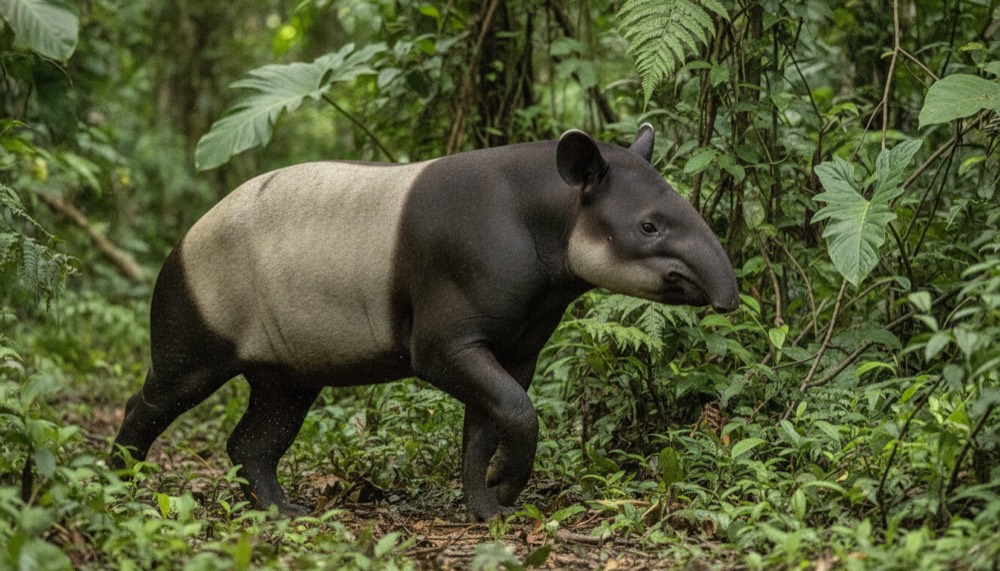
A tapir's nose and upper lip are joined together into one bendy little trunk. It uses this mini-trunk like a finger, to grab leaves right off the branch.
Can you guess a tapir's closest cousins? Not pigs, and not elephants — it's horses and rhinos!
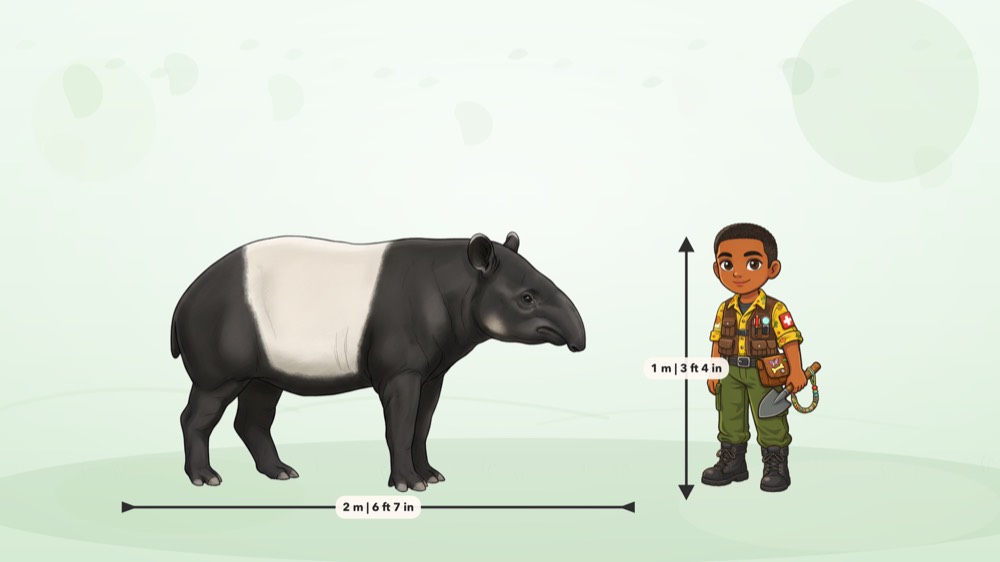
The Malayan tapir is the biggest of the four tapir kinds in the world, and the only one that lives in Asia. Standing on all fours, its back is about as tall as you are, and nose to tail it's nearly as long as two 5-year-olds lying head to toe.
A big Malayan tapir weighs about as much as 14 five-year-olds — all standing on one big scale together!
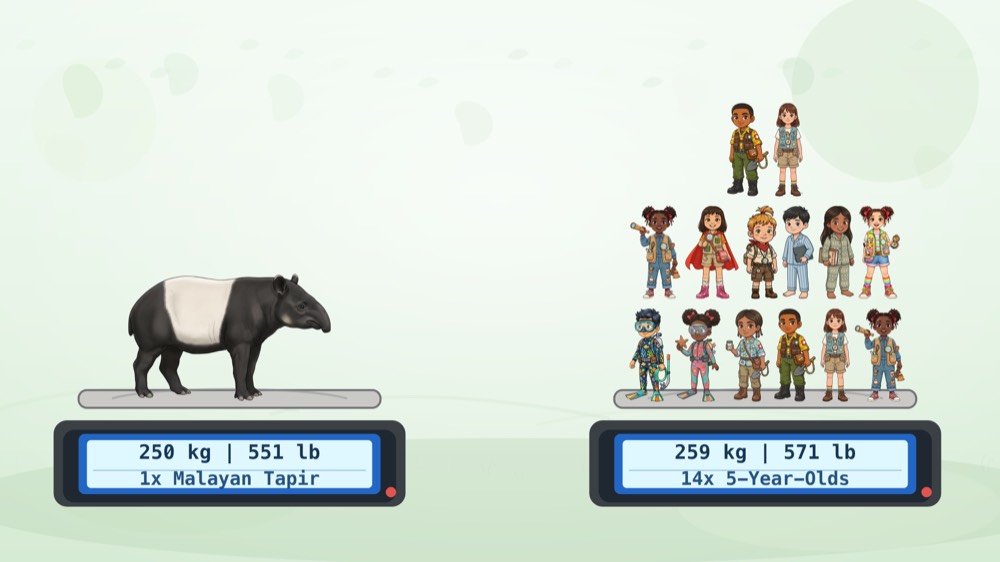
Can you picture 14 friends on one big scale?
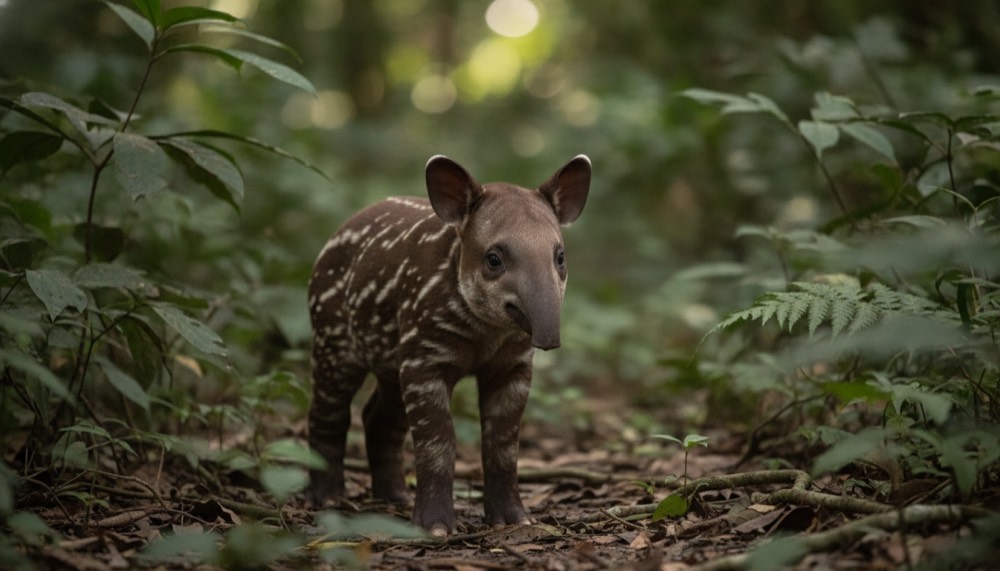
A tapir calf is born with brown fur and pale stripes and spots, like a watermelon rind. The pattern helps a baby hide in speckled forest light while it's too little to run fast. After a few months, the stripes fade and the black-and-white saddle pattern grows in.
Tapirs love water, too. They can sink right down and walk along the bottom of a river!
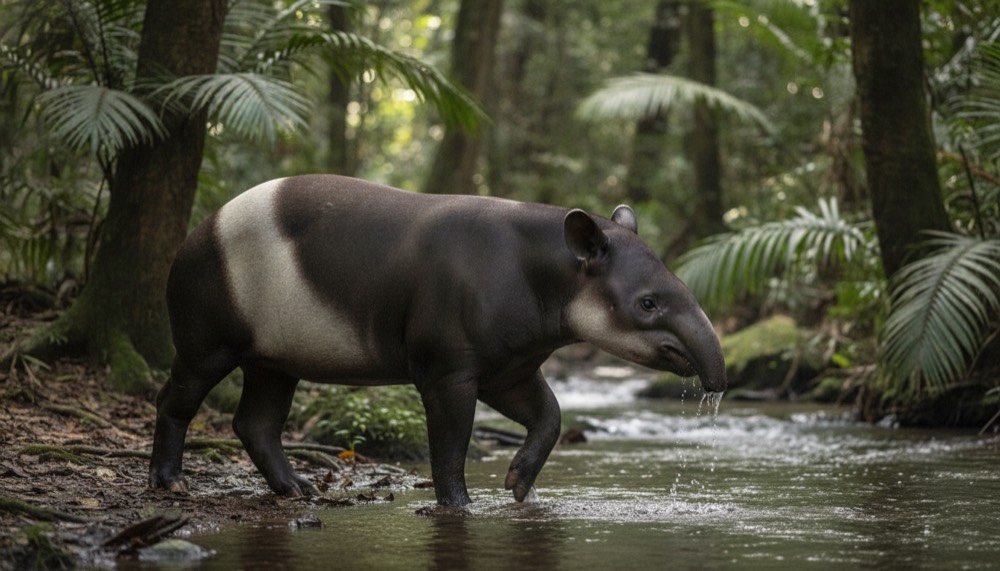
At night, a tapir zigzags through the rainforest, nibbling just a few leaves from each plant before moving to the next one. It finds its way mostly by smell and hearing, since its eyesight isn't very sharp. And when it wants to talk, it doesn't roar — it whistles!
Can you tiptoe quietly through the pretend leaves, the way a tapir sneaks through the forest at night?
Where to see a Malayan tapir
In the wild, Malayan tapirs live in rainforests in Malaysia, Thailand, Myanmar, and on the island of Sumatra. They're shy, mostly come out at night, and are very hard to spot — scientists usually find them with hidden cameras. For the rest of us, these zoos around the world have Malayan tapirs you can visit.
North America
Sempurna, Tanuck, and Nyawa
Wilder Institute/Calgary Zoo — Calgary, AlbertaIn August 2025 this zoo welcomed its very first Malayan tapir baby, a little watermelon-striped girl named Nyawa.
Learn more →Meet the tapir family
Minnesota Zoo — Apple Valley, MinnesotaFind the black-and-white tapir on the Tropics Trail. This zoo has helped 5 Malayan tapir babies be born since 2001.
Learn more →Meet the tapir family
San Diego Zoo — San Diego, CaliforniaLook for the black-and-white Malayan tapir in three spots along Tiger Trail, including a big pool for cooling off.
Learn more →Yuna and Baku
Point Defiance Zoo & Aquarium — Tacoma, WashingtonVisit this pair in the Asian Forest Sanctuary, where a tapir calf was born in 2025 — only the second in the zoo's 120-year history.
Learn more →Around the world
Meet the tapir family
Night Safari, Mandai Wildlife Reserve — SingaporeThis zoo is open after dark, which is perfect for a tapir that loves the night — and it's close to where wild Malayan tapirs live.
Learn more →Meet the tapir family
Diergaarde Blijdorp — Rotterdam, NetherlandsIt's the only place in the Netherlands to see a Malayan tapir, as part of a European breeding program.
Learn more →Meet the tapir family
Tiergarten Nürnberg — Nuremberg, GermanyIn German, the Malayan tapir is called a Schabrackentapir — the "saddle-blanket tapir."
Learn more →Animals sometimes move between zoos — check the zoo's own website before you visit.
For grown-ups
Malayan tapirs are listed as Endangered, and their numbers are still going down — fewer than 2,500 adults are thought to be left in the wild. The biggest threats are rainforests cleared for farming, roads that cut forests into pieces, and snares set to catch other animals.
There's a hopeful story too. In 2024 and 2025, three Malayan tapir calves were born at accredited zoos — Zoo Miami, Point Defiance Zoo & Aquarium, and the Wilder Institute/Calgary Zoo — all through a shared Species Survival Plan that pairs tapirs across zoos like one big family tree, to help keep the population strong.
Draw a tapir with your kid and hang it up to celebrate World Tapir Day. Grown-ups can also look for the RSPO label on products at the store, which is meant to help keep tapir forests standing.
Starters: "If you had a bendy trunk-nose like a tapir, what's the first thing you'd use it for?" "Tapir babies are born with watermelon stripes — why do you think that helps a baby hide?"
If your kid asks do tigers eat tapirs? — this holds up: "Sometimes, yes — tapirs and tigers share the same forest. But a tapir has excellent hearing and smell, and its best trick is slipping away quietly before a tiger even notices it's there."
Keep exploring
Wild Atlas has a whole page built around this animal — narrated facts, the full scale comparison against a 5-year-old, and a description of how tapirs squeak and whistle, in the Rainforest Explorers pack.
Meet the tapir in Wild Atlas →
For more, visit the IUCN SSC Tapir Specialist Group.
 Subscribe and the Farm Friends pack ($3.99) is free — yours to keep even if you unsubscribe.