 Free Farm Friends pack for newsletter subscribers →
When Wild Atlas launched, every animal carried its IUCN Red List conservation status. The Saola: Critically Endangered. The Snow Leopard: Vulnerable. The Chinchilla: Endangered. The Mallard: Least Concern.
This was not incidental. We made a deliberate choice not to hide the difficult ones, not to soften Critically Endangered into something that sounds less alarming, and not to skip the status for animals where it was uncomfortable.
Some parents, when they first encounter this, ask the same question: is this too heavy for young children? Is it appropriate to tell a five-year-old that a particular animal might disappear within their lifetime?
The research has a clear answer. And it is probably not the one you expect.
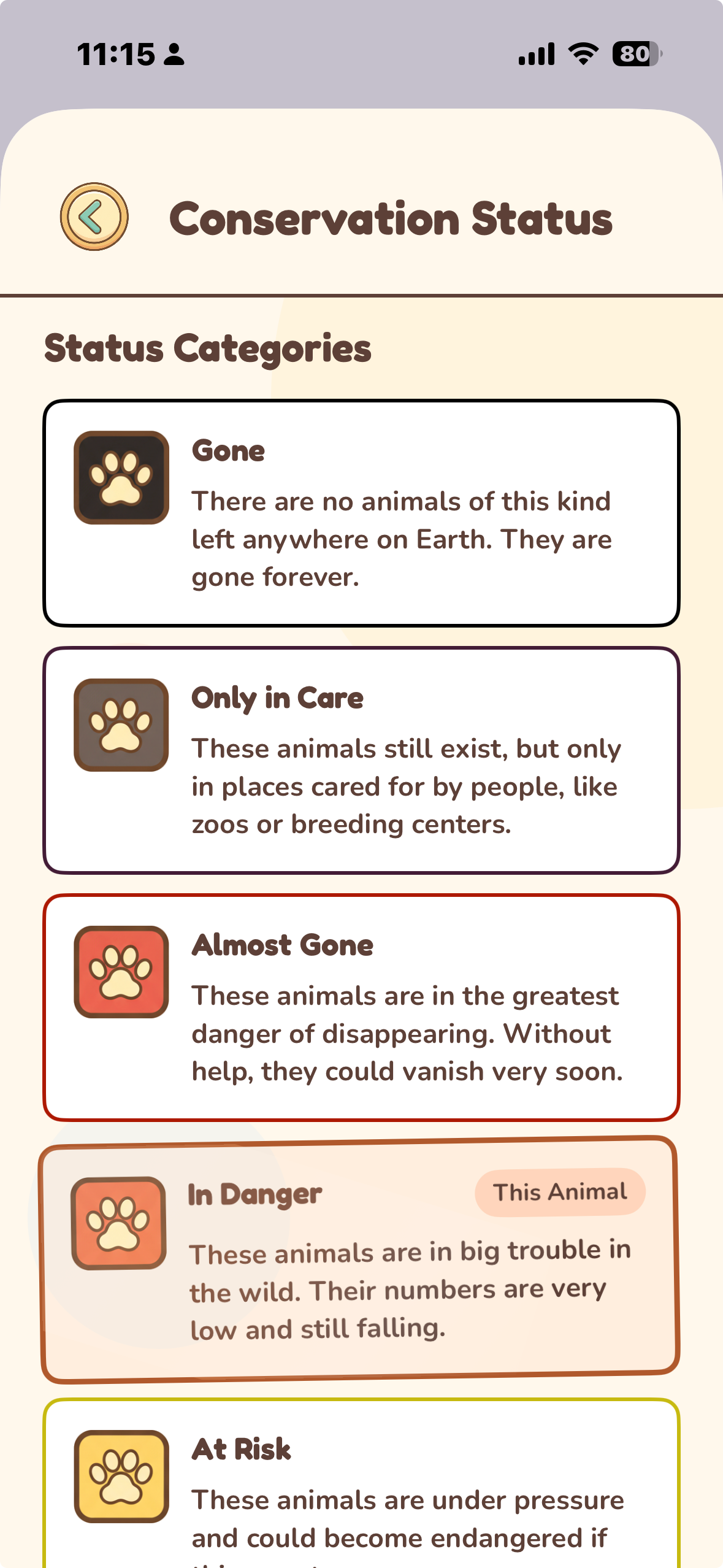
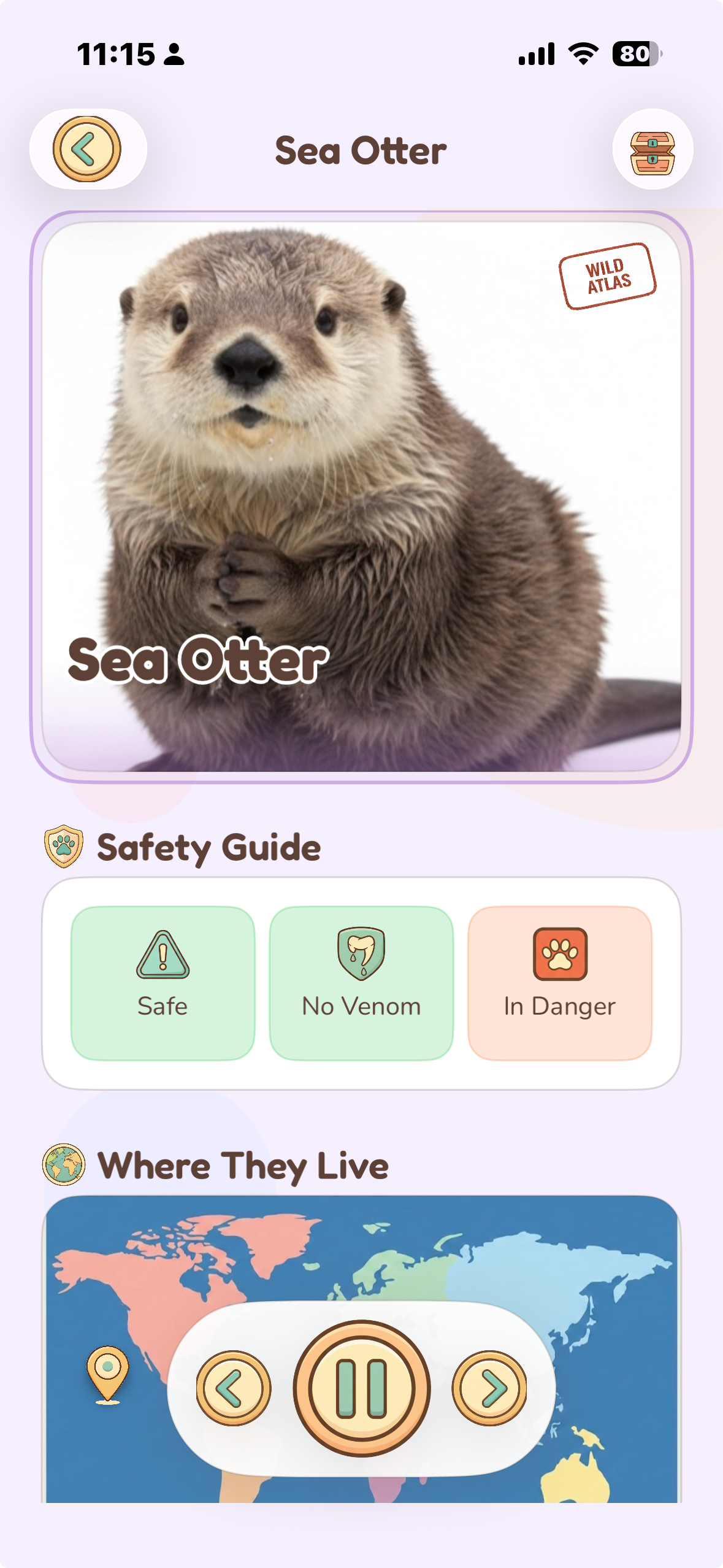
Tap the conservation status badge on any animal page and this guide opens — explaining every category in language a child can follow.
What children do with difficult information
The instinct to protect children from hard truths is understandable and, in most contexts, correct. But conservation status is a specific kind of information — it is factual, it is about the natural world, and it connects to something children at this age are already grappling with: the idea that things can be fragile.
A 2013 study by Ojala, published in Environment and Behavior, examined how children between 10 and 12 years old processed climate and environmental information. It found that children who were given accurate, specific environmental information — rather than vague or softened versions — showed higher engagement, stronger motivation to act, and better emotional regulation than children who received minimised or omitted information. The mechanism Ojala identified was that specificity gives children something to hold onto. Vagueness creates anxiety; fact creates a foothold.
Other research on children's emotional responses to nature (Kellert, 2002; Kahn & Kellert, 2002) consistently finds that children who are told the truth about environmental challenges — framed with agency and context, not just alarm — are more likely to develop what researchers call "environmental concern": a stable, positive orientation toward the natural world that persists into adulthood.
The key finding, across this literature, is that the problem is not the difficult information. The problem is difficult information with no context, no agency, and no way to respond. That is what creates the helplessness parents worry about.
How Wild Atlas frames it
Wild Atlas presents conservation status as one fact among many — the same way it presents size, weight, diet, and habitat. It is part of the animal's profile, not a warning or a campaign. The Saola is Critically Endangered. That is a true thing about the Saola, the same way it is a true thing that the Saola was first documented by scientists in 1992 and that fewer than a hundred are thought to exist.
This framing matters. The child is not being told "this animal is about to go extinct and it's very sad." They are being told: here is what scientists think about this species right now. Here is the word that describes its situation. Here is why.
The app doesn't assume children already know what these terms mean. Each status links to a brief, narrated explanation — so a child who hears "Critically Endangered" for the first time also hears what that means: that scientists believe the species faces a very high risk of extinction in the wild if nothing changes. The label and the meaning arrive together.
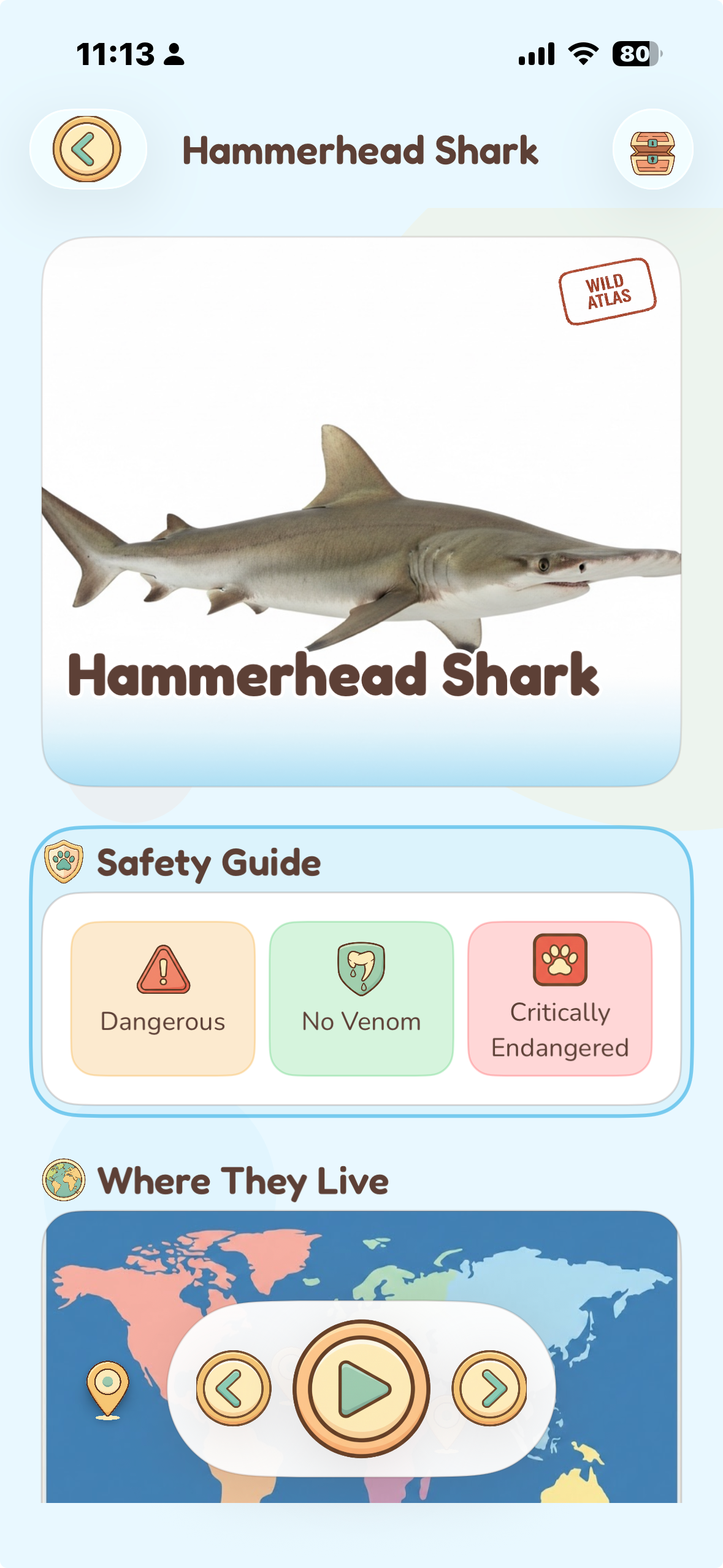
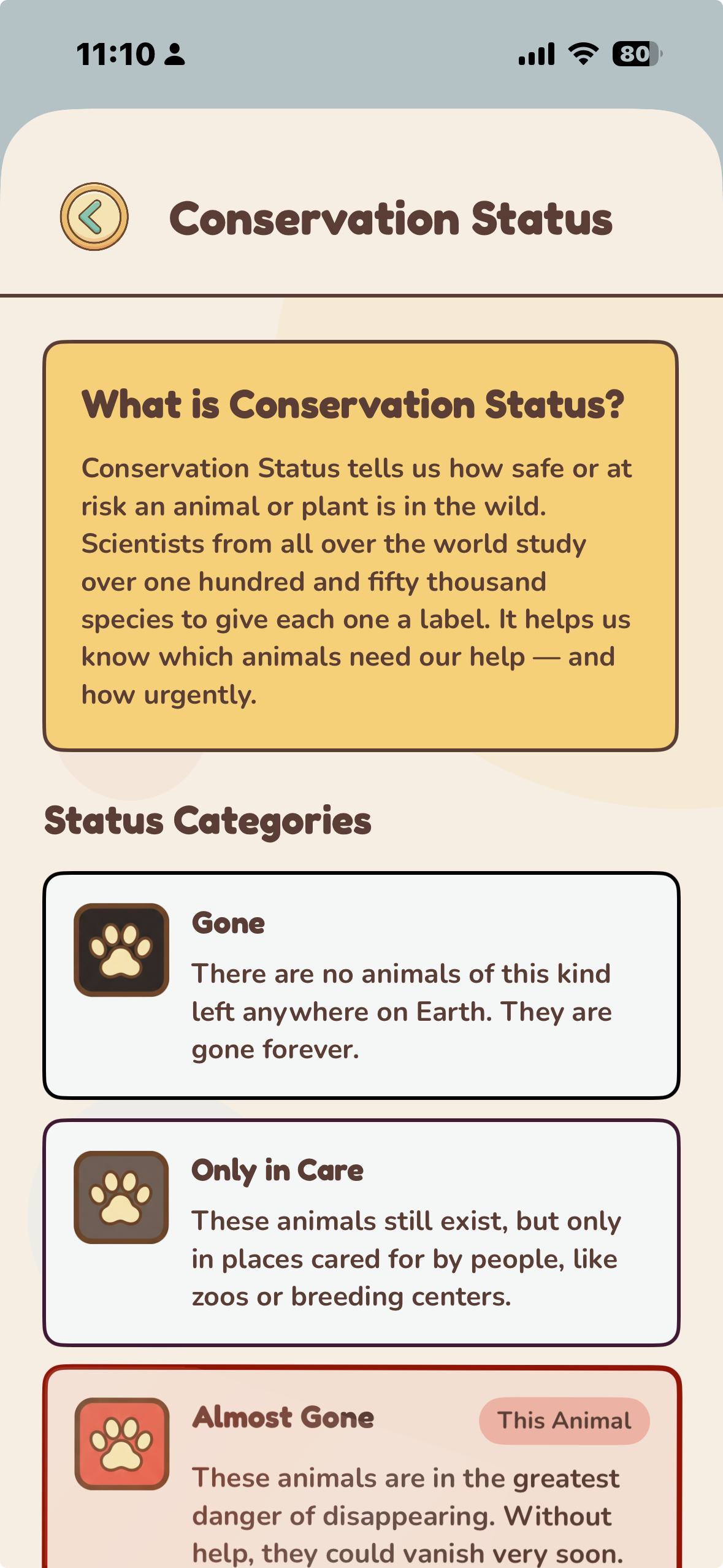
The Hammerhead Shark: Critically Endangered. Tap the badge and the app explains exactly what that means.
That distinction — between catastrophising and informing — is what the research on children's environmental learning consistently points to. Children who understand what Vulnerable means, and why a particular species is listed there, are processing real information. Children who are shielded from that information and then later discover it are more likely to feel deceived and more likely to feel helpless.
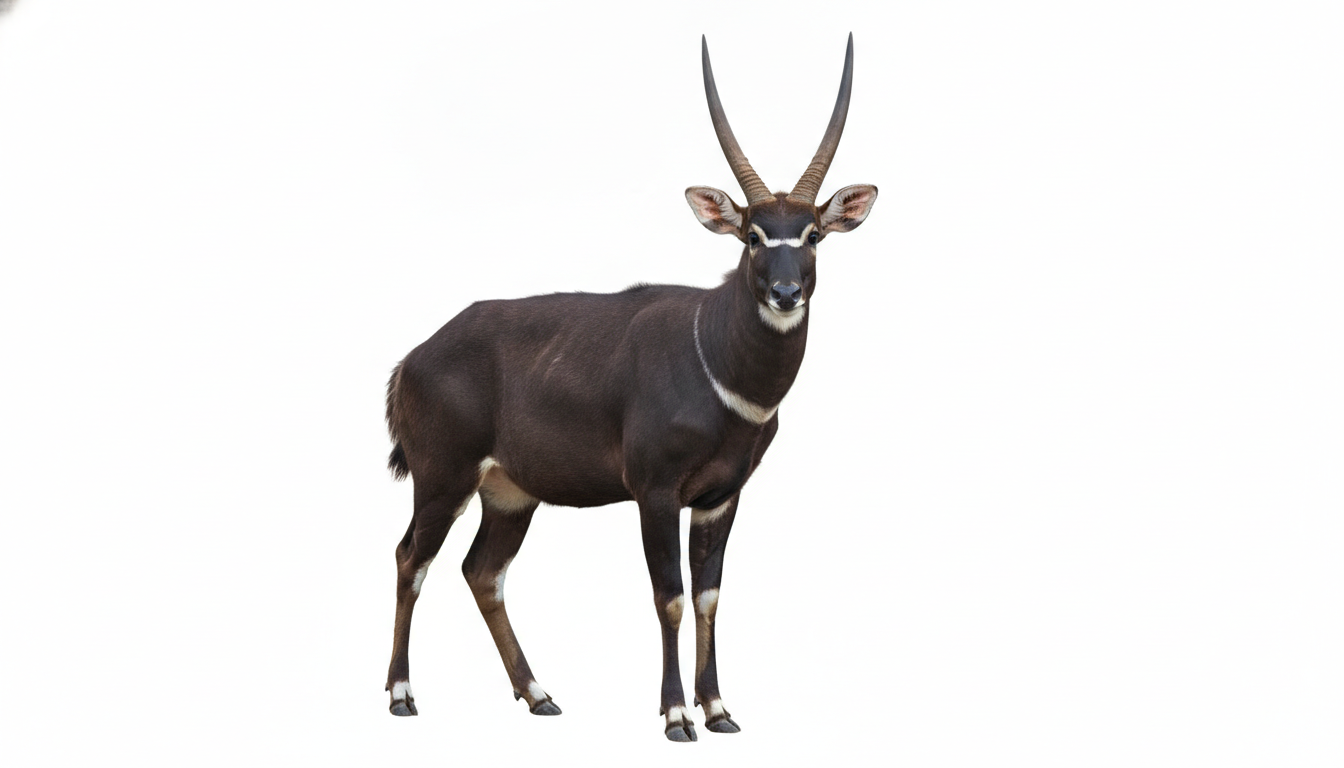
Legends of the Wild
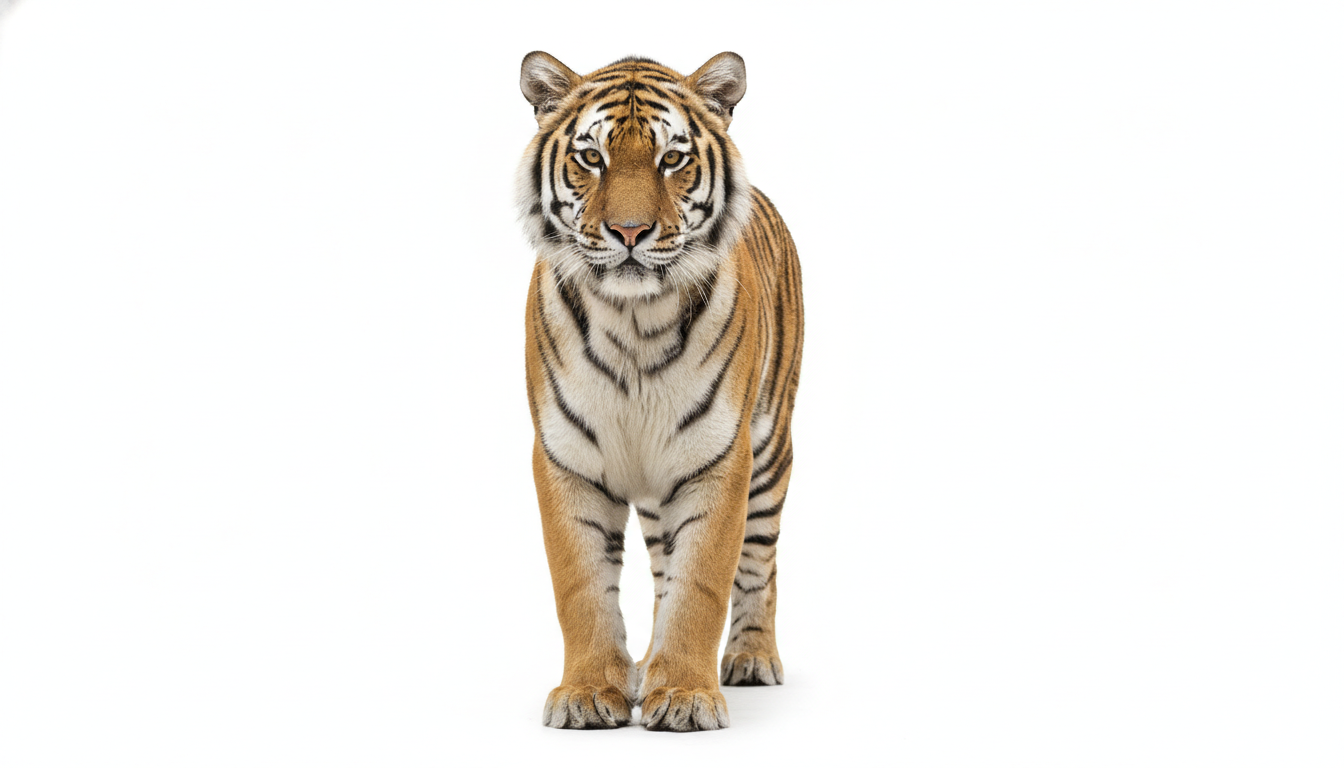
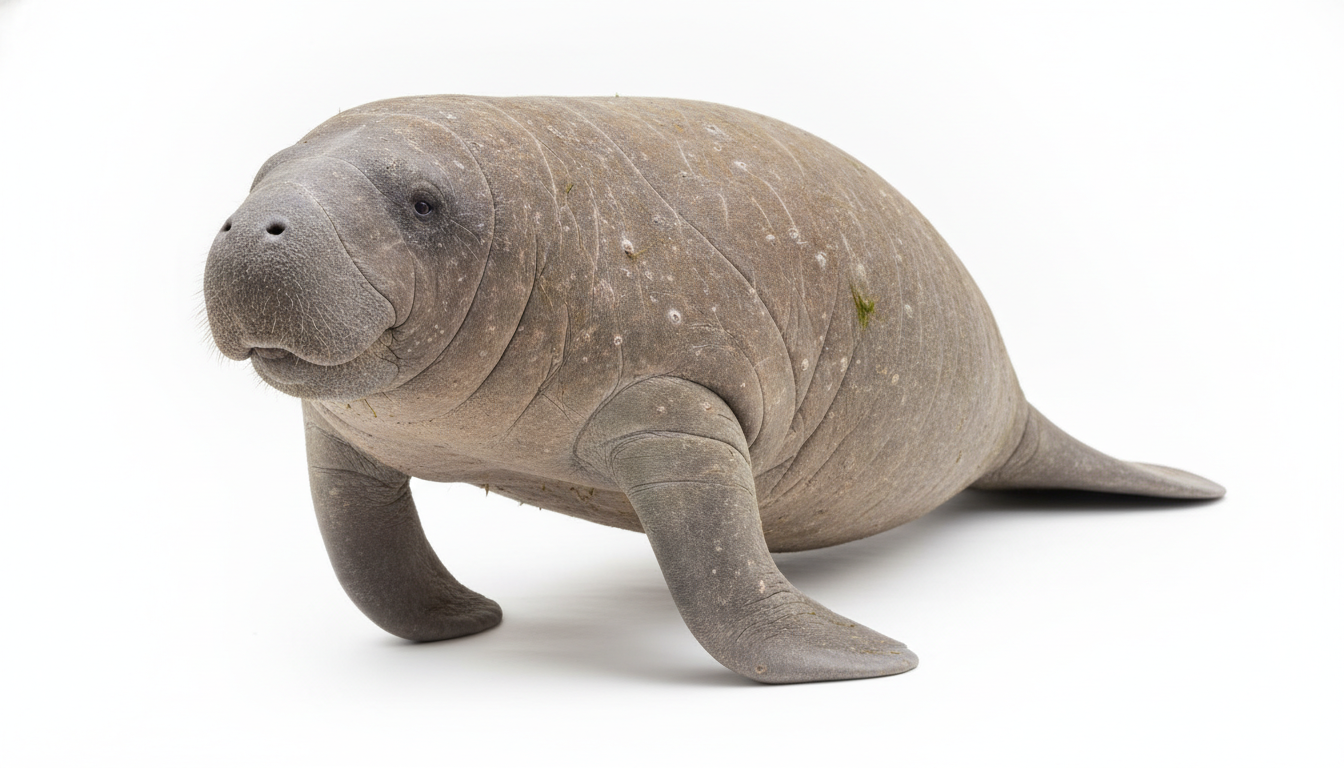
Wild Atlas's first premium animal pack — Legends of the Wild — brought 18 rare species into the app in July 2026. Of the 18, fourteen are listed as Vulnerable, Endangered, or Critically Endangered on the IUCN Red List. The Amur Tiger: Endangered, fewer than 500 in the wild. The Pangolin: various species range from Vulnerable to Critically Endangered; it is the world's most trafficked mammal. The West Indian Manatee: Vulnerable, recovering slowly after near-extinction in the 20th century.
The pack exists because these animals are remarkable — in their biology, their behaviour, and their rarity. The conservation status is part of that story, not a separate, heavier conversation layered on top.
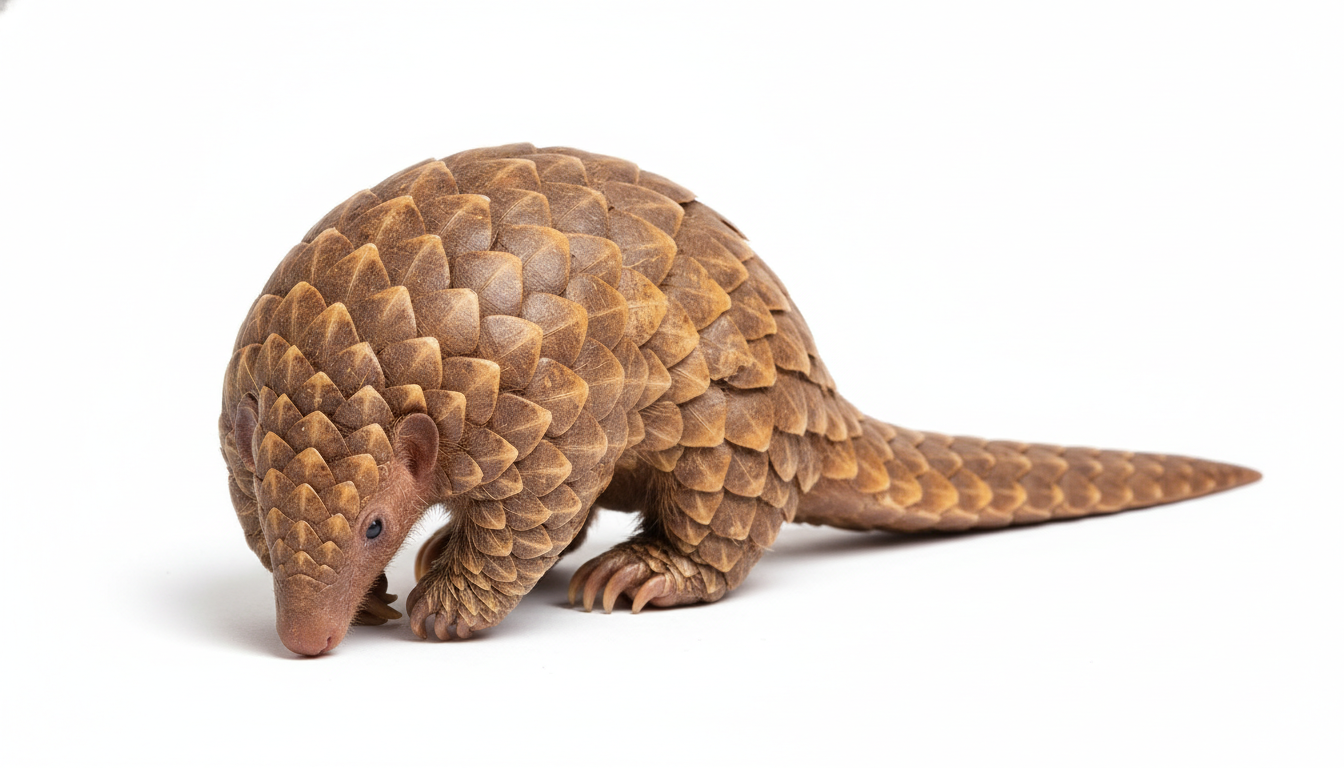
When a child learns that the Pangolin is Critically Endangered and also learns that its tongue is longer than its own body and is stored near its stomach — these facts sit together. The animal is extraordinary and it is at risk. A child old enough to understand the first fact is old enough to receive the second.
What parents can do with this
Wild Atlas does not script parental conversations. But parents who want to go deeper with their children after an animal page will find that the conservation status gives them somewhere to go. Questions like "what does Critically Endangered mean?" and "why is it endangered?" lead naturally into real conversations about habitat loss, wildlife trade, and what conservation actually looks like — including what ordinary people contribute to.
These are conversations that can be had lightly with a four-year-old and with more depth with a ten-year-old. The status is the same. The conversation grows with the child.
The alternative — presenting the natural world as universally fine and full and stable — might feel gentler in the moment. But it is not true, and children who later discover this often remember the gap between what they were told and what was real.
Wild Atlas was built to be honest about animals. The Saola is Critically Endangered. The Mallard is Least Concern. Both of those things are worth knowing — and so is the difference between them.
Wild Atlas is free on the App Store. Legends of the Wild — 18 rare species — is available for $3.99.
Sources: Ojala (2013), "Coping with Climate Change among Adolescents," Environment and Behavior; Kellert (2002), "Experiencing Nature," in Children and Nature; Kahn & Kellert (2002), Children and Nature: Psychological, Sociocultural and Evolutionary Investigations. IUCN Red List of Threatened Species.