 Free Farm Friends pack for newsletter subscribers →
Wild Atlas is fully navigable by a child who cannot read a single word — every fact, quiz question, safety guide, and answer is narrated aloud. Four packs are free to start (three animal packs plus a gift pack), and the parental gate means a grown-up is in the loop whenever the app hands off outside. You can hand Wild Atlas to a three-year-old and walk away.
Most children's apps designed for young kids still require a grown-up nearby. The text is too small, the menus assume reading, the quiz question appears on screen but nothing reads it aloud. The child taps something, nothing happens, and they hand the device back.
Wild Atlas was built to make that handback unnecessary.
Every fact in Wild Atlas is narrated. Every quiz question is read aloud. Every label, every guide, every piece of text that a child would need to engage with — the app reads it. A three-year-old who cannot identify a single letter can open Wild Atlas, tap an animal, and hear everything: the narrated fact, the safety description, the quiz question, the answer feedback. From start to finish, no reading required.
This was a design decision made early and held throughout. The question the team kept returning to was: could a child who cannot yet read use this independently? If the answer was no, something needed to change.
Why audio-first matters before five
Research on pre-reading development is consistent on one point: young children learn language through listening long before they can decode written text. A 2011 meta-analysis by Mol and Bus, published in Psychological Bulletin, found that shared book reading — primarily an oral experience for young children — significantly predicted emergent literacy and vocabulary growth. The mechanism is not the text on the page. It is hearing words used correctly, in context, repeatedly.
An app that requires reading to function excludes the age group that most benefits from the content. Most children are not decoding words reliably until five or six — and for a two-, three-, or four-year-old, audio is not a nice-to-have. It is the only path in.
What "fully narrated" actually means in practice
It is worth being specific, because "audio support" in children's apps often means something narrow — a play button next to a fact, or a voice that reads the animal's name. In Wild Atlas, the narration is structural.
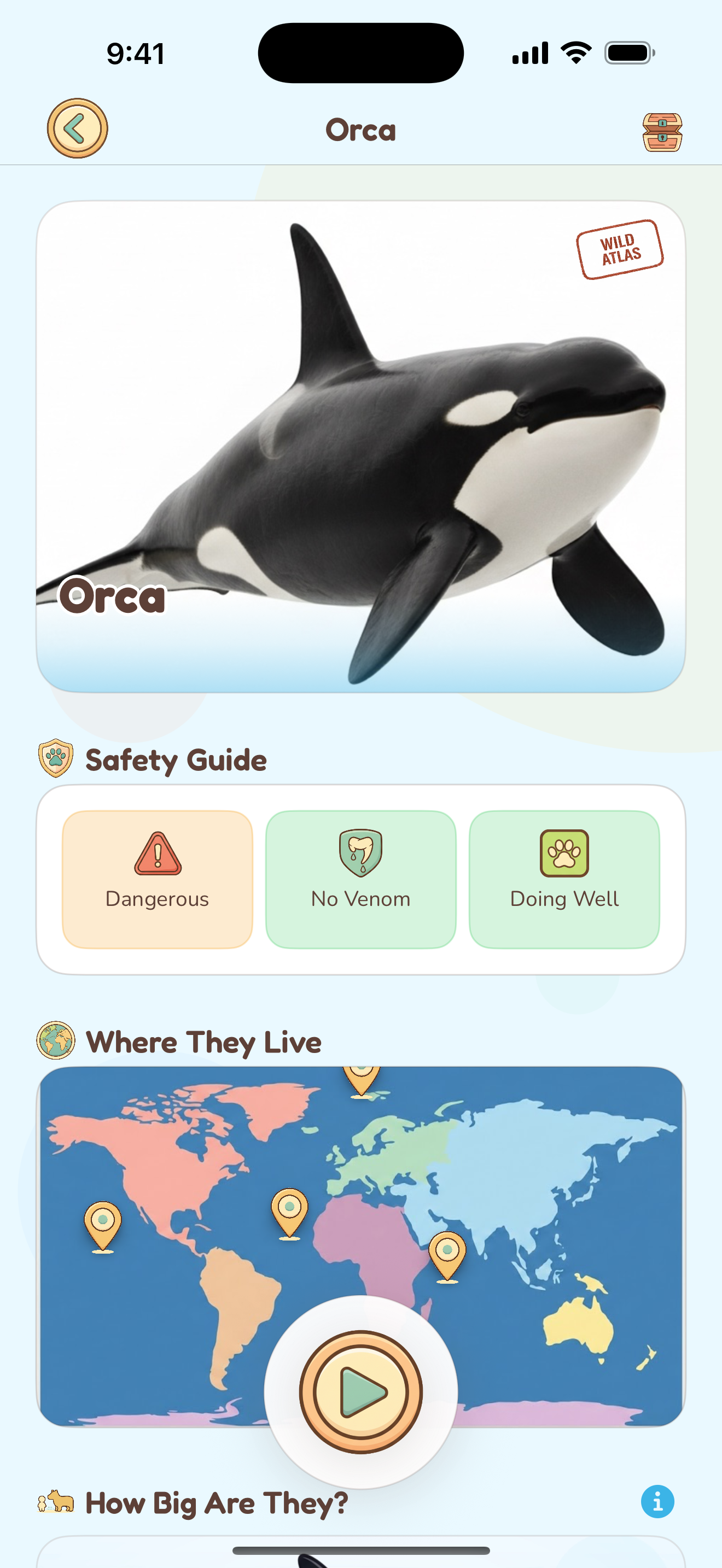
Animal facts. Every animal carries a set of narrated facts — the kind of thing a child asks: how big is it, what does it eat, where does it live. Tap the speaker or the fact itself, and the app reads it.
The Safety Guide. Each animal has a safety description — is it dangerous, is it venomous, what should you do if you encounter one. This section is fully narrated. A child who cannot read the word "venomous" can still hear the app explain what it means and whether this particular animal produces venom.
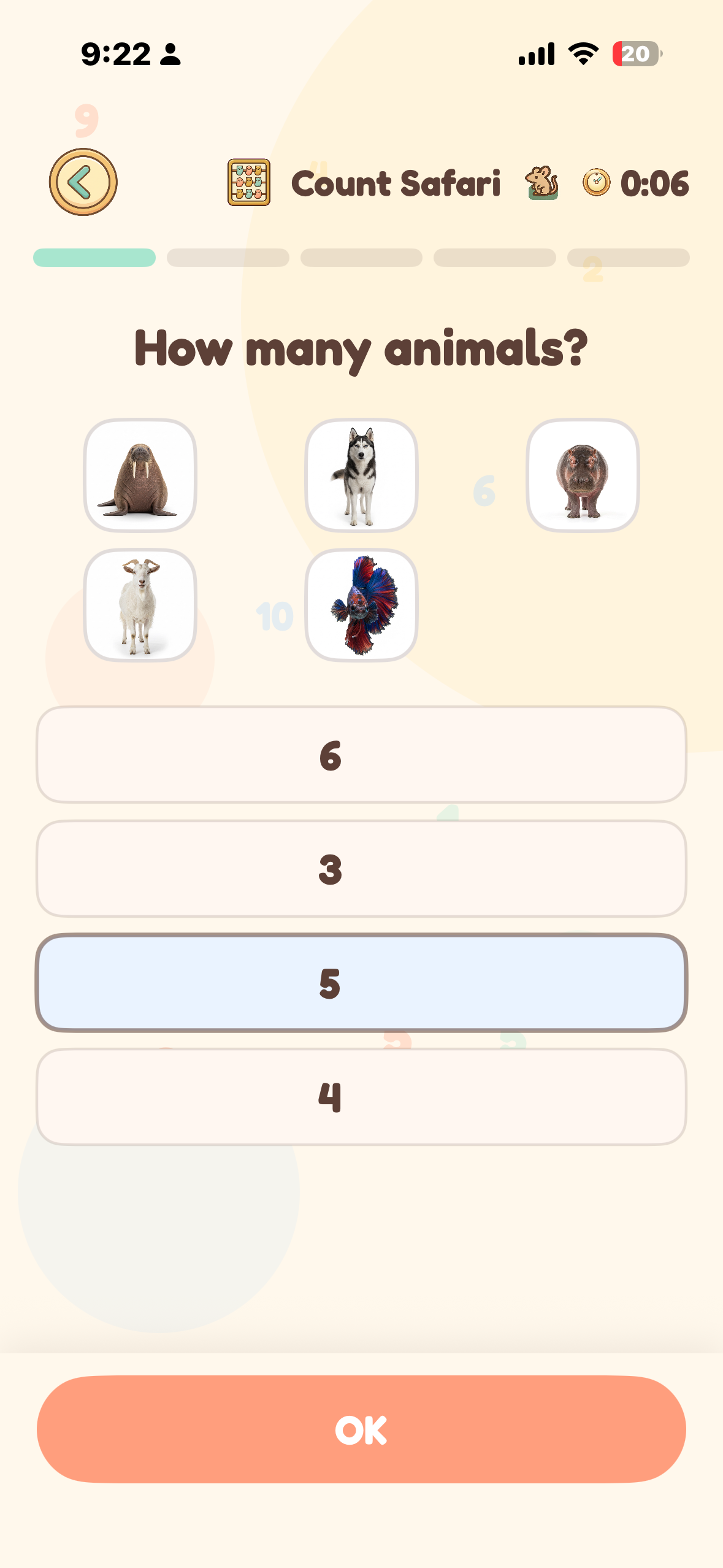
Quiz questions. When a child enters a quiz or game, the question is read aloud before they respond. They are not staring at text hoping to recognise a word. They hear the question, then tap.
Answer feedback. When a child gets something right or wrong, the app tells them — in words, not just a tone. The feedback is narrated.
The result is that a pre-reader can go from home screen to animal page to quiz and back again without needing anything decoded from text.
One thing parents notice quickly: the voice. Wild Atlas uses a warm, unhurried human narrator — not the high-energy, slightly frantic tone common in children's apps, and not a robotic text-to-speech voice. It sounds like someone who genuinely finds these animals interesting and wants to share that. For a child sitting quietly with a device, that matters. The voice invites curiosity rather than demanding attention.
Independence, not isolation
There is a meaningful difference between an app that keeps a child occupied and an app a child can use independently. Occupation is passive — content plays, the child watches. Independence is active — the child makes choices, follows curiosity, encounters something unexpected, and navigates what comes next on their own terms.
Wild Atlas is designed for independence. The home screen shows animals, clearly organised. Tapping one opens a world of information — and everything in that world speaks. A child who has discovered that octopuses have three hearts can navigate to another animal entirely, on their own impulse, without asking a grown-up to read anything.
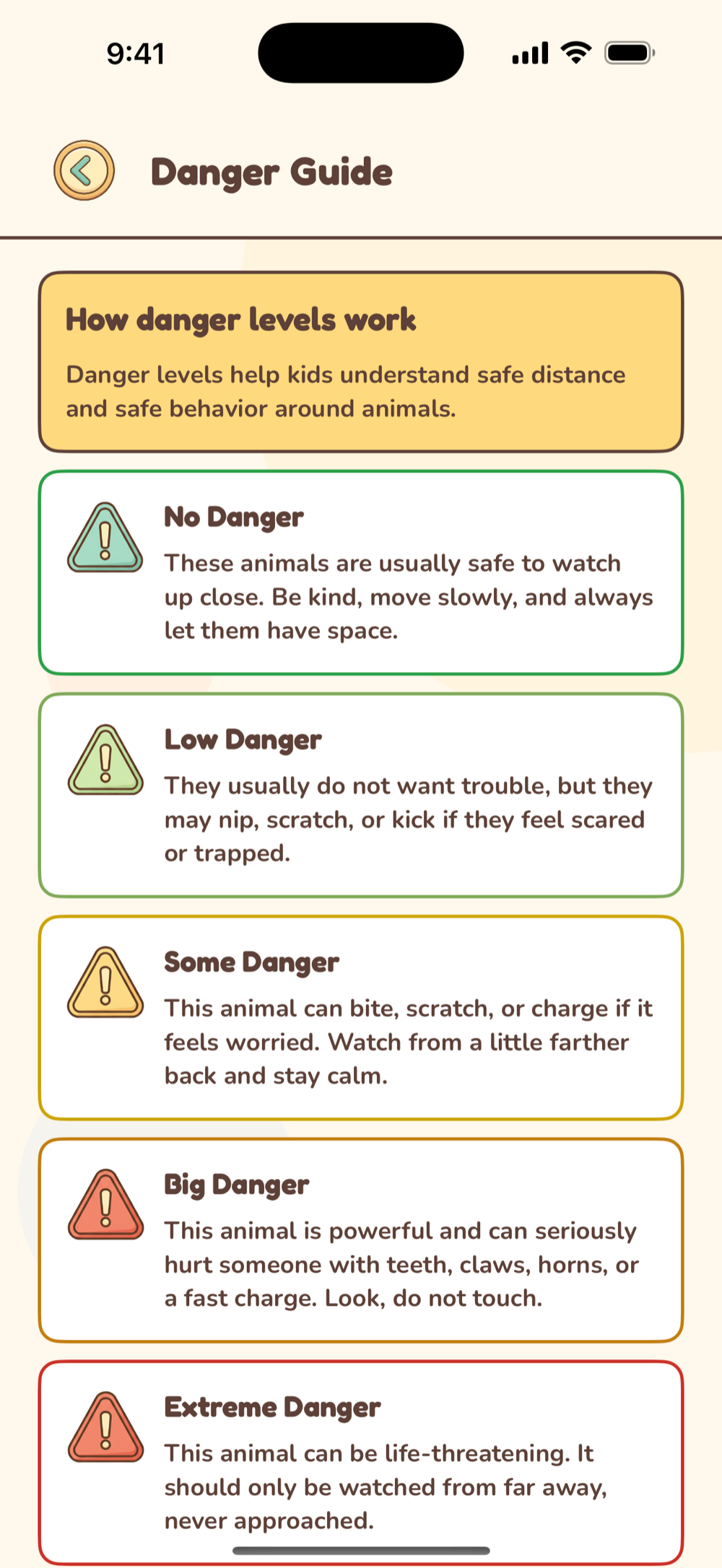
This is what the parental gate is for, too. Certain paths in the app — the shop, the update banner, anything that leads outside Wild Atlas — sit behind a simple gate a young child cannot pass. The design logic is that the child should never hit a wall inside the app that stops their exploration. The gate is not a wall for the child; it is a door for the parent that the child simply doesn't need to open.
A child using Wild Atlas independently is not unsupervised. They are just not interrupted.
Wild Atlas is free to download on the App Store. Four packs are included to start — three animal packs and a gift pack. If your child wants more, Legends of the Wild added 18 rare species in July, each fully narrated across six languages.
Sources: Mol & Bus (2011), "To Read or Not to Read: A Meta-Analysis of Print Exposure From Infancy to Early Adulthood," Psychological Bulletin; MacArthur-Bates Communicative Development Inventories vocabulary norms.